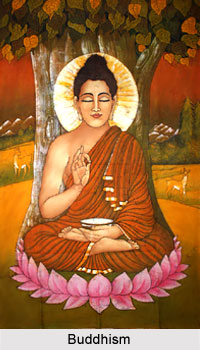
 Bodhi is both the Pali and Sanskrit word traditionally interpreted into English as `enlightenment`. The word "buddha" means "one who has achieved bodhi". Bodhi is also translated as "awakening". Although its most widespread usage by far is in the context of Buddhism, bodhi is also a technical term with several usages in other Indian philosophies and traditions.
Bodhi is an abstract noun constituted from the verbal root budh (to awake, become aware, notice, know or understand) matching with the verbs bujjhati (P?li) and bodhati or budhyate (Sanskrit).
In early Buddhism, bodhi conveyed a meaning synonymous to nirvana, using only a few different metaphors to describe the experience, which implied the elimination of raga (greed), dosa (hate) and moha (delusion). In the later school of Mahayana Buddhism, the status of nirvana was downgraded in some scriptures, coming to refer only to the elimination of greed and hate, connoting that delusion was still present in one who attained nirvana, and that one needed to attain bodhi to extinguish delusion. Hence, according to Mahayana Buddhism, the arhat has attained only nirvana, thus still being subject to delusion, whereas the bodhisattva not only achieves nirvana, but also full liberation from delusion as well. He thus achieves bodhi and becomes a buddha. In Theravada Buddhism, bodhi and nirvana carry the same meaning, that of being liberated from greed, hate and delusion. It should also be noticed that in the Mahayana Mahaparinirvana Sutra, "Great Nirvana" (maha-nirvana) is equal in all regards to Bodhi and indeed is the state of perfect Buddhahood.
In Buddhism, bodhi means the awakening experience attained by Gautama Buddha and his accomplished disciples and refers to the singular consciousness of a wholly liberated yogi. Bodhi is sometimes described as `complete and perfect sanity`, or cognisance of the true nature of the universe. After attainment, it is conceived that one is released from the cycle of samsara: birth, suffering, death and rebirth. The word Bodhi conveys the insight and understanding (wisdom) possessed by a buddha and is likewise used in Chrisitian mysticism to express the saint`s condition of being lit by a higher power - the fusing of the human and the divine in theosis (in Eastern Orthodoxy, Oriental Orthodoxy and Eastern Catholic theology, it is term that means salvation from unholiness by participation in the life of God). There is no image of "light" contained in the term "bodhi", though. Rather, it conveys the impression of awakening from a dream and of being aware and knowing (reality). It is thus more accurate to think of bodhi as spiritual "awake-ness" or "awakenment", rather than "enlightenment" (though it is true that imagery of light is extremely predominant in many of the Buddhist scriptures).
Bodhi is attained when the ten shackles that tie down a human being to the wheel of samsara have been resolved; when the Four Noble Truths have been fully apprehended and all volitional conditioning has reached cessation (nirodha), giving rise to transcendental peace (nirvana). At this moment, the psychological roots of all greed (lobha), aversion (dosa), delusion (moha), ignorance (avijj?), craving (tanha) and ego-centric consciousness (att?) are completely exterminated.
Bodhi is the ultimate goal of Buddhist life (brahmacarya). It is attained by observing the eightfold path, the development of the paramitas (virtues) and `profound wisdom` into the dependently arisen nature of phenomena.
Modes of Enlightenment, Bodhi, Buddhism
The following is specifically applied to Mahayana doctrine only:
Savaka-Bodhi (Arhat)
Those who study the commandment of a samma-sambuddha and then achieve enlightenment in this world are known as arhats. Such beings are competent at aiding others to reach enlightenment, as they may draw on personal experience.
Pacceka-Bodhi (Pratyeka)
Those who obtain enlightenment through self-realisation, without the help of spiritual guidances and teachers, are known as pratyekabuddhas. According to the Tripitaka, such beings only come up in ages where the dharma has been lost. Their dexterity in helping others obtain enlightenment is inferior to that of the arhats and it also takes more time for them to accumulate paramis (popularly known as Paramitas, it means perfection or culmination of certain virtues). Many pratyekas may arise at a single time.
Samma-Sambodhi (supreme Buddha)
These are perfect, most developed, most sympathetic, most loving, omniscient beings who fully apprehend the dhamma by their own endeavours and wisdom and teach it cleverly to others, freeing them from samsara. One that develops samm?-sambodhi is known as samma-sambuddha, and it is needed much more time of parami gathering here than to become a pratyekabuddha. A samm?-sambodhi is the one who gives rise to the path (previously) un-arisen, who engenders the path (previously) unengendered, who points out the path (previously) not pointed out. He knows the path, is proficient in the path, is virtuoso at the path. His disciples now keep following the path and afterwards become empowered with the path. This is the difference between an arahant and a buddha.