Veda states the conduct of the Brahmachari. According to the Vedas, the state of Brahmachari continues from the ceremony of the Upanayana until marriage. This period of his life is looked upon as a time of study, of trial, of subordination, and of initiation into the rules and regulations of caste. This is also to learn to read and write, to commit the Vedas and mantrams to memory, to study in those branches of knowledge for which he shows any aptitude. If his parents are sufficiently wealthy to be able to give him masters, above all things, to learn arithmetic in its elementary forms, and to study the various idioms of the language, these are the occupations that fill up his days. The Brahmins have their separate schools, to which children of other castes, particularly Sudras, are never admitted. The nature of their studies, the discipline and mode of teaching, the very principles of education, are all totally different in the one and in the other. The Brahmachari must never chew betel, he must never put flowers in his turban or in his hair, or ornament his forehead with the paste of sandalwood. He must never 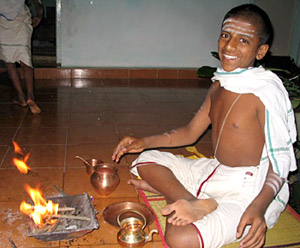 look in a looking-glass. Every day, morning and evening, he must perform the homam, or sacrifice of fire. He must take the greatest pains to conform to the rules and customs of his caste. He must show the most absolute and prompt obedience to his parents and his teachers. He must be modest, deferential and respectful to his superiors, and affable to his equals. His family and his masters take particular care to instruct him in the art of lying and dissimulation, cunning and deceit qualities which are fully developed in all Brahmins. They have formed the principal traits in their character. Besides this there are hundreds of minute details most essential in a Brahmin`s education. The education comprising rules of good manners and decorous conduct, the art of speaking and conversing in well-chosen language, the appropriate demeanour to assume on different occasions, how to hold oneself and how to use one`s eyes, the different degrees of hauteur or humility which should be shown under various circumstances and at different times and places according to the people who are present.
If, from want of means or other causes, a young Brahmin is still unmarried at the age of eighteen or twenty, he ceases to be a Brahmachari, but at the same time he does not become a Grahastha. For all these reasons, he obtains the right to the six privileges, which are inherent in this status. These privileges are to read the Vedas, to have them read to him, to perform the sacrifice of the yagnam, to cause the yagnam to be performed, to give, and also to receive, presents and alms. Three of these privileges are also shared by the Kshatriyas or Rajahs. As to the despised Sudras, they possess only one of them, namely, that which allows them to give alms or presents to those Brahmin who will condescend to accept them from their impure hands.
Rich Brahmins make a point of encouraging the study of the Vedas by offering prizes and other rewards, this being in the eyes of their fellows a work of the greatest merit. The Brahmins have done the Rajahs the honour of allowing them also to encourage the study of the Vedas by founding schools for that purpose and paying the professors. In the yagnam, a name which comprises the third and fourth Brahminical privileges, the sacrifice called homam is apparently included. The homam of the Rajahs is totally different. Every Brahmin must perform the homam at least once a day. It is a sacrifice offered to fire under various circumstances. This sacrifice is made by lighting a brazier, which is then consecrated by mantrams. Into this yagnam small pieces of wood are thrown that are gathered from one of the seven sacred trees. Afterwards a little melted butter and cooked rice are also thrown into it. These offerings are accompanied by suitable mantrams as well. The homam is almost invariably followed by another sacrifice, which is specially offered to fire, but only the ordinary puja is performed. The fifth privilege of the Brahmins, namely, the giving of alms and presents, is much less to their taste than the sixth in which the operation is reversed.
Amongst the gifts, which Brahmins are willing to receive, there are some, which are more especially acceptable. They are called the pancha-danas or the five gifts. They are gold, land, clothes, grain, and cows. The last-mentioned gift causes them particular pleasure, seeing that milk in various forms is their principal food. Brahmins also possess large landed properties originally given them by generous princes and on which they pay no taxes. These descend from father to son, and always retain their immunity from taxation. As a rule Brahmins do not cultivate their lands themselves, but lease them out to the Sudras, taking half the
Brahmins declare that he who fails to keep faith with them, or who injures them in any way, will be condemned after death to be born again as a devil. Such a person could live neither on the earth nor yet in the air, but would be reduced to dwelling in a thick forest, forever hidden amongst the foliage of a leafy tree. Day and night he would groan and bewail his unhappy fate. His only food would be the filthy juice of the palm tree, mixed with the saliva of dogs and he would have to use a human skull as a cup. As a rule Brahmins are exempt from all taxes on houses and other personal property.
The murder of a Brahmin, no matter for what reason, would be considered absolutely unpardonable. This is the greatest of all known crimes and would not fail to bring some terrible calamity to the whole country in which it had been committed.
A Brahmin rarely passes a day without bathing at least once, while those who wish to call public attention to their minute observance of religious customs must bathe three times a day. It is a common practice amongst natives to anoint themselves occasionally from head to foot with either oil of sesame or sometimes castor oil. They remove the dirt, which results from it by rubbing it of with certain herbs. They then have hot water poured over their bodies, and finally bathe in cold water. At their grand ceremonials Brahmins are in the habit of offering some such oily mixture to all their guests, who rub themselves over from head to foot with it, and then plunge into a bath. Dead bodies are similarly anointed before being conveyed to the funeral pile or burying ground. Some of these rituals have really help the Brahmins to create a landmark in the society.