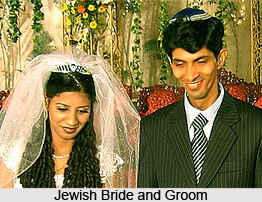
 Judaism considers marriage to be the perfect state of personal existence; a man without a wife, or a woman without a husband, is believed to be incomplete. In Jewish law, marriage is made up of two separate acts, called kiddushin and nissu`in respectively. Kiddushin alters the couple`s personal status, while nissu`in brings about the legal consequences of the change in status. There are three ways for a Jewish couple to effect kiddushin. The steps of marriage are mentioned below -
• With money or with an object of value is known as the first step or kesef. The object may be a ring or a coin, for the purpose of solemnized marriage, and in the existence of two witnesses, and then she accepts.
• Through a contract in the presence of two witnesses is the form of shtar. This is the declaration of kiddushin.
• By sexual intercourse with the intention of procreation in the bond of marriage; a method strongly dejected by the rabbinic sages and proposed only for levirate marriages.
A Jewish marriage ceremony is based on the regulations for transfer of property or of rights in antiquity. In marriage, the woman accepts a ring from the man, accepting the terms of the marriage. This ritual is called betrothal, or kiddushin or erusin. A ketubah or "marriage contract" is read publicly. Witnesses are needeed for both the signing of the ketubah and the ceremonies.
Pre Wedding Ceremony
An unmarried person is considered half a person amongst the Jews. The wedding day is believed to be the start of a new life as an absolute soul for both the bride (called the Kallah) and groom (called the Choson). So, in spite of the excitement of preparations the weeks before the wedding, the couple mentally get prepared to lay the foundation of their new life together by trying to enhance the quality and quantity of both their Torah learning and mitzvah observation and deepen their relationship with God.
Sabbath Before the Wedding - Ufruf
Before one week of the wedding, the Choson and Kallah do not confront each other. On the Sabbath of that week the Choson is called to the Torah (ufruf), to impress upon the couple the duty to look to the Torah as their guide in married life. The bride and groom maintain the world by raising children who will be engaging themselves in Torah study; therefore, the groom is called upon to read the letters of the Torah, which contain the ten utterances of creation.
After his Aliyah, the worshippers shower him with raisins and nuts, symbolic of their wishes for a sweet and fruitful married life blessed with many children. Meanwhile, on the same Sabbath, the Kallah`s family and friends throw a party or forshpiel for her, expressing their similar wishes for her. From a few days before wedding, until a week after the wedding, the couple is given a royal treat, therefore, not to be seen in public without a private escort.
 The Wedding Day ceremonies
The holiest day for the Jewish marriages of the year is Yom Kippur, the Day of Atonement. This is a fast day on which each person remembers in depth all of his past actions. Since on the day of one`s wedding God is sure to forgive the bride and groom of all their previous transgressions, it is seen as a private Yom Kippur for the couple. The couple fast until the ceremony, add Yom Kippur confessions to their afternoon prayers and recite the Book of Psalms, asking for forgiveness for the wrongdoings of their younger generations.
Previously, each of the couple had been but half a person. Now, with the hour of marriage, they resume their unique wholeness, a new and clean soul is again to be theirs. Standing under the Chupah their life destiny is set, all past estimate erased.
Greeting the Bride and Groom
At the wedding, pre-ceremony festivities begin at two separate locations, within the same building. The receptions are conducted separately since the Choson and Kallah do not see each other during the week prior to the wedding. In this ceremony, relatives and friends greet the bride and groom and bless them, independently offering them their heartfelt wishes. The following rituals take place during the ceremony of Kabbalas Ponim -
Tena`im - Condition of Marriage
Jewish tradition specifies that prior to the marriage ceremony, standard "Tena`im" (conditions) be stipulated in a written document by the groom and bride and their respective parents. This most often occurs just prior to the marriage ceremony, representing a commitment of the Choson to fulfill the promise to marry his Kallah.
With the signing and finalization of this obligation, through reviewing the text aloud, a plate is broken, signifying that just as the breaking of the plate is unalterable, so too should the engagement be irreversible.
Maamar Lecha Dodi - Chassidic Discourse
It is customary that the groom recite the Maamar Lecha Dodi - a Chassidic discourse on the consequence of marriage, according to Jewish mysticism. The discussion elaborates the elevation, which the groom and bride achieve through their bond in marriage.
Before the Chupah ceremony, the groom is escorted by his father and his father-in-law and then goes forward to veil the bride. The groom brings down the veil over the bride`s face. The veiling impresses upon the Kallah her duty to live up to Jewish ideals of modesty and reminds others that in her status as a married woman she will be absolutely unapproachable by other men. The covering of the face denotes her modesty, dignity and chastity, which distinguish the asset of Jewish womanhood.
The Jewish woman, being the strength and pillar of the home, is also reflected in these signs of modesty and dignity, which will be the pillars, and the foundation of their new home. At the end of the Bedeken it is traditional for the parents and grandparents to bless the bride.
Before the Chupah ceremony all the knots on the groom`s clothing are untied. This symbolizes that at the moment of marriage all other bonds are abolished. Except this cherished one made between the bride and groom. The groom wears the traditional white robe, known as the "Kittel", traditionally worn on Yom Kippur. This serves to strike a chord to the groom of the solemnity of the occasion.
Chuppah - Wedding Ceremony Under the Canopy
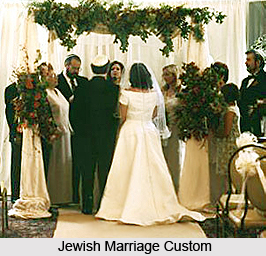
The wedding ceremony takes place under the open sky. When the couple arrives at the Chupah, the bride and family circles round the groom seven times. One of the many explanations for these seven circuits is that they represent a seven-fold bond which marriage will establish between the bride and groom and their families. The number seven represents the completion of the seven-day process in which the earth was created. During these seven days, the earth revolves on its axis seven times.
Post Wedding Rituals
In the ceremony Diaspora, the priestly blessings are recited while offerings are done to the God. There are special events where it is traditional in many societies that priestly blessings are offered. One such occasion is for the bride and groom in the most oath taking moments of their life under the Chupah. It is, therefore, customary in many communities that prior to the start of the betrothal blessings, a Kohen is called upon to bless the new couple.
More on Indian Religious Weddings
More on Indian Wedding Accessories
More on Indian Religious Weddings
More on Types of Marriages
See also