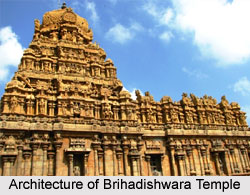
 Kumbakonam is one of the oldest towns of South India. There are numerous ancient temples in the town and also the famous Maha Makham Tank. Besides, there is a temple dedicated to Lord Brahma which is very unique and rare in India. It is considered one of the 7 important holy cities of India. It is at a distance of 38 km from Thanjavur.
There are many temples in Kumbakonam dedicated to Lord Shiva also, of which the temple of Adi Kumbeswarar is considered very sacred. This is situated in the heart of the town facing the east and occupies an area of 1, 89,000 sq. feet. The main gopuram is 128 feet in height and contains many figures of rare and exquisite beauty. There are four prakarams to the temple in which rows of houses, shops, and many shrines dedicated to Vinayaka, Subrahmanya, Bhikshatana, Sapta Kannikas, Lakshmi, etc. may be found. The sthala-vriksha is Kanni tree and this can be seen in the third prakaram. In the same prakaram there is a shrine for Vinayaka who is locally known as Adi Vinayaka. The legend goes to show that this Vinayaka came to this place even before Lord Shiva and hence the name Adi Vinayaka.
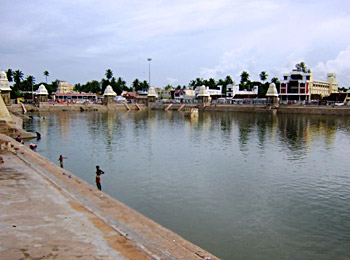
There are many teerthams in Kumbakonam, of which the Mahamakham tank is well. The tank covers an area of 20 acres and is surrounded on all sides by picturesque manda-pams. There is a belief that it contains a number of other teerthams in the form of wells. The Mahamakham tank is also known as Anuratha Teertham, Kanni Teertham, Papanasa Teertham, etc. The legend states that Lord Rama, Chandi, Sulochana and many others attained salvation by taking a dip in the tank. This has been surrounded on all sides by 16 beautiful mandapams which are stated to have been built in the year 1542.
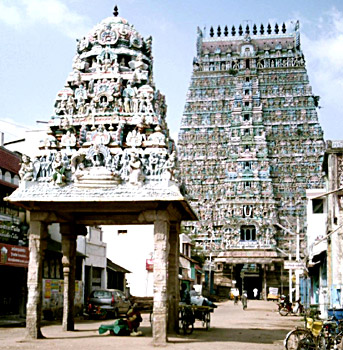 To the north of the Mahamakham tank there is a shrine dedicated to Lord Shiva under the name Kasi Viswanatha. It is said that Lord Kasi Viswanatha, at the instance of the Nava Kannikas, i.e., nine virgins namely Ganga, Yamuna, Godavari, Narmada, Saraswati, Kaveri, Kumari, Payoshni and Sarayu, came down to Kumbakonam and stayed with them. Temples for all the Nava Kannikas have been built here. Women worship the Nava Kannikas to get cured of sterility. Lord Rama on his way to Lanka to fight with Ravana came here and worshipped Lord Kasi Viswanatha.
The temple or Lord Kumbeswara contains some wonderful pieces of sculpture and architecture. On a single block of stone in the Navaratri Mandapam all the 27 stars and 12 Rasis (signs) have been carved out. The image of Lord Subrahmanya, enshrined in a part of the temple, is a rare specimen. He has six heads but only six hands holding different kinds of weapons. There are 2 Nagaswarams (pipes) made of stone.
There is a temple for Vinayaka on the bank of the temple tank. A legend associated with the temple has given Vinayaka the name Karumbayiran Vinayaka (Karumbu means sugarcane and Ayiram means one thousand). Some of the other well known temples of Kumbakonam are Sarangapani Temple, Sri Nageswara Temple, Sri Chakrapani Temple, Sri Kalyanasundareswarar temple and a lot more.
Sri Sarangapani Temple: Among the sacred 108 Tirupatis, this temple is given the third place next to Srirangam and Tirupati. The shrine is in the form of a chariot. A tank in panoramic settings, known as Hema Pushkarni, separates this shrine and Sri Adi Kumbeswara temple. There is a beautiful 12-storied gopuram, considered one of the largest in the South India. By the side of the temple is the Golden Lotus Tank, also known as Lakshmi Theertham. Goddess Lakshmi performed penance here and Vishnu came down as Aravamudhan and married her. Sri Sarangapani, Aravamudhan and Komalavalli are the presiding deities.
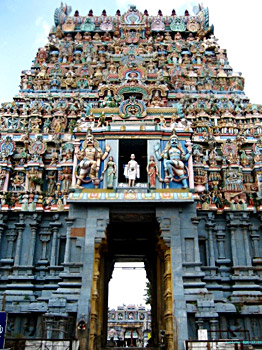 There are two entrances to the sanctum. One is kept open throughout the Uttarayan period and the other during the Dakshinayan period.
Sri Nageswara Temple: It is one of the most ancient temples in Kumbakonam. Adi Sesha and Lord Surya had worshipped Sri Nageswara here. When Adi Sesha was groaning under the weight of the world he came to Kuvinvanam (the present Nageswara temple) and did penance. Impressed Shiva and Parvati appeared before Adi Sesha and blessed him with enough strength. Another attraction here is the well in the temple known as Naga Theertham.
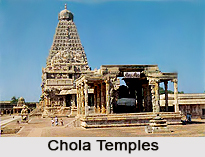
The temple is the master creation of early Chola Art and Architecture. The Sun`s rays fall on the Lingam in the central shrine through an opening in the eastern tower for three days in a year - on the 11th, 12th and 13th days in the month of Chaitra (April-May).
Sri Chakrapani Temple: The images of Sri Chakrapani with eight arms and Sudarsanavalli Thayar with a gracious visage are inspiring. Brahma, Lord Surya and Lord Agni are depicted as worshipping the Lord.
According to a legend, Surya once competed with Vishnu to decide who was brighter. Vishnu appeared in the form of a Chakra and put down the pride of Surya. Lord Chakrapani, like Shiva, has a third eye on His forehead.
Other temples in the town include Kasi Viswanatha, Someswara Temple, Somanatha, Gautameswara and Vedaranya Perumal temples.
Darasuram is located at a distance of 4 km from Kumbakonam. The Shiva temple here is dedicated to Airavateswara. Legend has it that Airavata, the white elephant of Indra, and Yama, the God of Death, had worshipped Lord Shiva here. There is a tank called Yama Theertham.
Sri Kalyanasundareswarar temple is an ancient Shiva shrine. The Lingam is made of a shining metal which changes colour five times a day. The images of Shiva and Parvati on Rishaba with Vishnu and Brahma are worshipped in the sanctum. Masi Magham (Feb-March) is a major festival. Nallur has another temple dedicated to Sri Adi Kesava Perumal.
Hence, it can be inferred that Kumbakonam has got so many temples of Lord Shiva and Vishnu and numerous mutts and religious institutions to inculcate Bhakti in the masses and elevate their souls and minds from all vices and worldly pursuits towards spiritual advancement.