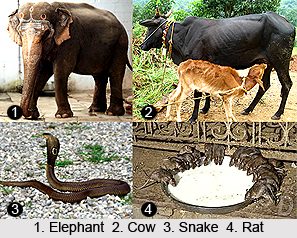
 Sacred animals in India are prevalent among the Hindus. A really good and pious Hindu would not dare to do certain actions forbidden by the sacred laws namely Dharma Sastras of Manu. His duty was to lay down rules for the different Hindu communities to follow and which no Hindu should transgress or sin. It has been laid down by this law giver to people that certain pests, like parrots, rabbits and so forth cause a good deal of loss to the ryots. Certain animals and plants, though causing trouble to people, are considered sacred and hence should not be destroyed.
It has been an acknowledged fact everywhere in the world that the lives of men are of graded importance. The Hindu law-giver, Manu had laid down that the life of a Brahmin is many times more precious than the life of a Kshatriya Indian caste or a Vaisya or a Sudra. The reason for this statement is that a really true Brahmin has nothing personal and everything he has and every action he does are for the benefit of humanity at large.
Feeding crows and dogs before eating
In typical Hindu families the daily meals for the members are prepared by the elderly lady e.g. the mother assisted by her daughters. Just as in typical Christian families, no one is allowed to eat till after grace, so in typical Hindu families no one is allowed to eat till after the prepared food is first offered to god. The chief male member of the family performs the pooja in which the food is offered to god. In some houses where pooja for the deity is not performed, the food prepared is offered to the deity kept in the house. After this mental offering, a handful of the food is taken and placed in the open courtyard of the house for the crows to feed on. Only thereafter, the inmates sit to take their meal, which, in the case of scrupulous old people, is taken only once during day and once during night throughout their lifetime. But when performing shraadh ceremonies, this custom is not followed. The ball of rice first offered to the manes of the dead relatives of the performers of the shraadh ceremony. They are not offered the shraadh preparation along with the manes for which the shraadh was specially designed and performed, and then placed in the courtyard of the house as an offering to the crows. Somehow, the Hindus have the belief that if the crows did not eat the food placed as a ball of rice offered to the manes, the relationship between them and the performer is not cordial and the incident perhaps foreboded evil. Anyhow there is the indication of the belief that the crows frequenting a particular house have some sort of relationship to the manes of the dead.
The other animal fed before taking the meals is the dog. This is done only at nights but not in day-time. The reason behind this can be mentioned as that crows are not available at nights but dogs are ready at hand.
From certain anecdotes current among the masses, it appears that this unique custom had its origin from the fear that the food might have been poisoned by some one. While history tells us that in royal families one member was ready to kill another to grasp power and wealth. Thus it is no wonder that people entertained the fear of being poisoned by their enemies in those days when there were rival clans in deadly feud. The offering of bribes to poison and thus remove undesirable people from the path was the most common. Therefore the explanation can be given as that people made use of the domestic crows and dogs to test the presence of poison in the food they were to take and this is no compliment to them at all from a moral aspect of view.
Viewed from the bright side it can be explained that the custom as having originated from the noble view taken by the people in recognizing even the inferior animals.
Eatables not to be sold
It is the belief with many of the Hindus that eatables should not be sold for money. If in any case someone does so, in that case he or she will have to remain for a time on certain levels of hell after his death. Further, the money obtained from sale of food, cakes and in fact of all eatables is considered an accumulation of sin and hence could not be conducive to the welfare and prosperity of the individual earning it.
The great woman saint of India, Auvaiyar, has distinctly stated that starving is perhaps preferable to food obtained from unloving hands. The beauty of home life and domestic bliss and happiness lies in the simple fact that the fare though poor is homely prepared and given by loving hands. The mother in case of children and wife in the case of the husband, usually provide that hand. There is a distinct difference between the loving spirit of the keeper of a hotel of public inn feeding the people and the mother at house.
Food taken from unloving hands builds up in the partaker the mental magnetism thereof. It eventually goes to destroy the finer feeling of love. In fact, if a man, though possessing a family of children, spends some years in a hotel, he runs the danger of losing his affectionate feelings towards his loved ones. Similarly one, though he may not have the requisite affection for the members of his family at first, may, in course of time, become much attached to them by the steady force of love manifested through homely meal prepared and given him by affectionate hands. Thus a seller of food, etc., cuts off a useful source for the manifestation of love in those frequenting him and hence stands condemned.