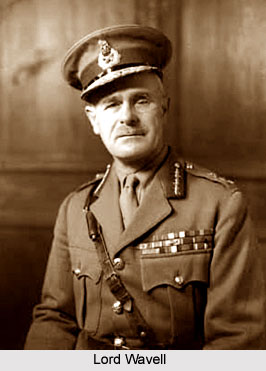
 In October,1943 Lord Wavell who had succeeded Lord Linlithgow as Governor-General, made an attempt resolve the stalemate the deadlock in India. He went to England for consultations in March 1945. The result of Governor`s consultations was soon revealed. He broadcast to the people of Indian the proposals of the British Government to resolve the deadlock in India on 14th June.
Mr. Amery, he was the Secretary of State for India. On 14th June made a similar statement in the House of Commons : "The offer of March 1942 stands in its entirely without change and qualification." He also proposed the renovation of the Governor-General`s Executive Council pending the preparation of a new constitution. With the expectation of the Governor-General and he Commander-in-chief all other member of the Executive Council would be nominated from amongst leaders of Indian Political life.
This Council would have "a balanced representation of the main communities, including equal proportions of Muslims and caste Hindus. It would work, if formed, under the existing constitution. Though the Governor-General`s veto would not be abolished, it would not be used unnecessarily. The portfolio of external Affairs was to be transferred from the Governor-General to an Indian member of Council. A Conference of representatives chosen by the Viceroy was to be convened with a view to obtaining from the leaders of the various parties a joint list, or failing it, separate lists of worthy people to constitute the new Executive Council" . It was also expected "that provincial ministers in Section 93 Province would resume office and that there would be coalition."
The Congress Working Committee members were let out of jail. Their high hopes prevailed on all sides as invitations for the planned Simla Conference went out to the leaders including Gandhiji. The conference was adjourned after three days of discussion and the meeting was held on June 25,1945. Mr. Jinnah had a short interview with the Viceroy on 11th July. In this interview he seems to have made it clear to the latter that the league, wishing to be regarded as the sole representative of Indian Muslims. That was firmly opposed to the inclusion of any long league Muslims in the Viceroy`s list. But the Viceroy could not agree to this point of view. Lord Wavell wound up the Conference by declaring a failure of the talks.
The responsibilities for the failure lies partly on Lord Wavell himself and partly on Mr.Jinnah. Mr.Jinnah aid that at a press conference : "On a final examination and analysis of the Wavell plan, we found that it was a snare…this agreement by which…we would have singed our death warrant. Next, in the proposed Executive we would be reduced to a monitory of one third. All the other monitories such as the Schedule Castes, Sikhs and Christians have the same goal as the Congress. On the top of this came the last straw…that even about the five members of the Muslim bloc which were allotted to communal wise.. the Muslim League was not entitle to nominate all the Muslim representatives. But we finally broke as Lord Wavell insisted upon his having one non-Leaguer, a nominee of Malik Khizr Hyat Khan, representing the Punjab Muslims"
Mr. Maulana Azad, the Congress President put the blame for the break down directly on the shoulders of Mr. Jinnah. Lord Wavell should have taken the leaders into confidence as regards the composition of his own list of members of the Executive Council. Possibly the Congress leaders might have been persuaded to accept that list either as a whole, or with minor modifications mutually agreed upon. He should not have allowed the league practically to veto the whole plan and thus alone to block the path of progress.
It must be noted in this connections that the Viceroy had assured the Congress President that "no party to the conference could be allowed to obstruct settlement out of wilfulness", but it seems that as in the parallel case of Cripps, Wavell`s hands were stayed at the last moment. The tangible result of the failure of the Simla Conference was to strengthen the position of Mr. Jinnah and the Muslim League. Which was clearly manifested in the elections of 1945-46.