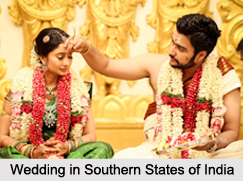
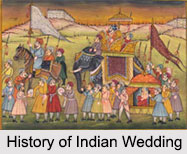
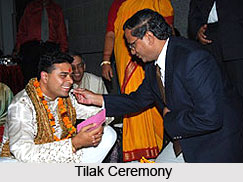
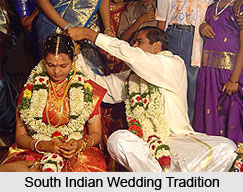
 The south Indian wedding is the most striking for its flowers and fragrance. The gates of the wedding hall are decorated with full-grown plantain trees, suggestive of evergreen plenty for endless generations. Overhead festoons of mango leaves signify the never fading relationship to begin here. Notes of nadaswaram are recited loud and clear to suggest the union here is scared and divine. Kolam or rangoli designs are done at the doorsteps to match the mood of the occasion. A hearty welcome is given to the guests who arrive for the function. At the threshold of the hall, sprinkling of rose water perfumes the visitors. Offering of flowers to women express a wish of sowbhayam for the lady guests. The sugar candy indicates the sweetness of happy event that the visitor has arrived to take part in.
The Evening Before The Wedding
The evening before the wedding day, the bridegroom is brought in a procession from a temple, sitting in a flower-decorated vehicle. He is then escorted by the bride`s parents and welcomed at the marriage mandap. This is known as the social function called `Janna Vasam` in south India. After reaching the marriage hall, there is a formal bethoral ceremony suggestive of the agreement between the families for the proposed alliance.
The Day Of The Wedding
Ganapathi Puja is done to ensure the remover of obstacles is invoked to waive away all impediments for such a favorable function. Navagraha puja is performed to encourage and plead the nine astral planets that rule over man`s destinies. The bride and the groom separately perform Vratham ritual. For the bride, it means the tying of the kappu - the holy thread on her wrists, which is meant to ward off all evil sprits and it symbolizes a kind of protective shield for the bride. For the groom vratham begins with invocations to the Gods Indra, Soma, Chandra and Agni.
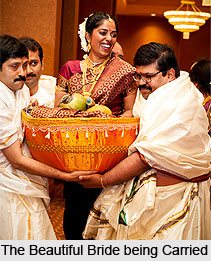
Malai Mathal is the ritual where, the bride and groom are lifted to the shoulders of their respective maternal uncles. This ritual signifies the continual sibling support to their mothers. And in that position the couple garland each other thrice for a complete union. In the shastras, the exchange of garlands signifies their unification, as one soul in two bodies. In Oonchal, couple is seated on a swing and rocked forth and back, as the gathered women sing songs to praise the couple. The bride and groom are given a sweet mixture of milk, sugar and bananas to eat. Water and lighted lamps are kept around the swing in order to guard the couple against demons and ghosts.
Pallikai Seeds Sowing is a fertility rite. Pallikais are earthern pots made a day earlier. Pots spread at the base with hariali grass and Bael leaves (vilvam). Nine kinds of presoaked cereals are royally sown in these pots by sumangalis. After the marriage, the sprouted seedlings are unconfined in a river or pool. This ritual signifies the blessing of the eight direction quartered guardian angels (Ashtadikh Paalaks) for a healthy life and children of the couple.
The Main Wedding
Vara Puja is performed when the feet of the bridegroom are washed in milk and wiped off with silk by the bride`s father. The groom is represented as the male principle of Godhead or the brahmachari. The Design of the Mangal Sutra varies from family to family according to the tradition. In Shivite families the design of the tulasi madam is decorated where as others could have the shiva lingam or Goddess Meenakshi represented. As the Mangalsutra is placed on the middle of the bride`s chest, it symbolizes that her man has occupied the whole of her being through her heart. The bride in all ceremonies is represented as the female principle of Godhead or the Shakti.
Kanya Danam is the ritual where the bride is made to sit on her father`s lap and is given away as a gift by him to the bridegroom. A ring made of Darbha of Kusa grass is placed on her head. They hold the Mangalsutra and chant the mantra meaning - "Let this gold multiply your wealth, Let this water purify your married life, And may your prosperity increase. Offer yourself to your husband."
The bride is then given a propitious ablution. A new sari, exclusive for the occasion, called the red koorai is chosen. She drapes around the sari by the sister of the bridegroom, thus signifying her welcome to the bride. A belt made of reed grass is then tied around the bride`s waist. Thanksgiving vedic hymns are said to the celestial caretakers of her childhood, the deities of Soma, Gandharva and Agni. Having attained nobility, the girl is now free to be given over to her man.
The vedic concept underlying this ritual is metaphorically that in her childhood Soma givers her the coolness of the moon. In the next stage of life the Gandharvas gave her playfulness and beauty. And when she becomes a maiden Agni gave her passions of life. After the father chants some prayers, the bridegroom returns his assurance to the father in law saying three times that he shall remain for ever her companion in joy and sorrow, in this life and life after.
Kankana Dhaarana is when the bride ties a string fastened to a piece of turmeric around the wrist of the bridegroom to bind himself by a religious vow. It is only after tying the kankanam that the groom gets the right to touch the bride.
Mangalya Dharanam is the rite of tying the Mangalsutra or Thali takes place at exactly the pre-determined propitious hour. The bride is seated on a sheaf of grain-layden hay looking eastward while the bridegroom faces westward.
 The bridegroom ties the gold Mangalsutra around the neck of the bride. The Nadaswaram is played loud and fast so as to soften any inauspicious sounds at the critical hour. This is called Getti Melam. Sumangali ladies sing fortunate songs. At the same time as the Mangalsutra a turmeric thread is also put around the bride`s neck. To this thread three knots are tied. The bridegroom ties the first one and the groom`s sister to make the bride a part of their family ties the other two knots.
Paani Graharam means holding hands and promises not part from each other even when they grow old. Saptha Padhi holds the bride`s hand the bridegroom walks seven steps around the holy fire with her. This is the most important part of the marriage ceremony. And only when they walk these seven steps together is the marriage complete. With each step they take a new vow. Pala Dhanam is the ritual, where gifts are exchanged between the families of the bride and groom. Pala Dhanam as ordained by the scriptures is thus an action signifying the mutual arrangements between the families, to be based on the principle of equality and respect for each other irrespective of the individual`s economic stature in life.
Pradhana Homam is a vital part of the wedding is the respect paid by the couple to Agni, the God of Fire. The couple goes around the fire, and feed it with ghee and twigs of nine types of holy trees as the sacrificial fuel. The fumes that rise are medicinal, curative and cleansing effects on the bodies of the couple. Agni, the mightiest power in the universe, the sacred purifier, the all-round benefactor is deemed as a witness to the sacred marriage. Treading on the Grindstone is the ritual where, the bridegroom holding the bride`s left toe helps her to tread on a grindstone kept on the right side of a fire. This ritual is emblematic of the solid rock foundation for the union.
Arundhati and Dhruva Star is the rite symbolic of the fact that important virtues are to be emulated throughout marital life. Next the groom shows the bride the star Arundhati as also Dhruva or the pole star. Arundhati is the wife of the Vashishta Maharishi and thus thought to be the ideal wife. Laaja Homam ritual comprises the bride`s own offering into the sacrificial fire. Reflecting the sibling support to her marriage her brother helps her. He gives her a handful of puffed rice grains, which she hands over to the bridegroom, who on her behalf, feeds it to the fire. Through this food offering, the bride seeks a long life for her husband and for circulation of her family. Participation of the bride`s brother indicates the continuation of links between the two families even after marriage. The couple moves around the fire three times. The feeding of puffed rice to the fire is repeated thrice.
Invitees shower saffron on the couple as benediction, this is the ritual of Akshadai i.e. rice grains colored with turmeric. Akshadai Graha Pravesham enters the new home of her in-laws.
The Evening Functions
Nalangu is performed in the evening of the marriage day is the time to relax and play. The newly wed wife calls her husband for play, inviting him by singing a song. Much to the merriment of all the guests and then follows a series of playful games. The bride smearing the groom`s feet with color paste, fanning him, showing him a mirror, breaking papads over each other`s head are few of the games.
These events bring out the qualities of the bride and the groom`s sporting spirit, kindness, co-operative nature thus surfacing the hidden traits for the other to note, thus bringing about better understanding and compatibility. The Night Time Homams are the functions performed on the evening of the wedding. Jayaathi Homam is performed to please and satisfy the Gandharvas and all other deities they believe in. The Gandharvas and other deities are the soft natured celestial beings generally associated with the finer sentiments of life, that are so necessary for a fulfilling married life.
Pravesa Homam is done to sanctify the bride`s entry into the husband`s home. The bride signifying that through her, new lives would be brought forth into this world brings along the sacrificial fire; same as the fact that fire brings forth new fires. Sesha Homam is the ritual of fire oblation with the residual ghee, a little of which is sprinkled on the bride`s head four times. The leftover ghee is considered as the sacred, the whole of which was offered to Agni. `Sesha` means leftover. The idea of sprinkling this residual ghee on the bride`s head denotes strength to be drawn from the four vedas; which is left over from one yuga or era to another.
Thamboola Charvanam is the ritual where, the bride`s brother gives the ceremonial first betel to the couple to chew. Betel leaf is usually posses several aphrodisiacal properties and to be eaten only after marriage. Other gifts are also given to bless the couple with long lives and children. Mangala Arathi is a solution of lime and turmeric powder that is prepared on a plate, circled around before the couple and thrown away to drive away evils. This is also done a number of times during the wedding ceremony. Shanthi is the ritual followed to the consummation of the marriage during the night fixed for an auspicious time for a happy, ever lasting married life that is full of understanding and affection. Two souls are united in a sacred act of fulfillment, to bring forth children as nature`s best creation.
Thus the south Indian marriage rituals are vast and expansive, although each of them has special significance and importance.
Kinds of Indian Wedding
More on Indian Wedding Accessories
More on Indian Religious Weddings
More on Types of Marriages
See also