 Kolam is drawn by using rice powder. Women draw with rice powder in swift, sure strokes. The women of South India then spread the carpets with elaborate geometrical designs in front of each house, hut and hovel. Women start their day by performing Kolam and it is a part of the daily chores of every South Indian woman. In Tamil, the word Kolam means form, appearance and beauty. The early reference of Kolam can be found in the poems of Andal, one of the Tamil Alvars.
Kolams are ornamental designs, which are drawn on the floor with rice powder; lime stone powder and red earth by the South Indian women. It is believed that the goddess Maha Lakshmi, deity of wealth enters only those homes that are adorned with fresh kolams.
The front side of the house has the mud floor in all traditional South Indian homes. The mud floor is levelled and sprinkled with water mixed with cow dung. This strengthens the surface and provides a brownish green base to set off the white lines of the Kolam. The cow dung has the antiseptic quality and also protects the house from any kind of impurity.
Type of Kolams
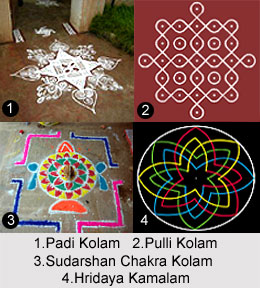
 Kolams can be of straight lines, curved lines, scallops, curlicues, dots and much more. The overall designs of Kolams used in the South Indian homes could be circular, square, hexagonal, octagonal, linear and so on. One exception is the `Pulli kolam` (kolam with dots) in which the pattern is outlined with dots. They are either joined with straight and curved lines to form designs or sometimes the design is drawn by chain links with the dots in the centre of each link. The unique nature of the chain link design is that it is often a single line drawn from start to finish. During festive occasions and on some special day, the bolder lines of red earth are used to present a bright contrast to the white lines.
Sometimes, the bamboos or metal pipes having holes are loaded with Kolam powder and rolled along to make ornate borders. Similarly, small flat bottomed metal plates or boxes with holes at the bottom are also used to imprint motifs with the powder. In South India, the kolam drawing turns more ritualistic during the month of Margazhi (mid December to mid January). At that the Kolam is drawn with yellow flowers of parangi (yellow pumpkin or squash), which are supported up on the bases of cow dung balls. The kolams drawn in the puja room or any place inside the house uses rice flour, as it is meant to serve as food for ants and other small insects.
There are various types of Kolams drawn during different occasions. Each of the Kolams of each occasion varies from each other and is drawn with different purposes. On Fridays and sacred occasions, the `Hridaya Kamalam` (lotus of the heart) and the `Sri Chakram` (the auspicious circle) are drawn to ensure success and wealth. There are also kolams for each day of the week and for propitiating the planets. The tantrik kolam designs are seen with syllables of mantras for prayers to specific deities.
At the time of weddings and other such functions, a central motif is drawn in front of the manai, which is called the `manai` or the `padi kolam`. The `manai` is a wooden plank used for seating the couple or the main persons involved in the marriage.
Again, each caste and sub sect of South India has his or her own typical design. For example, the Iyers (Saivite Brahmins of Tamil Nadu) have a square design; the Iyengars (Vaishnavites) have a similar design with concave lines. The manai is also decorated with parallel lines at both edges to indicate its sacredness.
During the festival of Krishna Jayanthi (Krishna`s birthday), the Kolams are drawn showing little feet going from the entrance to the puja room. This denotes that coming of the baby Krishna in the puja room. A large kolam is drawn at the altar, which represents the frame of it.
In South India, a kolam is must to start anything auspicious whether it is big or small. The kolam can be seen in the kitchen top, which is ornamented daily with a few lines of kolam. The marriage venue and the temple precincts are also decorated with kolams. It involves all the individuals and the community for an artistic pursuit on a day-to-day basis. The coloured Kolams are prepared by using natural materials such as turmeric powder is used for yellow Kolam and powdered leaf for green and so on.
Preparation of Kolam
On the day of the puja or the occasion, a thick solution of rice paste is prepared. This paste is made by soaking and grinding rice and then it is mixed with water. The liquid is soaked with a small piece of cloth, which is used as a sponge. This cloth is held in the palm as the fingers draw the lines on the floor. The dried Kolams look strikingly bright and white.
Now days, the rangoli powders available in market are mixed with white kolam powder and used to create colourful drawings. The preparation of colourful grain mosaic kolam is difficult as rice paste is smeared and then it is mixed with colours. Now, in South India Kolam artists are available along the roadside, who prepares large size pictures of gods or prominent individuals with multicoloured kolam powders. The sticker kolams are also available in all South Indian market.
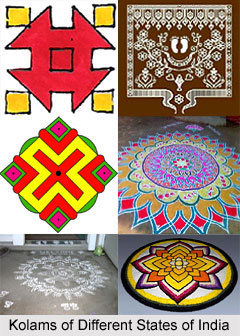
The Onam festival of Kerala is celebrated with gorgeous kolams prepared with fresh flowers and with a brass lamp at the centre. The Kolams are called `Base` in Karnataka, `Muggulu` in Andhra Pradesh `Chowkpurna` in Uttar Pradesh, `Alpana` in West Bengal and Assam and `Rangoli` in Gujarat and Maharashtra.