Buddhist literary source for ancient Indian history
|
Buddhist literature, is also substantial from the historical point of view to understand the ancient Indian history.
|
|
|
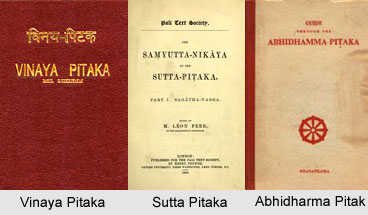 After Brahmanical literature comes the Buddhist literature, which is also substantial from the historical point of view. There are three branches of Buddhist literature-Jatak, Pitak and Nikaya. The most vital of Buddhist literature is known as Tripatika, comprising three divisions-Vinaya, Pitaka, Sutta Pitaka and Abhidharma Pitaka. These are written in Pali and contain religious philosophies of Buddhism. Other books of Pali literature which are also crucial from a historical point of view include- 'Milinde Panha', 'Dipavamsa' and 'Mahavamsa'. 'Milinde Panha' comprises the conversation between Greek king Menander (king Milinda) and Buddhist saint Negsena. 'Dipavamsa' and 'Mahavamsa' which were composed in Ceylon, delineates not only the history of Ceylon, but also deals with the history of India, from 6th century B.C. to 4th century B.C. These religious books for the first time lets one to know about Chandra Gupta Maurya. One of the most substantial books of Buddhist literature is 'Anguttara Nikaya' that illustrates the political, social and religious conditions of 6th century B.C. In addition to this, other important books include- 'Mahvichasya' by Asva Ghosh, 'Satasahasrika', 'Prajnaparamita' and 'Madhyamika Sutras' by Nagarjuna, a grand teacher of Buddhism, 'Mahayana Sutralamkara' by Asanga, 'Abhidharma Kosha' by Vasubandhu etc. Asva Ghosh, author of 'Buddhacharita' and 'Saundarananda', was a contemporary of King Kanishka. Much is owed to Buddhist literature, for furnishing loads of information about Ashoka, Kanishka, Pushyamitra Shunga, Chandra Gupta Maurya, etc. After Brahmanical literature comes the Buddhist literature, which is also substantial from the historical point of view. There are three branches of Buddhist literature-Jatak, Pitak and Nikaya. The most vital of Buddhist literature is known as Tripatika, comprising three divisions-Vinaya, Pitaka, Sutta Pitaka and Abhidharma Pitaka. These are written in Pali and contain religious philosophies of Buddhism. Other books of Pali literature which are also crucial from a historical point of view include- 'Milinde Panha', 'Dipavamsa' and 'Mahavamsa'. 'Milinde Panha' comprises the conversation between Greek king Menander (king Milinda) and Buddhist saint Negsena. 'Dipavamsa' and 'Mahavamsa' which were composed in Ceylon, delineates not only the history of Ceylon, but also deals with the history of India, from 6th century B.C. to 4th century B.C. These religious books for the first time lets one to know about Chandra Gupta Maurya. One of the most substantial books of Buddhist literature is 'Anguttara Nikaya' that illustrates the political, social and religious conditions of 6th century B.C. In addition to this, other important books include- 'Mahvichasya' by Asva Ghosh, 'Satasahasrika', 'Prajnaparamita' and 'Madhyamika Sutras' by Nagarjuna, a grand teacher of Buddhism, 'Mahayana Sutralamkara' by Asanga, 'Abhidharma Kosha' by Vasubandhu etc. Asva Ghosh, author of 'Buddhacharita' and 'Saundarananda', was a contemporary of King Kanishka. Much is owed to Buddhist literature, for furnishing loads of information about Ashoka, Kanishka, Pushyamitra Shunga, Chandra Gupta Maurya, etc.
Jatakas illustrate the birth stories of Buddha and are vital for furnishing information about the communal conditions prior to Buddha. As observed by Dr. Winternitz, "The Jatakas were of inestimable value, not only as regards literature and art, but also from the point of view of the history of civilization for the period of the 3rd century B.C." So far about 549 Jataka stories have been printed. A flamboyant picture of the political, social, economic and religious conditions of the people can be described regarding the 2nd or 3rd century B.C., from the Jatakas.
|
|
|
|





