


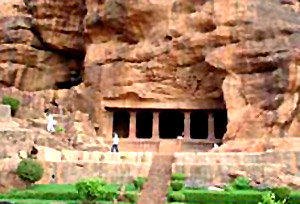
 It is however in the arena of sculpture and architecture, Gupta period reached somewhat the zenith. It is argued that during the Gupta period the typical proto-type of Brahmanical architecture in the form of Hindu temple, Brahmanical cave temples, came into existence and hence developed a whole new concept of Brahmanical Architecture and sculpture. It is however in the arena of sculpture and architecture, Gupta period reached somewhat the zenith. It is argued that during the Gupta period the typical proto-type of Brahmanical architecture in the form of Hindu temple, Brahmanical cave temples, came into existence and hence developed a whole new concept of Brahmanical Architecture and sculpture.
Brahmanical Cave temple Brahmanical cave temple was discovered at Udayagiri near Bhopal having an inscription dated 401 A.D. and referring to the reign of Chandragupta II. It is the earliest dated Hindu temple known so far. The shrine is partly rock-art and partly stone built, as a shallow pillared portico has been added in front of the excavated cella. This style is just a transition from the pure cave shrines to the structural ones. The portico, the carved doorway and the pillars with their Bowl of Plenty capitals show the typical features of the Gupta style. Siva Images. There was a remarkable revival of Hinduism in the Gupta period and it is reflected in its sculpture. Some of the most beautiful Siva images, as for example, the Sivalinga from Khoh belong to the Gupta period. Both the linga form and the anthromorphic image of Siva existed in the Kusana period, but their combination as evolved in Ekamukhi and Chaturamukhi Sivalinga was a characteristic feature of Gupta iconography. The Ardhanarisvara form of Siva represents a synthesis between the eternal pair of opposites by presenting the deity as half male and half female, was rendered by the artists of our age with masterly skill. 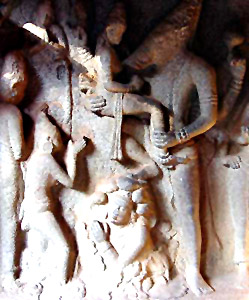
Vishnu Images Perhaps the best qualities of the Gupta plastic art find expression in the superb example of Vishnu from Mathura with the face revealing a celestial contentment and serene spiritual contemplation. For the first time, Gupta statuary begins to show the images of the cosmic form of Vishnu combining a human head with those of a boar and a lion. These are images of Nrisimha-Varaha Vishnu. A different form of the cosmic aspect of Vishnu in this period is that in which the central human figure is surrounded by a number of radiating heads, eg., the eight-armed figure on the great architrave from Garhwa. The great Varaha image at Udayagiri is prevalent c. 400 A.D. This has been rightly regarded as a monument to the genius of the Gupta sculptors. Its volume and powerful execution furnish a happy contrast to the scenes of lesser dimensions forming the background. The two flanking scenes also are of unusual significance, representing the birth of the Twin Rivers, Ganga and Yamuna. The whole scene probably coveys an ideal representation of the Madhyadesa, which was the heart of the wide culture empire built in this age. Images of Surya: Images of the solar deity show that the sun-god was clad in the northern dress, wearing coats and trousers and long buskined boots. This form of the deity is found right from Afghanistan to Mathura and Madhydesa. He is also shown as accompanied by his two attendants Danda and Pingala. |
| |||



Home > Reference > History of India > Gupta Empire > Art and Architecture of the Gupta Period > Brahmanical Architecture of Gupta Era
Brahmanical Architecture of Gupta Era
| During the Gupta period a major group of Brahmanical architecture appeared which mirrored the very concept of Hinduism. |
| ||||||||||||||||||||||||||||

