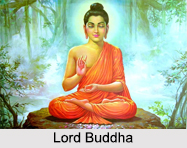
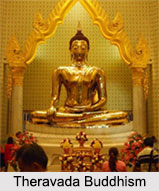
 Theravada Buddhism is one of the oldest forms of Buddhist school that is said to have originated in India. After the death of Buddha, two principle schools of Buddhism emerged. One was Theravada Buddhism and the other was Mahayana Buddhism. Till date Theravada Buddhism is referred to as the "School of the Elders". Theravada Buddhists claim that they follow the original teachings of Buddha. Theravada Buddhism emphasizes personal salvation through one"s own efforts. It is a conservative form of Buddhism that adheres to Pali scriptures and the non-theistic ideal of self purification to Nirvana. The doctrines included in Theravada Buddhism are an extension of the doctrines discussed in the Buddhist Council. The teachings of Buddha were then penned down in Pali and are known as the Tripitaka. Till date, the Theravada Buddhists strictly follow all the teachings and rules that Buddha had once formulated.
According to Theravada Buddhism, one is only a "true" Buddhist when he desires to follow the Buddha, commits himself to following the guidance of the Sangha, and resolves to follow the teachings of Buddha. Compared to the Mahayana school, Theravada places less emphasis on a concern for the enlightenment of others and a much higher emphasis on the importance of monks and the monastic lifestyle.
History of Theravada
While tracing the roots of Theravada School it has been found out that, it has been derived from the Vibhajjavada group. This group is rooted in the Sthavira group. The Third Buddhist Council took place in the presence of Emperor Ashoka. Later, this group was divided into four groups. One of these groups, "Tamraparniya", is considered the base for Theravada Buddhism. In India this school is known as "Theravada".
Doctrine of Theravada
The fundamental principle of Theravada Buddhism is that an individual must rely on his or her analytical power to understand the world around him. Although a rational man is self sufficient with his logic, yet he needs a guide or a wise man to guide him. In order to break the cycle of misery and agony, man needs to free his mind from the defilements of the temporal world. One of the major features of the Theravada is that it considers Buddha as the supreme leader who paved the way to Nirvana for other Buddhist followers.
 Philosophy of Theravada
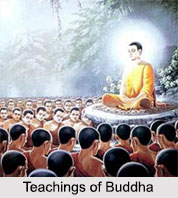
The philosophy of this school is that all worldly phenomena are subject to three characteristics - they are impermanent and transient; unsatisfactory and that there is nothing in them which can be called one"s own. All compounded things are made up of two elements - the non-material part and the material part. They are further described as consisting of 5 constituent groups, namely the material quality, and the 4 non-material qualities - sensations, perception, mental formatives and consciousness. When the perfected state of insight is reached, that person is a "worthy person", an Arhat. The life of the Arhat is the ideal of the followers of this school, a life where all birth is at an end, where the holy life is fully achieved, where all that has to be done has been done, and there is no more returning to the worldly life.
Scriptures of Theravada
The Tripitaka is followed by the Theravada Buddhists. It consists of three segments - Vinaya Pitaka, Sutra Pitaka and Abhidhamma Pitaka. It is written in Pali as Buddha propagated that teachings should be delivered in native language. Hence, Pali was chosen over Sanskrit.
In many Buddhist countries, Theravada Buddhism still exists and attracts numerous followers.