


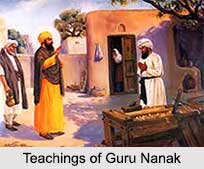
 Teachings of Guru Nanak reflected his deep philosophical understanding. He spread the message, "There is no Hindu, no Mussalman" and also said that "All are creatures of God and His creation". Guru Nanak strongly believed in the view that there is only One God and there are numerous ways to reach Him. Teachings of Guru Nanak reflected his deep philosophical understanding. He spread the message, "There is no Hindu, no Mussalman" and also said that "All are creatures of God and His creation". Guru Nanak strongly believed in the view that there is only One God and there are numerous ways to reach Him.
According to Nanak, Truth is higher than everything but higher still is truthful conduct. He regarded all men as children of the same God and taught sympathy and compassion for the whole of human race. He laid emphasis on moral virtues such as mercy, contentment, continence, truth, benevolence, faith, honesty, humanity and civility. Teachings of Guru Nanak on Religion Guru Nanak tried to unite the Hindus and the Muslims in an unbreakable bond of love and mutual understanding. He considered Hinduism and Islam as two ways but the God of both is one. According to the teachings of Guru Nanak, it is through good conduct and the recitation of the Name of the Lord that a person would attain ‘Mukti’ or the freedom from the endless cycle of life and death. He never suggested the life of a mendicant to his followers and Nanak’s disciples had to participate in worldly affairs and take care of their family responsibilities. He rejected practice of austerities, fast, wearing sacred thread or ragged clothes and considered going about bathing at the places of pilgrimage as useless. Above all, they had to live as good human beings. The teachings of Guru Nanak clearly stated his view about religion and religious person also. Guru Nanak said, "Religion consists not of mere words. He who looks upon all men as equal is religious". He always strongly promoted universal brotherhood in his bani, and for him, God was the binding force, not a divisive ‘my’ or ‘our’ God. Nanak said that nobody can find this God in remote temples or faraway places and as He is found everywhere. 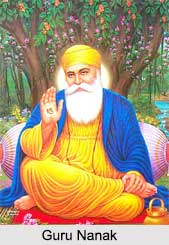
Teachings of Guru Nanak on Caste System Guru Nanak strongly stood against these kinds of segmentations and said that there is no difference between any of the creatures of the God and everyone is equal. He was against caste system. According to him, a man should be honoured for his devotion to God and not for his social position. He said, "The caste of a person is what he does". He maintained this throughout his entire life and also set out to dissolve differences through the institutions like Sangat and Pangat. Teachings of Guru Nanak on Gender Equality Guru Nanak strongly supported religious practice among women and said that women can also attain Mukti, as the way to realisation of God is open to all human beings. Nanak said this at such a time, when women were treated as inferior to men and impure and it was also said that one had to be born a man in order to attain Mukti. Nanak criticised labelling women as “impure” the holy book of Sikhs, ‘Guru Granth Sahib’. The teachings of Guru Nanak stressed on forgiveness as an essential element of human interaction. He often came across intolerant people, during his travels; however, he always forgave them and said that it is stupid to entangle oneself with a foolish person. Nanak was always concerned about the ordinary people and his compositions mainly reflect the language of the people of his period. Guru Nanak’s compositions contain truths that pertain not only to the religious aspect of people’s lives, but also the social and familymatters, something that have been ordinarily considered outside the horizon of religion. Guru Nanak actually presented the world a simple, non-ritualistic religion that allows its followers to live a religious life, while taking care of their worldly duties, all at the same time. |
| |||



Home > Society > Indian Religion > Indian Religions > Indian Saints > Guru Nanak Dev Ji > Teachings of Guru Nanaka
Teachings of Guru Nanaka
| Teachings of Guru Nanaka always spread to believe in One God. He stood for equality of all the human beings. |
| ||||||||||||||||||||||||||||

