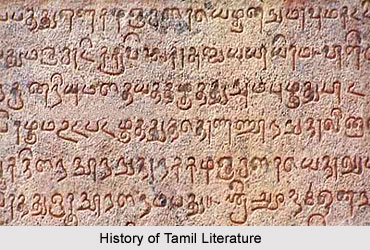
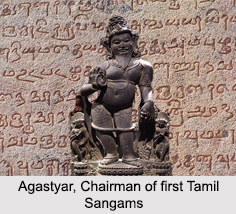
 Believed to have been produced between the 1st and 3rd centuries AD, the Sangam Literature is the earliest corpus of texts written in Tamil, which is one of the major languages of South India. The word Sangam means "association" that refers to Tamil Sangam, which means an association of Tamil poets and their works that flourished in the ancient history of South India.
Compilation of Sangam Literature
The Sangam Period is the time when most of the available Sangam Literature is from the Third Sangam, which is also known as the Madurai College of Antiquity. It is said that the Pandya dynasty of the mythical cities of South Madurai, Kapatapuram and Madurai, patronized the three Sangams. Based on the chronology, this available literature was compiled and categorized in the 10th century into 2 categories. The categories are the Patinenmelkanakku, which are the 18 greater text series, this is further sub divided into the Ettuthogai (8 anthologies) and the Pattuppattu (10 idylls). Then the other category is the Patinenkilkanakku, which are the 18 lesser text series.
Classification of Sangam Literature
The primary themes of Sangam Literature are mainly emotional and material topics such as love, war, governance, trade and bereavement. The Sangam poems falls under 2 categories: akam or the inner field and puram, which describes the outer field. The subjects in the inner field discusses about personal or human aspects like love and intimacy. While in the outer field, the topics discuss all other aspects of human experience such as heroism, courage, ethics, benevolence, philanthropy, social life, and customs. The division into akam and puram is not rigid, but depends upon the interpretation used in a specific context.
There is a certain kind of environmental category whose thematic classification in the Sangam Literature ties the emotions involved in akam poetry to a specific landscape, which is called tinai. Then there are the kurinci or the mountainous regions, mullai or forests, marutam or agricultural land, neytal or coastal regions and palai or desert.
Rediscovery of Sangam Literature
The works of the Tamil poets were collected into various anthologies that were edited and colophons were added by anthologists and annotators around 1000 AD. Soon thereafter, the Sangam literature started to fall out of popular memory, until they were rediscovered in the 19th century by scholars such as Arumuga Navalar, C. W. Thamotharampillai and U. V. Swaminatha Iyer. In 1851, Navalar brought the first Sangam text into print; this was the Thirumurukaattuppadai, which is one of the 10 Idylls. And in 1887, Pillai brought out Kaliththokai, the first of the 8 anthologies. Swaminathaiyar published his first print of the Ten Idylls in 1889.
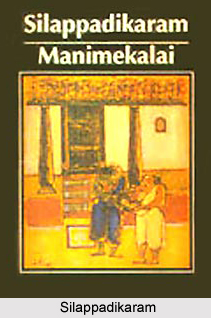
These scholars together printed and published Tholkappiyam, Manimekalai, Silappatikaram and Purananuru. Among these the Tholkappiyam authored by Tolkappiyar was the earliest work, which provides the information on social, economic and political conditions of the Sangam Age along with the Tamil grammar.