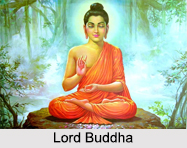
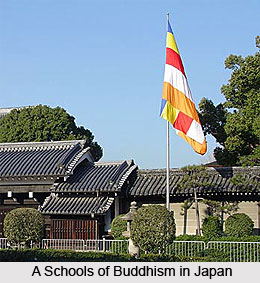
 In the 6th century, Buddhism came into Japan from China. The main eras during which Buddhism flourished were at Heian and Kamakura ages. There are 5 Japanese Schools of Buddhism and these still exist in the country. Nichiren, Pure Land, Shingon, Tendai and Zen are the 5 Japanese Schools of Buddhism.
Nichiren Buddhism: This school of Buddhism is named after its founder. Nichiren propagated the Lotus Sutra. Nichiren himself was a Tendai monk but he left the establishment to pursue his own path. He desired for a purer vision of the Lotus Sutra. In his writings one finds that he was of the view that the Buddhist followers need to recite the Lotus Sutra to realize the Buddha nature in them.
Pure Land: it is also known as Amida Buddhism. It teaches the salvation tradition of the Amida Buddha. It further states that Amida Buddha is an incarnation of Buddha. He refuses to accept his enlightenment unless he has achieved it for his followers. Pure Land Buddhism gained popularity in Japan during the Kamakura Period. This school opened Buddhism for the lower classes as well as for women.
Shingon Buddhism: This school was established by Kobo Daishi. This is the tantric school of Buddhism in Japan. During the Heian Period it came into prominence. Till date it is one of the popular forms of Buddhism in Japan. The main doctrine of Shingon Buddhism was to realize one`s own nature with the celestial Buddha. This is can be achieved by following a secret doctrine that is transmitted orally fro the teacher to the disciple.
Tendai Buddhism: This is probably the most important Japanese School of Buddhism. This school is based on the Lotus Sutra. This sutra is considered to be the supreme mixture of Buddhist doctrine. It became popular in the Heian Period.
Zen Buddhism: This is the most popular Japanese School of Buddhism till date. It is closely associated with the art and culture of Japan. The origin of Zen Buddhism is in India. All the traditions of Buddhism are followed in this Japanese School of Buddhism.