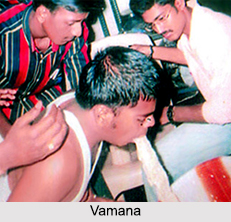
 Vamana in Ayurveda is one of the five main procedures of Panchakarma. In this process the infected doshas are thrown out of the body by medication of emetics. Ayurveda states that the emesis procedure that is used in Vamana Therapy of Panchakarma is quite painless and smooth, with a very little nausea or discomfort. It is the procedure for discharging excess kaphic aama and kapha. It usually takes place in the upper portion that is the kapha zone of the body and it generally uses the upward movement of the doshas to eliminate aama from the body. If the body is completely prepared and if the treatment is correctly administered then vamana effectively removes the toxins from the kapha zone of the body.
Procedure of Vamana
Vamana procedure is mainly recommended in the spring season since there is a natural increase of kapha dosha in this season. In a disease having predominance of Kapha Dosha, Vamana can be administered at any time after performing "Snehana" and "Swedana". The patient feels better after vomiting for 4 to 8 times. This is followed with the internal administration of ghee and a steam bath. After performing Vamana therapy, the patient should take rest and not consume heavy food. Fasting is highly recommended immediately after Vamana therapy.
Benefits of Vamana
Vamana is usually administered particularly for kapha related disorders or aama. These comprise allergies, all lung problems, diabetes mellitus, bronchial asthma, chronic colds, arthritis, chronic skin disorders, rheumatic diseases, acute abdominal diseases and more. It is also beneficial for vital disorders of the body. After vamana, the sinuses are cleared which in turn provides relief from congestion, wheezing and breathlessness.
Cautions about Vamana
Vamana therapy is contraindicated for people who are very thin or weak, elderly people who are weak, young children and pregnant women also. People with tuberculosis, hepatitis, pleurisy, cirrhotic or degenerative diseases, collapsed lung and problems with blood pressure should not undertake this therapy. People who have a major vata imbalance should also avoid this procedure.
In Ayurveda, vamana therapy is administered for removing the toxins and wastes of the body. In simple terms it is described as therapeutic emesis.
Vamana
Vamana in Ayurveda is the process of throwing out the impure materials and doshas from the body. The treatment is most effective in case of Kapha dosha.