


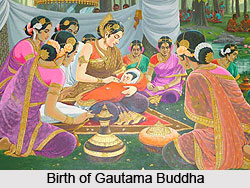
 Siddhartha Gautama, popularly known as Gautama Buddha was born in 560 BC. He was the prince of Lumbini, Nepal at the foot of Mount Palpa in the Himalayan Ranges. He was born to Suddhodhana, King of the Sakyas and Maya Devi. His mother died seven days after his birth. So Siddhartha was raised by his foster mother, Mahapajapati who was Maya’s sister. Mayadevi was a Koliya princess. On the night Siddhartha was conceived, his mother Maya Devi dreamt that a white elephant with six white tasks entered her right side and after ten lunar months Siddhartha was born from her right side. According to the Sakya tradition, when queen Maya became pregnant she went to her father’s kingdom to give birth but after leaving the capital of Kapilavastu, she gave birth to Siddhartha along the way of Lumbini in a garden beneath a Sal tree. Siddhartha Gautama, popularly known as Gautama Buddha was born in 560 BC. He was the prince of Lumbini, Nepal at the foot of Mount Palpa in the Himalayan Ranges. He was born to Suddhodhana, King of the Sakyas and Maya Devi. His mother died seven days after his birth. So Siddhartha was raised by his foster mother, Mahapajapati who was Maya’s sister. Mayadevi was a Koliya princess. On the night Siddhartha was conceived, his mother Maya Devi dreamt that a white elephant with six white tasks entered her right side and after ten lunar months Siddhartha was born from her right side. According to the Sakya tradition, when queen Maya became pregnant she went to her father’s kingdom to give birth but after leaving the capital of Kapilavastu, she gave birth to Siddhartha along the way of Lumbini in a garden beneath a Sal tree.
Naming of Gautama Buddha Siddhartha means ‘one who has accomplished his aim’. Gautama was the clan name or family name of Siddhartha. He was also known as Sakyamunias he was the Ascetic of Sakya tribe. King Suddhodhana arranged for the naming ceremony on the fifth day of Siddhartha's birth and invited eight Brahmin Scholars to read the future. Kaundinya, the youngest of the Brahmins also told that the baby boy would become a ‘Buddha’. Astrologers Prediction of Gautama Buddha’s Life Upon the birth of Siddhartha, the astrologers predicted that when he would be adult, Siddhartha would either become a ‘Chakravarti’ or a universal monarch and would abandon all earthly comforts to become a monk. He would become a Buddha, a perfectly enlightened soul who would bring enlightenment to the entire mankind. Siddhartha’s father wanted that his son would become the universal monarch and asked the astrologers about the cause that would compel Siddhartha to retire from the material life and enter into spiritual life. The astrologers foretold that Siddhartha would see a feeble old man, a diseased man, a dead person and a monk. In other stories it is said that the great hermit, Asita came from his mountain abode to see the newborn baby and after examining his birthmarks when the baby placed his feet in Asita’s hair he foretold that the baby would either become a monarch or a great holy man. King Suddhodhana tried his best to prevent his son from becoming a monk and he raised him in extreme luxury and indulgence and tried to keep him attached to the sensual pleasure away from all earthly pain and sorrow. Birthday Celebration of Gautama Buddha Buddha Jayanti is the celebration of Gautam Buddha’s birth and falls on the full moon in the Hindu month of Baisakh. Buddha Jayanti is commemorated on the month of May by followers of Buddhism, and the festival is also recognised as Vesak or Buddha Day. |
| |||



Home > Society > Indian Religion > Types of Religion in India > Hinduism Religion > Hindu Gods > Gautama Buddha > Birth of Gautama Buddha
Birth of Gautama Buddha
| Gautama Buddha was born as a prince of Sakyas in Kapilavastu and was named as Siddhartha. |
| ||||||||||||||||||||||||||||

