Wind Instruments, referred to as Sushira Vadya in Indian musical terms, are those which use air either directly or indirectly to produce sound. In most of the wind instruments, air is made to vibrate and is the cause of tones; but in some cases, as in the harmonium, air is only a means to vibrate a reed which gives out the note. The wind instruments consist of a resonator, usually a tube, in which a column of air is set into vibration by the player blowing into (or over) a mouthpiece set at the end of the resonator. The pitch of the vibration is determined by the length of the tube and by manual modifications of the effective length of the vibrating column of air. Wind instruments fall into two basic categories- woodwind instruments and brass instruments.
History of Wind Instruments in India
The earliest wind instruments would have been made of hollow tubes readily available to man: horns, human and animal bones, and bamboo shoots. Even today trumpets of human thigh bones are used in Ladakh and contiguous areas. The buffalo horn, Seengh (Hindi, Marathi, etc.), Kombu or Kommu (Tamil, Kannada, Telugu), are common throughout India, and the metal curved trumpet still goes by the name of Seengh or Kombu, indicative of animal origins of the instrument as well as the name.
Among the ancient instruments found resembling modern-day wind instruments are the whistles shaped like birds found in the Indus Valley excavations. Also conch shells have been found, but it is difficult to say whether they were really used as musical instruments. Vedic literature has ample references to wind instrument like the Venu and the Nadi; and it is supposed that flute players offered as sacrifice in the Mahavrata ceremony. The Toonava was another flute mentioned in these scriptures; the Bakura was also a wind instrument, perhaps a Conch shell.
Types of Wind Instruments in India
A number of wind instruments are used in Indian classical music. These include the Pungi, Bansuri, Venu, Shehnai, Kuzhal, Nadasvaram etc.
Bansuri
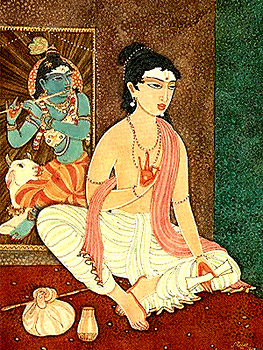
The Bansuri is among the most popular wind instruments in India. It is a transverse alto flute made of a single length of bamboo with six or seven open finger holes. It is an ancient instrument depicted in Buddhist paintings from around 100 AD. It is most often associated with the Lord Krishna and Radha. The North Indian Bansuri, typically about 14 inches long, was traditionally used as a soprano instrument primarily for accompaniment in lighter compositions including film music. The South Indian counterpart of the Bansuri is the Venu, used in Carnatic Music of South India. It is a keyless transverse flute made of bamboo, which comes in various sizes.
Shehnai
Another very popular wind instrument used in Indian Classical music is the Shehnai. It is considered to be an auspicious instrument and is often used for marriages and festive occasions. The Shehnai is a double reeded wind instrument with a widening tube towards the lower end.
Kuzhal
A popular double reed wind instrument used in the South Indian state of Kerala is the Kuzhal. It is similar in construction to a large Shehnai and has a very loud and penetrating tone. It is used primarily for outdoor festivals, in conjunction with drums and other percussion instruments. The Kuzhal is generally used for classical performances of different musical instruments that are unique to Kerala.
Nadasvaram
By far the most popular wind instrument among all the others in the South is the Nadasvaram. It is the world`s loudest non-brass acoustic instrument. It is similar to the North Indian Shehnai but larger, with a hardwood body and a large flaring bell made of wood or metal. As it is considered as a very auspicious instrument, it is the key instrument which is played in almost all Hindu marriages and temples in South India. The instrument is usually played in pairs, and accompanied by a pair of drums called Thavil.
 Pungi
Pungi
The Pungi is an important wind instrument used in Manipuri dancing. It has been further developed from the Shehnai and is a long bodied drum with both ends covered in skin. The Pungi or Been is the musical instrument played by snake charmers.
Apart from these above mentioned instruments, a number of other instruments are used in Indian music which have been borrowed and adopted from world music. Though these instruments have originated and gained popularity in different parts of the world, their use and popularity is increasingly seen in the world of Indian music as well. Popular in world music in the category of wind instruments are the Saxophone, Clarinet, Harmonica, Trumpet etc. Not only are these instruments of the world stage, but are also found used in Indian music in various forms such as fusion, film music etc.
Wind Instruments
Wind instruments are those which produce sound by means of air blown through them. Referred to as Sushira Vadya, there are a number of wind instruments are found used in Indian music.