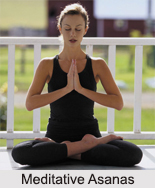
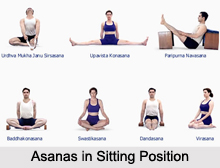
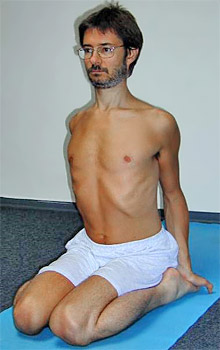
 Virasana, or the heroic pose, is a meditative Yoga asana that putatively resembles a man in a martial stance. It was first mentioned in the Mahabharata, in a dialogue between Shiva and Parvati
Meaning of Virasana
Virasana is also called the `heroic-pose` according to tradition and literature. The literal meaning of `Vir` is Hero or chief in Sanskrit. The way a brave man takes position while attacking his enemy, similar position is formed in this asana.
Yoga Texts and Virasana
Virasana arguably possesses the distinction of being the first specific asana to be mentioned in Indian texts (thanks to its mention in the Mahabharata), and is at least 2400 years old. Although the Patanjali Yoga Sutra precedes the Mahabharata, it provides no descriptions of any asanas and the Yoga Yajnavalkya, one of the first yoga texts to describe asanas, postdates it. In the Mahabharata, Lord Shiva characterizes the Virasana as the pose forest dwelling ascetics should assume when they perform their austerities.
Practice of Virasana
A sequential process for performing Virasana is given below
* One should kneel on the floor on a folded blanket to pad your knees, shins, and feet if necessary, with the thighs perpendicular to the floor and touch the inner knees together.
* The person has to slide the feet apart, slightly wider than the hips, with the tops of the feet flat on the floor.
* One must angle the big toes slightly in towards each other and press the top of each foot evenly on the floor.
* With one`s torso leaning slightly forward, he/she should exhale and sit back halfway.
* One must wedge the thumbs into the backs of the knees and draw the skin and flesh of the calf muscles toward the heels. Then sit down between the feet.
* If the buttocks do not comfortably rest on the floor, one should raise them on a block or thick book placed between the feet.
* He/she should make sure that both sitting bones are evenly supported and allow a thumb`s-width space between the inner heels and the outer hips.
* One should turn the thighs inward and press the heads of the thigh bones into the floor with the bases of the palms.
* The person has to lay the hands in the lap, one on the other, palms up, or on the thighs with palms down.
* One should firm the shoulder blades against the back ribs and lift the top of the sternum like a proud warrior.
* Then the person should widen the collarbones and release the shoulder blades away from the ears.
* One should lengthen the tailbone into the floor to anchor the back torso.
* In the beginning, one should stay in this pose from 30 seconds to 1 minute and then gradually extend the stay up to 5 minutes.
* While exiting from the posture, one should pres the hands against the floor and lifts the buttocks up, slightly higher than the heels.
* Then the person should cross the ankles underneath the buttocks and then sit back over the feet and onto the floor and stretch the legs out in front.
* It may feel good to bounce the knees up and down a few times on the floor. If the ankles are painful in this pose, one may roll up a towel and place it underneath them before he/she sit back.
Effects of Virasana
There are several benefits of Virasana. The thighs, knees, and ankles gets stretched and toned. The posture strengthens the arches. The practice of this asana improves digestion and relieves gas; it also helps in relieving the symptoms of menopause. Practicing Virasana reduces swelling of the legs during pregnancy (through second trimester). Virasana acts as a therapeutic healer for high blood pressure and asthma. In this asana the joints of the legs, the waist, the spinal column and the neck get curved in opposite direction. As a result of this, the blood circulation to these joints is synchronised. The spinal column becomes flexible and its functioning improves. There is pressure on the digestive organs and the belly gets stretched, which promotes their functioning in the long run.
Precautions in practice of Virasana
Virasana is not recommended if the practitioner is suffering from heart problem. In case of headache, one should practice this pose lying back on a bolster and for a knee or ankle injury, one should avoid this pose unless the person has the assistance of an experienced instructor. The process of the backward bending should be done slowly and controlled; else it becomes difficult to maintain the balance. The loss of balance may prove injurious to certain parts of the body. Slow and controlled movements help in having halt at the needed point and avoiding the unwanted strain.
Virasana is one of the world`s most ancient exercise postures, and its mention in the Mahabharata gives it especial distinction. Its beneficial effects have ensured it remains performed by yoga practitioners.