 Taj Mahal is a World Heritage Monument in India which was built by Mughal Emperor Shah Jahan in memory of his wife Mumtaz. It is considered as one of the greatest architectural achievement in the whole range of Indo-Islamic architecture. It attracts millions of visitors a year. In 2007, it was declared a winner of the New7 Wonders of the World.
Location of Taj Mahal
Taj Mahal is located at the south bank of the Yamuna River in the Indian city of Agra. With a vast Mughal garden that covers almost 17 hectares, it is located in the Agra District in Uttar Pradesh.
History of Taj Mahal
While delving into the history of Taj Mahal, one will come across the unforgettable love story of a prince and an exquisitely beautiful lady who was a Persian princess who died giving birth to their 14th child, Gauhara Begum. Taj Mahal is a saga of love between Shah Jahan, a Mughal Emperor and Mumtaz Mahal marble platform, by the banks of Yamuna River. An estimated 20,000 people worked to complete the enchanting mausoleum, on the banks of the Yamuna from 1631 AD and completed at the end of 1648 AD. Every possible attempt was made to beautify Taj Mahal.
Architecture of Taj Mahal
The individuality of Taj Mahal lies in some really remarkable innovations carried out by the horticulture planners and architects of Shah Jahan. The colour amalgamation of lush green scape reddish trail and blue sky over it show cases the monument in ever changing shades and moods. The relief work in marble and inlay with precious and semi precious stones make it a monument apart.
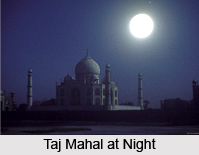
 It expands on the design traditions of Persian and earlier Mughal architecture. While earlier Mughal buildings were mainly constructed of red sandstone, Shah Jahan promoted the use of white marble inlaid with semi-precious stones. The tomb is the innermost focus of the entire complex of the Taj Mahal. It is a large, white marble structure standing on a square plinth and consists of a balanced building with an "iwan" (an arch-shaped entrance) topped by a large dome and finial. The foundation structure is a large multi-chambered cube with chamfered corners forming an uneven eight-sided construction that is around 55 metres (180 feet) on each of the four long sides. Each side of the "iwan" is framed with a massive "pishtaq" or leaped arcade with two likewise shaped arched balconies piled on each side. Four minarets surround the tomb, one at each corner of the plinth facing the chamfered corners. The main chamber has the artificial sarcophagi of Mumtaz Mahal and Shah Jahan.
The most stunning feature is the marble dome that surmounts the tomb. The top is decorated with a lotus design which also provides to emphasize its height. The shape of the dome is emphasised by four smaller domed chattris and is slightly asymmetrical. Their columned bases open through the roof of the tomb and provide light to the interior. Tall ornamental spires (guldastas) broaden from edges of base walls, and give visual highlighting to the height of the dome. The lotus motif is repeated on both the chattris and guldastas. The main finial was initially made of gold but was replaced by a copy made of gilded bronze in the early 19th century. The minarets, which are each more than 40 metres (130 ft) tall, demonstrate the designer`s inclination for symmetry.
The external decorations of the Taj Mahal are among the supreme in Mughal architecture. The attractive elements were created by applying paint, stucco, stone inlays or carvings. The decorative elements can be grouped into either calligraphy which was created in 1609 by a calligrapher named Abdul Haq. Much of the calligraphy is composed of florid "thuluth" script made of jasper or black marble. Higher panels are written in somewhat larger script to decrease the skewing effect when viewed from below. On the lower walls of the tomb are white marble dados sculpted with realistic bas relief representations of flowers and vines. The inlay stones are of yellow marble, jasper and jade, polished and levelled to the surface of the walls.
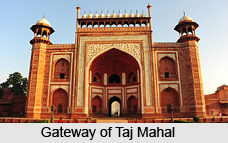
 The main gate of Taj Mahal faces the Southern gate. The gateway is 151 feet by 117 feet and rises to a height of 100 feet. Tourists can enter the main compound by a small gate at the side of the main gate. The main gate of red sandstone measures 30 metres in height. It is inscribed with verses from the Koran in Arabic. The small domed pavilions on top are in Hindu style. A striking feature of the gateway is that the lettering appears to be of the same size. The engravers have skilfully enlarged and lengthened the letters, which create an illusion of uniformity. The interior compartment of the Taj Mahal reaches far ahead of traditional ornamental elements. The floorboard work is a lapidary of precious and semiprecious gemstones. The inner chamber is an octagon with the design allowing for entry from each face. The four innermost upper arches form balconies and each balcony`s external window has an involved screen from marble.
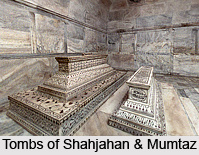
The bodies of Mumtaz and Shah Jahan were put in a comparatively plain tomb beneath the inner chamber with their faces turned right, towards Mecca. Both the base and casket are highly inlaid with expensive and semiprecious gems. Shah Jahan"s cenotaph is bigger than his wife`s, but reflects the same elements. The Ninety Nine Names of God are calligraphic inscriptions on the sides of the real tomb of Mumtaz Mahal.
 Garden of Taj Mahal
The Taj Mahal garden is also known as the "Charbagh" garden. The method of the garden in Taj Mahal comes from the Persian Timurid technique of gardens and is based on the concept of paradise garden which was brought into by Babur. Number four or its multiples are considered as the holiest number of Islam religion so the "Charbagh" Garden of Taj Mahal was made all the actions subsequently. This garden is packed with flowers, fruits, birds, leaves, symmetry, and delicacy, which served a lot of functions along with depicting abstract meanings about paradise.
Visiting Information of Taj Mahal
The Taj Mahal is closed on Fridays and the nearest train station to Taj is named Agra Fort Railway Station, 3 kilometres from Taj Mahal. Agra"s Kheria airport is a military base and the flight from Delhi to Agra is less than an hour long. Kheria airport is 13 kilometres away from Agra city. Agra is well connected by bus to cities and the daily buses ply.