Percussion instruments produce sounds, while being struck with an implement, shaken, rubbed, scraped, or by any other action which sets the object into vibration. The term usually applies to an object used in a rhythmic context and/or with musical intent.
Chenda
It is a cylindrical percussion instrument used widely in the state of Kerala and also in some parts of Karnataka, where it is called Chende. It is mainly used as an accompaniment in Hindu religious art forms like Kathakali, Koodiyattam and rituals. It is also used in a folk dance-drama called Yakshagana popular in Karnataka. A chenda is made out of a cylindrical wooden drum, and has a length of 2 feet and a diameter of 1 foot. Both side of it is covered with skin (usually cow skin). Chenda is suspended in drummers neck so that it hangs vertically facing the upper parchment of the covered skin. using two stiks the drummer strikes the upper parchment.
Dhol
The dhol is a percussion musical instrument) widely used in the Punjab region, and nowadays, it is very popular in modern Punjabi music. A double-sided sided barrel drum , it is played mostly as an accompanying instrument to the traditional Punjabi dance of Bhangra and the traditional dance of Gujarat, the Raas. The drum consists of a wooden barrel with animal hide stretched over its open ends, covering them completely. These skins can be stretched or loosened with a tightening mechanism made up of either interwoven ropes, or nuts and bolts. Tightening or loosening the skins subtly alters the pitch of the drum sound. The stretched skin on one of the ends is thicker and produces a deep, low frequency (higher bass) sound and the other thinner one produces a higher frequency sound. In contemporary Punjabi music, dhols with synthetic, or plastic, treble skins are very common.
The dhol is played using two wooden sticks, usually made out of bamboo and cane wood. The most common rhythm played on the dhol is the Chaal, which consists of 8 beats per measure. The stick used to play the bass side of the drum is a bit thicker (roughly about 10 mm in diameter) and is bent in a quarter-circular arc on the end that strikes the drum, the dagga. The other stick is much thinner and flexible and used to play the higher note end of the drum, the thili.
The Dholak
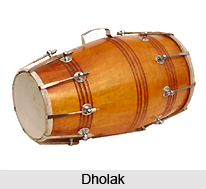
It is a classical North Indian hand drum, which is cylindrical in shape, bored out of solid wood. Its pitch is variable and is an essential accompaniment for folk music of North India. It has a simple membrane and a handle on the right-hand side. The left-hand membrane has a special coating on the inner surface. This coating is a mixture of tar, clay and sand (dholak masala) which lowers the pitch and provides a well-defined tone. The dholak is the main accompaniment instrument of the Qawwali. It is mostly also used in dances like the Bhangra and Garba to devotional Bhajans and kirtans. However, It is not used as much as for classical music.
Idakka
It is an hour-glass drum from Kerala, south India, which is played with a stick. The idakka`s pitch may be bent by squeezing the lacing in the middle. It is slung over the left shoulder and the right side is beaten with a stick. The left hand is used for tightening and loosening the tape wound round the middle. Varying the tension of the tape produces variations in tones. imple melodies extending over one octave can be played in this instrument. The Idakka is one of the five instruments that constitute the panchavadhyam of Kerala. Since it is considered to be a very auspicious instrument, it is the custom to play the Idakka as an accompaniment to singing during the Pujas. It is also used during Kathakali, when a female character holds the stage (when the Chenda is not played). In Koodiyattam, the Idakka gives good support to the Mizhavu. The Idakka is an indispensable accompaniment for other dance forms, most notably Mohiniyattam and Krishnanattam. However, of all the tradititional instruments of Kerala, Idakka is regarded as the most difficult to learn and master.
Kanjira
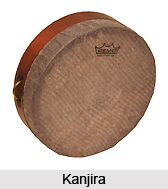
It is an percussion instrument, which is mostly used in Carnatic music concerts (South Indian classical music) as a supporting instrument for the mridangam. The kanjira is a recent invention and was added to classical concerts during the 1930s. It consists of a circular frame made of the wood of the jackfruit tree, between 7 and 9 inches in diameter and 2 to 4 inches in depth. It is covered on one side with a drumhead made of monitor lizard skin, while the other side is left open. The frame has a single slit which contain three to four small metal discs - often old coins, which jingle when the kanjira is played. The kanjira is probably the most difficult Indian drum to play. It is normally played with the palm and fingers of the right hand, while the left hand supports the drum. The fingertips of the left hand can be used to bend the pitch by applying pressure near the outer rim. Normally, without tuning, it has a very high pitched sound. To get a good bass sound, the performer reduces the tension of the drumhead by sprinkling water on the inside of the instrument. This process may have to be repeated during a concert to maintain a good sound.
Mizhav
It is a big copper drum played as an accompanying percussion instrument in the Koodiyattam and Koothu, performing arts of Kerala. The drum is played only with hands. It is used to accompany the holy ritualistic temple performance of Koodiyattam and Koothu. Only Ambalavasi Nambiar community members are allowed to play it inside temples or yet in Koothambalams.
Mridangam
It is a percussion instrument from South India. It is the primary rhythmic accompaniment in Carnatic music. In ancient Hindu sculpture, painting, and mythology, the mridangam is often depicted as the instrument of choice for a number of deities including Ganesha (the protector) and Nandi, who is the vehicle and companion of Lord Shiva. The word "mridangam" is derived from the two Sanskrit words "Mrid" (clay or earth) and "Ang," (body). Early mridangams were indeed made of hardened clay. But now, over the years, the mridangam is a double-sided drum whose body is usually made using a hollowed piece of jackfruit wood about an inch thick. The two mouths or apertures of the drum are covered with a goat skin leather and laced to each other with leather straps around the circumference of drum. These straps are put into a state of high tension to stretch out the circular membranes on either side of the hull, allowing them to resonate when struck. These two membranes are dissimilar in width to allow for the production of both bass and treble sounds from the same drum. The smaller membrane, when struck, produces higher pitched sounds with a metallic timbre. The wider aperture produces lower pitched sounds.
The mridangam is played resting it parallel to the floor. A right-handed mridangam artist plays the smaller membrane with his or her right hand and the larger membrane with the left hand. However, since it is a very difficult art, one needs to learn it and vigorously practice both the fingering strokes and solfa passages to achieve proficiency and accuracy in this art. Thus, complex calculations and metres may be employed when the mridangam is played.
Pakhavaj
It is also called mardal, pakuaj, pakhvaj and mardala is an ancient Indian barrel shaped percussion instrument which is similar to the mridangam, famous in North India. It is widely used for Orissi dancers and sometimes for Kathak. It is the standard percussion instrument in dhrupad. Pakhawaj is a long bodied wooden drum with both ends covered in skin and is the most traditional drum of North India. Played horizontally with the fingers and palms of both hands, the right hand surface is tuned to the pitch required and the left hand surface provides the base. The goatskin membranes are looped with leather thongs around the hollowed barrel, which is widest in the middle. Eight pieces of two inch wooden roundstock are pried between thongs and barrel and are hammered tight.
The treble skin is fitted with three concentric rings of dense black hardened paste which helps create a sound resonant with harmonics. The treble skin is tuned with a tuning-hammer, holding the instrument in a vertical position, striking down along the rim over the barrel to raise the pitch, turning the pakhavaj on its vertical axis as it is tuned all along the circumference of the skin. Care has to be taken that the sound emitted by a particular stroke should merge completely with that of the accompanying tanpura.
Tabla
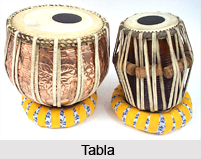
It is a popular Indian percussion instrument used in the classical, popular and religious music of the Indian subcontinent and in Hindustani classical music. The instrument consists of a pair of hand drums of contrasting sizes and timbres. The musician uses the base of the palm as well as the fingers to produce great variations in sounds. The right hand drum is tuned to the tonic dominant or sub-dominant and the left-hand drum acts as the base.
Thavil
The thavil is a barrel shaped percussion instrument from South India. It is used in folk music and Carnatic music, often accompanying the nadaswaram. It consists of a cylindrical shell hollowed out of a solid block of wood. Layers of animal skin (water buffalo on the right, goat on the left) are stretched across the two sides of the shell using hemp hoops attached to the shell. The right face of the instrument has a larger diameter than the left side and the right drum head is stretched very tightly, while the left drum head is kept loose to allow pitch bending. The instrument is either played while sitting, or hung by a leather strap from the shoulder of the player. The right head is played with the right hand, wrist and fingers. The player usually wears thumb caps on all the fingers of the right hand, made from hardened glue. The left head is played with a stick made from the wood of the portia tree. Sometimes, however, the left-handed players use their opposite hands and some nadaswaram groups feature both a right- and a left-handed thavil player.
Dhadh
It is small two-sided wooden drum, also known as the damru. It is about 10 to 12 inches in length with a narrow waist in the middle. The parchments are held by cotton straps. It is held in the left hand and played with the right hand.
Ghatam
It is also a percussion instrument, used in South Indian Carnatic music. It is an earthenware pot, where the artist uses the fingers, thumbs, palms, and heels of the hands to hit the outer surface of the ghatam. An airy low-pitch bass sound, called "gumki", is created by hitting the mouth of the pot with an open hand. Another way to produce the `gumki` sound is sometimes to press the mouth of the pot against the bare belly of the artist, which deepens the tone of the bass stroke. Different tones can be produced by hitting different areas of the pot with different parts of the hands. Ghatam usually accompanies a mridangam.
Although the ghatam is the same shape as an ordinary Indian domestic clay pot, it is made specifically to be played as an instrument, the tone of the pot must be good and the walls should be of even thickness all around to produce an even tone. In fact, there are two types of ghatams; Madras and Manamadurai. The former is a light pot which requires less force to play, suited for extended fast patterns, whereas the latter is a heavy, thick pot with tiny shards of brass mixed into the clay. This type of ghatam is harder to play but produces a sharp metallic ringing sound which is favored by some players.
Morsing
This instrument is also called the mourching or morching is a percussion instrument, mainly used in the Carnatic music of South India. It consists of a metal ring in the shape of a horseshoe with two parallel forks which form the frame, and a metal tongue in the middle, between the forks, fixed to the ring at one end and free to vibrate at the other. The metal tongue is bent at the free end in a plane perpendicular to the circular ring so that it can be struck and is made to vibrate. This bent part is called the trigger. The morsing is placed between the teeth and held firmly in the hand and is struck using the other hand to produce sound. Movement of the player`s tongue, variations of the throat and blowing and sucking of air through the instrument produces different sounds or overtones.
The basic pitch of the instrument can be varied very little. Significantly, the pitch of the instrument can only be reduced and not increased. To reduce the pitch a little, bee-wax can be applied on the plucking end. To increase the pitch, it can be filed, although this may damage the instrument.
|