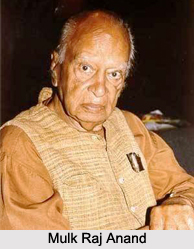
 Mulk Raj Anand was an Indian writer in English, mostly in the post colonial Indian writing in English, famous for picturising the society that was common before and after India gaining independence. He has three autobiographies Seven Summers (1951), The Morning Face (1968) - won the Sahitya Academy Award (Best Literature award) in India, Conversations in Bloomsbury (1981).
Early Life of Mulk Raj Anand
Mulk Raj Anand was born in Peshawar, Pakistan. Mulk Raj Anand studied at Khalsa College, Amritsar, graduating with honours in 1924, before moving to England, where he attended University College London as an undergraduate and later Cambridge University, earning a PhD in Philosophy in 1929. During this time he forged friendships with members of the Bloomsbury Group. Mulk Raj Anand spent some time in Geneva, lecturing at the League of Nations` School of Intellectual Cooperation.
Career of Mulk Raj Anand
The literary career of Mulk Raj Anand was launched by family tragedy, instigated by the rigidity of the caste system. His first prose essay was a response to the suicide of an aunt, who had been excommunicated by his family for sharing a meal with a Muslim.
Inevitably, Anand, who spent half his time in London and half in India, was drawn to the Indian independence movement. At the same time, he also supported freedom elsewhere around the globe and even travelled to Spain to volunteer in the Spanish Civil War. He spent World War II working as a scriptwriter for the BBC in London, where he became a friend of George Orwell.
Works of Mulk Raj Anand
Mulk Raj Anand returned to India in 1946, and continued with his prodigious literary output there. His work includes poetry and essay on a wide range of subjects, as well as autobiographies and novels. Prominent among his novels are The Village (1939), Across the Black Waters (1940), The Sword and the Sickle (1942), all written in England, and The Private Life of an Indian Prince (1953), perhaps the most important of his works written in India. He also founded a literary magazine, "Marg" and taught in various universities.
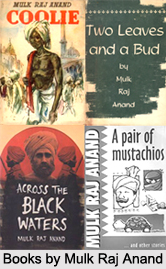 His first main novel, "Untouchable", published in 1935, was a chilling exposé of the day-to-day life of a member of India`s untouchable caste. It is the story of a single day in the life of Bakha, a toilet-cleaner, who accidentally bumps into a member of a higher caste. Bakha searches for comfort to the tragedy of the destiny into which he was born, talking first with a Christian missionary and then with a follower of Mahatma Gandhi, but by the end of the book he concludes that it is technology, in the form of the newly introduced flush toilet that will be his saviour. While the toilet may deprive him and his family of the traditional livelihood they have had for centuries, it may also liberate them in the end by eliminating the need for a caste of toilet cleaners.
This simple book, which captured the puissance of the Punjabi and Hindi idiom in English was widely acclaimed and Mulk Anand won the reputation of being India`s Charles Dickens. His friend, E. M. Forster, whom he met while working on T. S. Elliot`s magazine Criterion, wrote the introduction. In Anand`s second novel, Coolie (1936), he continues to describe the plight of India`s poor by telling of a 15-year-old boy, trapped in servitude as a child labourer, who eventually dies of tuberculosis.
Two Leaves and a Bud (1937) describe an exploited peasant, who is killed while trying to protect his daughter from being raped by a British colonial official. His later works, including the novel Private Life of an Indian Prince, were more autobiographical in nature, and in 1950 Anand embarked on a project to write a seven-part autobiography, beginning with Seven Summers. One part, Morning Face (1968) won him the National Academy Award. Like much of his later work, it contains elements of his spiritual journey as he struggles to attain a higher sense of self-awareness.
Books by Mulk Raj Anand
| Untouchable (1935) |
| Coolie (1936) |
| Two Leaves and a Bud (1937) |
| The Village (1939) |
| Across the Black Waters (1939) |
| The Sword and the Sickle (1942) |
| The Big Heart (1945) |