


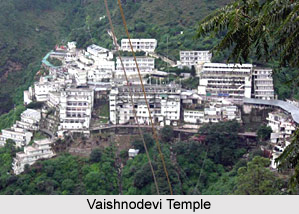
 The pilgrim to Mata Vaishnodevi is to the cave where she merged her human form with the astral form of the three energies. A pilgrimage to this shrine is considered to be the holiest. She resides in a cave located among the Trikuta Mountains. Over five million pilgrims visit here every year. It is situated at an altitude of 5200 feet above sea level. The pilgrims trek 12 km from the base camp at Katra with the journey ending with the darshan of the pindis within the cave. The pilgrim to Mata Vaishnodevi is to the cave where she merged her human form with the astral form of the three energies. A pilgrimage to this shrine is considered to be the holiest. She resides in a cave located among the Trikuta Mountains. Over five million pilgrims visit here every year. It is situated at an altitude of 5200 feet above sea level. The pilgrims trek 12 km from the base camp at Katra with the journey ending with the darshan of the pindis within the cave.
The journey usually starts according to the pilgrims with the call from Her - Maan Aap Bulandi or Bulawa aya hey. For no one can visit the Shrine without her express blessings. History of Mata Vaishnodevi The cave according to geological studies is a million years old. Rigveda does mention Trikuta but has no reference to worship of Mother Goddess. The worship of Shakti started only in the Puranic period.The first mention to the Mother Goddess is in the Mahabharat during the battle of Kurukshetra, Arjun is said to have invoked the blessings of Mother. He calls her as Jambookatak Chityaishu Nityam Sannihitalaye - you who always dwell in the temple on the slope of the mountain in Jamboo. It is also believed that the Pandavs were the first to build the temples at Kol Kandoli and Bhawan in gratitude. Here there are five stone structures believed to represent the five Pandavs. The Shrine Board runs three Bhojanalyas at Main Bhawan complex and one at Manokamna Bhawan complex. These Bhojanalyas provide wholesome vegetarian food to the pilgrims on a no profit basis. Run round the clock and serve a varied but traditional menu. In addition to full meals, packed snacks, beverages, mineral water and milk etc. are also available here. Medical facilities are available for the yatris at Bhawan. In addition, other facilities include free toilet facilities, drinking water, enquiry and announcement booths are available all through the Bhawan Complex. STD/PCOs, Bank branches, a Police Station and a post office are also functional. There is also a small market complex where toiletries, medicines, eatables and other utility items are available. Fair price Bhaint shops selling Prasad and Souvenir shops selling photographs and cassettes are also located inside this market complex. It is reiterated that all establishments of the Board are run on a no profit basis and yatris can be sure of the quality and prices of goods offered in these establishments. 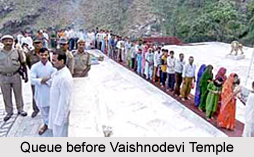 The Holy cave is situated at a height of 5200 ft above sea level. Even during summers, the nights are cool. Shrine Board has arranged for free blanket stores at various locations. For a nominal and refundable security deposit, yatris are issued blankets for the night.
The Shrine Board has posted various levels of officers including senior officers at all important locations including Bhawan. Yatries are welcome to contact any of them for advice or assistance. Preparing for Darshan of Mata Vaishnodevi Most pilgrims prefer to take a bath before proceeding for darshans. In the olden days pilgrims used to take a bath at the Bathing Ghat, with the water that flows from the feet of Mata. Attempts have been made to channelise the water from the Holy Cave to all these new Bathing areas, so that irrespective of where the pilgrim takes a bath, he receives the cleansing effect of the Holy Water. The traditional Bathing ghats have also been enlarged and developed many pilgrims would still like to take a bath at the original ghats. Pilgrims are required to deposit all their belonging in the free cloakrooms, as nothing except cash and selected offerings are allowed inside the Holy Cave. All articles of general use like belts, wrist watches with leather belts, combs, pen, pencil, purses, handbags, etc. are prohibited. In particular, a shoes/bags cloakroom has been made operational just outside Gate No.1, which is the entrance to the queue complex. This cloakroom can be used for depositing all leather and other goods, which are prohibited, inside the Holy Cave. No sweets are allowed either. After taking a bath at the Bathing Ghat or elsewhere, pilgrims can reach Gate No.1 where upon announcement (and/or display on the display board) of the group number, they are allowed inside the queue which would lead them eventually to one of the greatest moments of their lives, a Darshan of the Divine Mother inside the Holy Cave in the natural rock form i.e. the Holy Pindies. Waiting in the Queue in Mata Vaishnodevi Temple Immediately after a pilgrim's group number is called or displayed, he/she is ushered in through Gate No.1 into the queue complex. The queue complex is a long corridor, which opens first into two large waiting halls, one after the other and finally opens at the mouth of the Holy Cave. The Shrine Board has installed coloured Television sets all along the queue corridor. These television sets relay a direct telecast of the Holy Cave and the Holy Pindies. Pre recorded messages explaining the procedure of darshans are also relayed since the time available for darshans inside the Holy Cave is limited, yatris are advised to carefully watch the television sets and hear the pre-recorded messages. This will help them in having proper darshans inside the Cave. Prasad of Mata Vaishnodevi 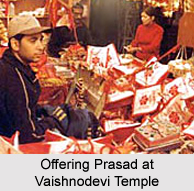 The traditional offering to the Goddess invariably comprises a coconut. However for reasons of time and security, coconut offerings are not allowed to be carried by the pilgrims beyond a designated point.
Instead, at a designated point in the main waiting hall, pilgrims have to deposit their coconuts to the temple priests who then take responsibility for the rituals. The pilgrim is handed over a token and the offered coconuts can be reclaimed after darshans upon producing the token at the Coconut Prasad Counter. Outside the exit tunnel and just beyond the Amrit Kund lies the Prasad counter. The temple priests hand over the blessings of the Mother Goddess in the form of Prasad pouches to the devotees. Each Prasad pouch comprises the Mishri Prasad plus a blessed coin, carrying the image of the Holy Pindies. In addition, Khazaana (coins) are given to the devotees. This Khazaana Prasad is believed to be a good luck coin(s) and devotees would do well to keep it in their cash boxes, temples or other important places in their homes or establishments. There are other blessed items too, especially the chunnis and the cholas which are used for Shringar of the Holy Pindies. Since the Vastras of the Pindies are changed twice a day during Aarti, the Vastras, which have been used once but are subsequently changed, are offered as Aashirwad (blessings) to the devotees. These are readily available at the Souvenir shops run by the Shrine Board at Katra, Adkuwari, Sanjichhat and Bhawan. Gold and Silver coins of the Holy Goddess are also available. One may contact the officials of the Shrine Board for more details. Architecture of Mata Vaishnodevi Temple While on the way to the Sanctum Sanctorum, one crosses a small patio type of structure on the right hand side of which is a Cave opening. This is the original Cave leading to the Holy Pindies. In the olden days, the yatris used to reach the Sanctum Sanctorum through this cave only. Nowadays, this cave is kept closed for a large part of the year. Since this cave is quite narrow, it takes several minutes for a single person to cross it and reach the Sanctum Sanctorum. Considering the rush that the Holy Shrine normally witnesses, it is not possible to keep the original cave open except when the yatra is less than 8000 pilgrims per day. The three Pindies in Mata Vaishnodevi Temple The three Pindies in Mata Vaishnodevi Temple are Maha Kali, Maha Lakshmi, Maha Saraswati .Mata Vaishnodevi is considered to be an incarnation of the three Supreme Energies. Darshan of Mata Vaishnodevi Just like the Trikuta Mountain, which is one at the base but has three peaks (hence the name Trikoot), the revelation of the Mother Goddess in the Holy Cave is in a natural rock form, which is one at the base but has three heads at the top. The entire rock body is immersed in water, and a marble platform has now been constructed all around. The main Darshans remain to be of the three heads called the Holy Pindies. The uniqueness of the Holy Pindies is that although they emanate from one single rock form, each one is distinctly different from the other two in colour and texture. Puja of Mata Vaishnodevi The arti is performed twice a day first time in the morning just before the sunrise and second time in the evening immediately after the sunset. The procedure is very sacred and a lengthy one. It is performed by the pujaris inside the sanctum-sanctorum and than again outside the cave. Before the arti the atam pujan or self-purification is done. Then the Goddess is bathed in water, milk, ghee (clarified butter), honey and sugar. Thereafter she is dressed in a saree, chola and chunri and ornaments. This takes place while the mantras are being recited. The tilak is placed on the forehead of the deity and prasad is offered. The pujaris also perform puja of various Gods and Goddesses, as it is believed that during the arti, all the Gods and Goddesses are present inside. The jyoti (lamp) is lighted and arti is performed. After this the thaal-plate that contains the lamp is brought outside the holy cave, where arti is again performed in the presence of pilgrims. After the arti the pujari distributes prasad and the charanamrit (the holy water) to the devotees. This takes nearly two hours during which darshan remains suspended. |
| |||



Home > Reference > Indian Temples > North Indian Temples > Temples in Jammu and Kashmir > Mata Vaishnodevi Temple
Mata Vaishnodevi Temple
| Mata Vaishnodevi Temple is in Kashmir . A pilgrimage to this shrine is considered to be the holiest. |
| ||||||||||||||||||||||||||||

