Mahabharata means "the great narrative of the battle of the Bharatas." The Bharatas as mentioned in the Rig Veda are a war-like tribe who lived in the country of the Upper Granges and the Yamuna River. A major part of Hindu culture, this epic is part of the Hindu Itihasa or history and thus forms an important part of Hindu mythology. It has been believed by historians that Mahabharata is just a fictitious fable narrated by the great Sage Ved Vyas. However various noted scholars are of the opinion that the Great Indian Epic is a detailed account of an event that occurred in the past. The Mahabharata is one of the two major Sanskrit epics of ancient India, besides Ramayana. Mahabharata till today serves as the longest single poem. This Great Indian Epic gains prominence as a literary work. The Mahabharata is one of the longest epic in the world with more than 74000 verses, long prose and about 1.8 million words in total. Furthermore, Mahabharata is considered to be the source for the development of Sanskrit Literature.
The epic is interwoven within a story structure. It is employed that it is recited to the King Janamejaya who is the great-grandson of Arjuna, by Vaisampayana, a disciple of Vyasa. The recitation of Vaisampayana to Janamejaya is then recited again by a professional story teller named Ugrasrava Sauti, many years later, to a gathering of sages. A copper-plate inscription of the Maharaja Sharvanatha 533-534 from Khoh, Madhya Pradesh illustrates the Mahabharata as a collection of 100,000 verses, it was known from this evidence, that it is likely there are about 18 books whose anthology took place in the first century. Most Parvas are named after one of their constituent sub-parvas. The Harivamsa Parva was considered an appendix (khila) to the Mahabharata.
Origin of Mahabharata
According to Hindu mythology it is believed that Mahabharata was written by Ved Vyasa. The origin of the Great Indian Epic dates back to the late Vedic period and it probably reached its final form in the early Gupta period. However the first section of the Mahabharata states that it was Ganesha who on behalf of Vyasa wrote down the text when Vyasa dictated it. Lord Ganesha is said to have written it only on one condition that Vyasa would never pause in his recitation.
Story of Mahabharata
The tragedy of a terrible war of annihilation forms the actual subject of the heroic poem. This old heroic poem forms the nucleus of the Mahabharata. Among the descendants of Bharata, a ruler named Kuru was especially prominent, and his descendants, the Kauravas (Kuruides), were so long the ruling race of the Bharatas, that the name Kuru or Kaurava in the course of time assumed the character of a name for the tribe of the Bharatas, and their land is that of Kurukshetra or Kuru-land. A family feud in the royal house of the Kauravas leads to a long battle, a truly internecine struggle in which the ancient race of the Kurus, and with it the family of the Bharatas, is almost entirely ruined.

The history of this battle was told in songs, and these songs were combined into a heroic poem of the great battle in the field of the Kurus.
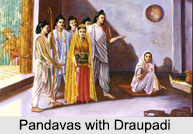
The main action of Mahabharata revolves around the contest of Pandavas and Kauravas and the contest is set in the strategic and fertile plain of Delhi. The Kauravas were the hundred sons of Dhritarashtra and their capital was Hastinapur, the Pandavas on the other hand were the five sons of Pandu. As Dhritarashtra was blind, the Kuru territories were succeeded by the Pandavas, but Pandu had a skin ailment and hence even he was not eligible to rule. In order to avoid conflict between the Pandava and the Kaurava brothers, Dhritrashtra had divided the kingdom into two equal halves and the Pandavas ruled the kingdom from Indraprastha. But this arrangement did not satisfy the Kauravas and they invited the Pandavas to a gambling match. The result of the gambling match was that the Pandavas lost everything they had staked and the a settlement was reached that they would be allowed to retain half the patrimony and their joint wife Draupadi provided they went to an exile for a period of thirteen years. But even after they returned from exile, the Kauravas did not allow them to rule. Hence the matter had to be settled through war.
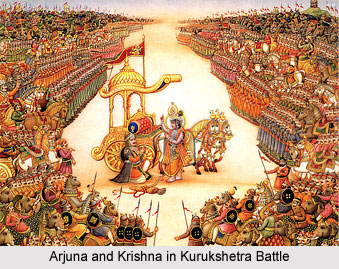
As a result an eighteen day long battle was fought in the plains of Kurukshetra and many clans most of whom belonged to the Kauravas was annihilated in the battle. The Pandavas established their victory and ruled the kingdom peacefully for some years. Then the Pandava brothers renounced their royal status after installing a grandson walked towards City of the Gods in the Himalaya.
Teachings of Mahabharata
Mahabharata explains the Hindu Philosophy at length. It mentions all four kinds of Purushartha to be achieved by every man. This Great Indian Epic describes about Politics (Artha sastra), Erotics (Kamasastra), and Virtues (Dharma sastras) by the great sage Vyasa. Added to it, the Mahabharata is also a compilation of stories about the ancestors of Pandavas and many kings like Yayathi, conflict of Devas and Asuras, Story of Garuda. Karma and Dharma play an integral role in the Mahabharata. It explains the Hindu Philosophy at length.
Parvas of Mahabharata
The 18 Parvas of Mahabharata include `Adi Parva` or the `Book of the Beginning` describing the origin of the Great Indian Epic. `Sabha Parva` or the `Book of the Assembly Hall` is the second Parva among the 18 Parvas. It introduces Maya Danava and narrates the building of a palace and court (Sabha), at Indraprastha. The third chapter is the Vana Parva or Aranyak Parva which is the `Book of the Forest` and mentions about Pandavas` life wile in exile. Virata Parva is the Book of Virata, narrating the year spent incognito at the court of Virata. Udyoga Parva or the Book of the Effort describes the preparations for war by the Karauvas and the Pandavas. Bhishma Parva is the Book of Bhishma. Drona Parva or the Book of Drona speaks about the great battle with Drona as commander. Karna Parva is the Book of Karna describing Karna. Salya Parva is the Book of Salya dealing with the last day of the battle. Sauptika Parva is the Book of the Sleeping Warriors. Stri-Parva is the Book of the Women explaining their plight after the Kurukshetra war. Shanti Parva is the Book of Peace while Anushashana Parva is the Book of the Instructions laid down by Bhisma. Ashvamedhika Parva describes the Horse Sacrifice conducted by Yudhishtira. Ashramavasik Parva or the Book of the Hermitage, Musala Parva or the Book of the Clubs, Mahaprasthanika Parva or the Book of the Great Journey and the Svargarohana Parva respectively explains the final and eventual end of the Kauravas, Pandavas and Yadava and marks the end of an era.

Context of Mahabharata
The social and political conditions prevailing during the time of the Mahabharata is of a clan based society, particularly in the case of Yadavas. It has been seen in the great epic that several times the narrative has been intervened by Krishna, a Yadava chief. The Pandavas and the Kauravas were the descendants of Puru whereas the Yadavas were the successors of Puru`s brother. Hence there is a touch of distant kinship present in Mahabharata. The geography of Mahabharata encompasses Ganges-Yamuna doab and adjoining areas and also Saurashtra in Gujarat.
Mahabharata is a masterpiece in many ways as it includes larger than life characters such as Lord Krishna, Bhisma, Arjuna, Karna, Yudhisthir, Duryodhana, Dronacharya and others. Every single incident of Mahabharata is full of twists and turns and the most important contribution of the Mahabharata is the holy scripture of the Hindus, the Bhagavad Gita. It can thus put forth that the Mahabharata is the basis of cultural consciousness that symbolize Hinduism. The Mahabharata ends with the Pandavas entering heaven and marks the beginning of the Hindu age of Kali (Kali Yuga), the fourth and final age of mankind, where the great values and noble ideas have crumbled, and man is heading towards the complete dissolution of right action, morality and virtue. In addition to that, the Mahabharata, the Great Indian Epic can be used to trace the spread and development of Vaishnavite thought in Hinduism.