Introduction
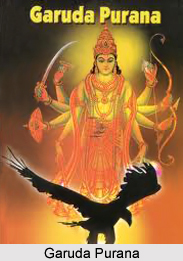
 Garuda Purana is one of the ancient Indian texts which forms a part of `Smriti` literature.
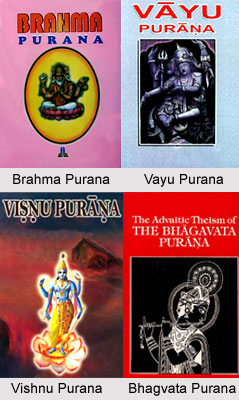
It is in the form of instructions given by Lord Vishnu to his carrier, Garuda, said to be the King of birds. The Garuda Purana deals with astronomy, medicine, grammar and gemstone structure and qualities. In addition, the Garuda Purana is considered the authoritative Vedic reference volume describing the Nine Pearls, which includes not only the well known Oyster Pearl, but also the Conch Pearl, Cobra Pearl, Boar Pearl, Elephant Pearl, Bamboo Pearl, Whale Pearl, Fish Pearl, and Cloud Pearl. The Garuda Purana is a Sattvika Purana. The others in this group are Vishnu Purana, Narada Purana, Bhagavata Purana, Padma Purana and Varaha Purana.
Garuda Purana is one of the ancient Indian texts which forms a part of `Smriti` literature.
It is in the form of instructions given by Lord Vishnu to his carrier, Garuda, said to be the King of birds. The Garuda Purana deals with astronomy, medicine, grammar and gemstone structure and qualities. In addition, the Garuda Purana is considered the authoritative Vedic reference volume describing the Nine Pearls, which includes not only the well known Oyster Pearl, but also the Conch Pearl, Cobra Pearl, Boar Pearl, Elephant Pearl, Bamboo Pearl, Whale Pearl, Fish Pearl, and Cloud Pearl. The Garuda Purana is a Sattvika Purana. The others in this group are Vishnu Purana, Narada Purana, Bhagavata Purana, Padma Purana and Varaha Purana.
Ved Vyas taught the Puranas to one of his disciples named
Romaharshana. And it was Romaharshana who related the stories of the Indian Puranas to everyone else. The Bhagavata Purana says the Romaharashana had a son named Suta and it was this son who related the story of that particular Purana to the other sages. Thus, Suta was a very learned sage. He was very well versed in the Puranas and in the Shastras as well as a devotee of Lord Vishnu. Romaharshana came to a forest known as Naimisharanya. He sat there and contemplated the mysteries of the Lord Vishnu. Several other Rishis (sages) led by Shounaka also came to the forest. And they started asking Romaharshana, all the questions about God and His existence. Thus, he started reciting the Garuda Purana, which gave all the answers about the questions the sages had asked.
Content of Garuda Purana
The Garuda Purana is a medium sized Purana consisting of nineteen thousand Shlokas. The thousand Shlokas of the Garuda Purana are divided into two parts, a Purva Khanda (first part) and an Uttara Khanda (subsequent part). Each Khanda has several chapters (adhyaya). The Purva Khanda is much longer; it has two hundred and thirty-four chapters. The Uttara Khanda has only forty-five. The Garuda Purana contains detailed descriptions of Vishnuite worship and rituals, and the focus of this Purana is Vishnu worship. The latter half of this Purana deals with life after death. Following this is an account of funeral procedures, including rituals, the astrological timing of the post-death observances, reincarnation and ritual gifts.
It also describes around 24 types of death punishments given to a person after death for the sins committed in life. These deaths include Khumbipakam (burned in oil) and Kirimibhojanam (given as prey to leeches). The final part of this text is an appeal to self-knowledge as the key to liberation, going beyond austerities and study of the texts. This has given great importance to the origin of Garuda. There are nineteen thousand verses describing the ways to the Lord.
The Hindus of north India generally read this Purana while cremating the bodies of the dead.
Khandas of Garuda Purana
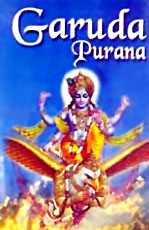 Khandas of Garuda Purana are mainly two- Purva Khanda and Uttara Khanda. Each Khanda has several chapters (adhyaya). The Purva Khanda is much longer; it has two hundred and thirty-four chapters. The Uttara Khanda has only forty-five. Found in the Khandas of the Garuda Purana are some basic concepts dealt with in all Puranas. It treats some of the five themes, i.e., Creation, the ages of the world, the genealogies of the solar and lunar dynasties; but far more attention is given to the worship of Vishnu, to descriptions of Vishnuite rites and festivals (Vratas), to expiatory ceremonies (Prayascittas) and glorifications of sacred places. It is also cognisant of Sakti-worship, and gives rules for the worship of the five gods- Lord Vishnu, Lord Shiva, Goddess Durga, Lord Surya and Lord Ganesha.
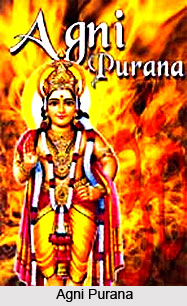
Moreover, like the Agni Purana, it is a kind of encyclopaedia, in which the most varied subjects are dealt with. Thus we find the contents of the Mahabharata and the Harivamsa Parva being retold, and there are sections on cosmography, astronomy and astrology, omina and portenta, palmistry, medicine, metrics, grammar, knowledge of precious stones (Ratnapariksa) and politics (Niti). A considerable portion of the Yajnavalkya Dharmasastra has been included in the Garuda Purana.
What is counted as the Uttarakhanda or second part of the Garuda Purana is the Pretakalpa, a voluminous body of work which is actually quite unsystematically organised. This portion deals with everything connected with death, the dead and the beyond. There are to be found here doctrines on the fate of the soul after death. Karma, rebirth and release from rebirth, on desire as the cause of Samsara, on omens of death, the path to Yama, the fate of the Pretas (i.e., the departed who still hover about the earth as spirits, and have not as yet found the way to the world beyond), the torments of the hells, and the Pretas as causing evil omens and dreams. Interspersed with this are the rules of all kinds regarding the rites to be performed at the approach of death, the treatment of the dying and of the corpse, funeral rites and ancestor-worship, the especial funeral sacrifices for a Sati, i.e., a woman who enters the funeral pyre with her husband. Here and there there can also be seen legends recalling the Buddhist Petavatthu, telling of encounters with Pretas who relate the cause of their wretched existence. Among the Mahatmyas which claim to be parts of the Garuda Purana, especial mention should be made of a Gaya Mahatmya in praise of Gaya, the place of pilgrimage, where it is particularly meritorious to perform Sraddhas.
Sins in Garuda Purana
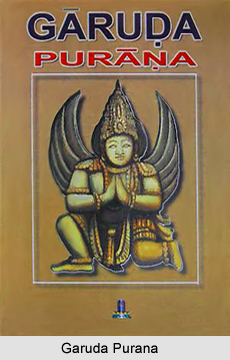 The sins and its consequences have been described by Lord Vishnu to Garuda. One who murders a Brahman becomes consumptive. One who has killed a cow becomes hump-backed and moron. One who has murdered a virgin becomes infected with leprosy. The killer of a woman and the destroyer of embryos becomes a savage infected with all diseases. Somebody who commits illicit intercourse becomes a eunuch.
A person who eats flesh becomes red. A Brahman, who eats what should not be eaten, becomes big-bellied. Someone who insults his teacher becomes epileptic. Someone who scorns the Vedas and the Shastras becomes jaundiced. A stealer of jewels would be born as a low caste. A Brahmin who does not recite the Gayatri mantra, who does not meditate at dusk, who is wicked inside while pious outside becomes a crane.
Someone who deceives a friend becomes a mountain-vulture; who cheats in selling becomes an owl; who speaks ill of caste and order would be born as a pigeon. If one hates mother, father and teacher, quarrels with sister and brother, is destroyed when an embryo in the womb. A woman, who abuses her mother-in-law and father-in-law, causes constant quarrels; becomes a leech. One who abandons her own husband, runs after another man, becomes a flying-fox or a house-lizard. One who commits unnatural vice becomes a village pig.
One who steals food becomes a rat; one who steals grain becomes a locust; one who steals water becomes a Chataka bird and who steals poison become a scorpion. One who steals vegetables and leaves becomes a peacock. One who steals perfumes becomes a musk-rat. One who steals honey becomes a gad-fly; steals flesh becomes a vulture and one who steals salt becomes an ant. One who steals betel, fruits and flowers becomes a forest-monkey. One who steals shoes, grass and cotton take birth from sheeps` wombs. One who lives by violence, who robs caravans on the road, becomes a goat in a butcher`s house.
The sinner who takes back by force what has been given by him would go into hell. The makers of bad karma after experiencing the tortures of hell are born with the residues of their sins in these forms.
Medicine in Garuda Purana
 Medicine as in Garuda Purana lists down five steps of medical treatment. First treatment is nidana which is the diagnosis of a disease before the symptoms are evident. This again spills into purva rupa. Purva rupa is the stage when early symptoms of the disease appear. Next is the stage of rupa when all signs appear. Upashya is the fourth stage that centres on the treatment of disease through medicine, diet and other activities. Samprapti is the final and the recovery stage.
Fevers are of different types. Some accompanied by hiccups, vomiting, eruptions on the skin, loss of appetite, laziness and sleepiness. Headaches, body aches, fainting fits, insomnia, delirium, sweating and thirst are other signs. This is the nidana stage of fever. Sections on the nidana follow.
The medicines to be used depend on the disease, its causes and on the season. It also depends on the disease whether it is due to phlegm, bile and wind or a combination of all three. The ingredients used for making the medicines are black mustard seeds, wheat, pepper, honey, a fruit, castor-oil, lotus leaves, a specific lentil, spinach, pomegranate, saffron, a specific lemon, myrobalan, jackfruit, grapes, dates, ginger, black pepper, asafoetida, rock-salt, clarified butter, oil of sesame, sugarcane, molasses, buttermilk, licorice , triphala, ashvagandha , indigo, yavakshara, jaggery, turmeric, garlic, fenugreek, shirisha, cardamon, sandalwood, devadaru, ivory, lac, palasha, betel leaf and salt .
The herb named punarnava should be crushed and drunk with water when pushya nakshatra is in the sky. This is done in order to stop snake from entering the house. There are other methods like the root of the shalmali tree can be crushed and drunk with water if snakes are to be repelled. Again the root of the lajjaluka can be gathered when pushya nakshatra is in the sky. The root is then crushed in order to get the juice and that is smeared on the hands. This ensures that one can catch snakes fearlessly. Despite this if a snake bites a person; the juice of the mahakala creeper should be consumed.
Physiognomy in Garuda Purana
Physiognomy in Garuda Purana is an important chapter that is dealt deftly. The science of Physiognomy is known as samudrika shastra. The physical features are analyzed in order to know the character of the person. A man who has soft feet that never sweats will be king. His toes will be even and on his legs no vein would be seen. A man who has round thighs and less body hair will be a king. It is said that there would be one hair on each pore of his body.
A man who has rough nails on his toes will be a poor man. His face would reveal the veins. He would have dry toes and flat foot. Each of his pores would have only three hairs. One becomes a learned person if he has two hairs in each of his pores. A person would always be sick if has skinny thighs.
A man`s longevity could be judged the number of forehead lines. Somebody who has three lines on their forehead would live for sixty years, one who has two lines live for forty years and one who has one line would live for twenty years. A person would die at a young age if a single line extends right across the forehead. But if three lines extend right across the forehead, the person will live for a hundred years.
A woman who has a round face would bring prosperity to her house. A woman who has round eyes would become a widow and would suffer throughout life. If a woman has large eyes and red lips then she would be happy always. She will always suffer if there are many lines on woman`s palm. If there are few lines on a woman`s palm, she would remain always poor. She will become either the wife or the mother of a king if there is a sign of a chakra on woman`s palm. A woman who has bright eyes has a good fortune. A woman who has shining teeth gets good food to eat. One who has a glowing skin gets to sleep on good beds.
A man who has a long nose is lucky. A man who has a bent nose is a thief and a man who has a nose that is bent to the right is cruel. A man who sneezes one at a time is considered strong. A person would live for long if he speaks in a nasal tone. A person who has eyes like a cat`s eye indicates that he is a sinner. Those men who have different eyes are cruel. A man with symmetric eyebrows is poor. A man cries but his tears cannot be seen then he is considered unfortunate.
If on a woman`s palm a line is thick she will have many sons. However if the life is thin, she will have many daughters. It is also considered that those whose life lines are split do not live for a long. However those whose life lines are long and unbroken live long.
Astrology and Astronomy in Garuda Purana
 Astrology and astronomy in Garuda Purana reveal about the twenty seven stars, twelve zodiac signs, as well as about the positions and conjunctions of planets. Lord Surya`s chariot is drawn by seven horses. These seven horses are Vrihati, Gayatri, Ushnika, Trishtupa, Jagati, Pamkti and Anushtapa. Lord Chandra chariot is drawn by ten white horses.
The twenty seven stars are: Bharani, Ashvini, Krittika, Mrigashira, Rohini, Punarvasu, Pushya, Ardra, Magha, Ashlesha, Purvafalguni, Uttarafalguni, Chitra, Vishakha, Hasta, Savti, Jyeshtha, Mula, Purvashada, Uttarashada, Shravana, Dhanishtha, Purvabhadrapada, Shatabhisha, Anuradha, Revati and Uttarabhadrapada.
When Anuradha, Ashvini, Mrigashira, Revati, Mula, Pushya, Punarvasu, Hasta or Jyeshtha is in the sky it is good to begin a journey. Similarly it is said that when Hasta, Vishakha, Chitra, Svati, Uttarafalguni, Anuradha, Uttarashada, Ashvini, Rohini, Pushya, Punarvasu Dhanishtha is in the sky the new clothes should be worn. When Krittika, Bharani, Ashlesha, Magha, Mula, Vishakha, Purvaphalguni, Purvashada or Purvabhadrapada is in the sky then wells and ponds are to be dug. For harvesting crops and constructing temples these stars are fortunate. When Revati, Ashvini, Chitra, Svati, Hasta, Punarvasu, Anuradha, Mrigashita or Jyeshtha is in the sky then seeds should be sown. Boats can also be built when these stars are in the sky. When Rohini, Shatabhisha Ardra, Pushya, Uttarabhadrapada, Dhanishtha, Uttarashada, Uttarafalguni or Shravana is in the sky then coronation should be fixed.
Lunar day is known as a tithi. Fourth day is known as chaturthi. The sixth day is known as shashthi , eighth is known as ashtami, ninth is known as Navami, twelfth day is dvadashi, fourteenth is called chaturdashi. The new moon day is known as amavasya and full moon is known as Purnima. It has been said that one should not travel on the following days Shashthi in the months of Vaishakha and Shravana, Ashtami in the months of Ashvina and Ashada, chaturthi in the months of Jaishtha and Phalguna, dvadashi in the months of Magha and Karthika, dashmi in the month of Agrahayana and Bhadra and chaturdashi in the months of Pausha and Chaitra.
The twelve Zodiac signs are Mesha, Vrisha, Mithuna, Karkata, Simha, Kanya, Tula, Vrishchika, Dhanu, Makara, Kumbha and Mina. Janma rashi is the sun sign under which a person is born is known as janma rashi. The position of the moon in relation to the janma rashi is also considered. First house is the janma rashi. The second house is the next rashi and so on till one has the twelfth house. It is considered that a person will be poor if the moon is in the second house. One would be honoured by a king if the moon is in the third house. There would be quarrels if moon is in the fourth house, if it`s in the fifth house then marriage, if it is in the sixth house then lot of wealth incurred. If the moon is in the seventh house then the person would be highly honoured. There would be a threat to life if the moon is in the eighth house. If the moon is in the ninth house he would get lot of assets and in the tenth house achievement, in the eleventh house it would be victory and in the twelfth house it is a definite demise.
Some of the planet combinations are: in the first house Shukra and Chandra; in the second house Chandra, Budha, Shukra and Brihaspati; in the third house Mangala, Shani and Surya; in the fourth house Budha; Shukra, in the fifth house Brihaspati Chandra and Ketu; in the sixth house Shani, Surya and Mangala; in the seventh house Brihaspati and Chandra; in the eight house Budha and Shukra; in the ninth house Brihaspati; in the tenth house Surya, Shani and Chandra; and in the twelfth house Budha and Shukra. However in the eleventh house al the planets are good.
Ruchi, Garuda Purana
Sage Ruchi had spent his time travelling around the earth. He was a bachelor and was not interested in marrying. He never had a house and only meditated and wandered. His ancestors visited him. They asked Ruchi the reason for not marrying. They explained to him that it is his duty to get married and have sons as unless he has a son, they will be in hell. They also suggested that only meditation would give him a place in heaven. Nor will you be able to attain heaven through meditation alone.
Ruchi told them that he has no desire to get into a marital relation. He believed that attachment would bring unhappiness and the soul gets ruined. However his ancestors persuaded him to get married to which sage Ruchi finally agreed. As he was poor he wondered who would marry a poor old man like him. In order to get a solution he prayed to Lord Brahma. The duration of his tapasya was hundred years. At the end of hundred years Lord Brahma appeared. On hearing Sage Ruchi`s demand, Brahma asked him to pray to his ancestors. They were pleased with his prayers and produced an apsara named Pramlocha. Pramlocha`s daughter married Manini.