


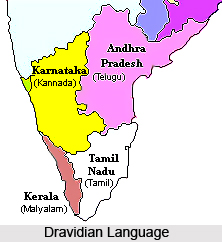
 The Dravidian languages comprise of around 73 languages and are mainly the main languages of the people of southern India and parts of eastern and central India including Afghanistan, Bangladesh, Pakistan, Nepal, Iran, northeastern Sri Lanka and some other parts of abroad. Among the Dravidian languages, most of the speakers are of Tamil, Kannada, Telugu and Malayalam languages. As per the history, it has been evidenced that Dravidian languages are extant since the 6th century BC though the origins of this languages, the period of their differentiation and their subsequent development are still obscure. The Dravidian languages comprise of around 73 languages and are mainly the main languages of the people of southern India and parts of eastern and central India including Afghanistan, Bangladesh, Pakistan, Nepal, Iran, northeastern Sri Lanka and some other parts of abroad. Among the Dravidian languages, most of the speakers are of Tamil, Kannada, Telugu and Malayalam languages. As per the history, it has been evidenced that Dravidian languages are extant since the 6th century BC though the origins of this languages, the period of their differentiation and their subsequent development are still obscure.
The earliest Dravidian language to be developed for literary purposes was Tamil, in which there is an extensive corpus of lyric poetry dating to the early centuries of the Christian era. The reason for this priority was the fact that the Tamil country was the furthest removed from the centre of Aryan expansion, and the develop¬ment of the native language was not inhibited by the competition of Sanskrit language or Prakrit language. From this period onwards there is a continuous and extensive literature in Tamil, and three language periods, Old, Middle, and Modern Tamil, are distinguished. The Middle Tamil period begins with the lyrics of the Shaiva 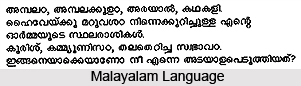 and Vaishnava religious teachers who flourished under the Pallavas, and con¬tinued until late medieval times. The modern period of the language begins, as elsewhere, round about 1800 A.D., when the influence of English and European models began to be felt. Although considerably modernised, the written Tamil language differs considerably from the spoken language, which has evolved a good deal further. A movement to bring it more in line with the spoken language has not, however, made much progress, since the latter is divided into various kinds according to both locality and class. and Vaishnava religious teachers who flourished under the Pallavas, and con¬tinued until late medieval times. The modern period of the language begins, as elsewhere, round about 1800 A.D., when the influence of English and European models began to be felt. Although considerably modernised, the written Tamil language differs considerably from the spoken language, which has evolved a good deal further. A movement to bring it more in line with the spoken language has not, however, made much progress, since the latter is divided into various kinds according to both locality and class.
The Tamil language was less influenced by Sanskrit than the other three Dravidian languages, and the number of Sanskrit and other Indo-Aryan loan¬words in it is considerably smaller. At the Old Tamil stage they are very few indeed, and there was perhaps a deliberate attempt to avoid them. The Sanskrit influence is a good deal more extensive in the writings of the Shaiva and Vaishnava saints, and greater still in some later works, but it never attained the same degree as it did in Malayalam, Kannada, and Telugu. Recently there has been a movement to purify the Tamil language of extran¬eous elements, but in view of the continual need for fresh technical vocabulary this is hardly likely to be completely effective. 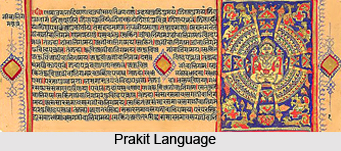 The Malayalam language existed in the early period only as a dialect of Tamil, and it was not until about A.D. 1000 that it achieved the status of an independent language. It has its own alphabet with the full complement of Sanskrit letters (unlike Tamil, which manages with far fewer), and it makes liberal use of Sanskrit loan-words. A very highly Sanskritized style was at one time current under the name of Mani-pravala. Its literary development in modern times has been considerable.
The literary development of Kannada and Telugu was inhibited at first by the fact that these territories were under the dominion of the Andhra Empire, whose administrative language was Prakrit. In this respect they were followed by their immediate successors. It is not until about A.D. 500 that one witnesses the commencement of the use of the native languages. The history of the Dravidian language estimates that Kannada inscriptions begin to occur about A.D. 450, and Telugu inscriptions from about A.D. 650. The earliest Kannada literary text dates from the latter part of the ninth century, but the names of a number of earlier works are known. There is a considerable body of work from the tenth century, mainly the work of Jainas. All this is written in Old Kannada, which gave place later to Middle Kannada, which was itself, by a continuing process of evolution, replaced by Modern Kannada. In the case of Kannada 
there is no marked difference between the spoken and written language, such as was noted in the case of Tamil. Literary Telugu begins about the end of the first millennium with Nannaya’s translation of the Mahabharata. This is followed during the succeeding centuries by a considerable number of works based mainly on Sanskrit originals, as elsewhere, mainly in verse. The Vijayanagara Empire coincided with the most flourishing period of classical Telugu literature. The develop¬ment of the modern language and literature followed the usual lines, and, as in Tamil, there was during most of the modern period a considerable difference between the spoken and written languages. Since about 1940, however, there has been a strong movement to bring the written language more into line with the spoken, and, by and large, this movement has been successful. |
| |||



Dravidian Language
| Dravidian Languages are mainly spoken by the people of southern India and parts of eastern and central India. |
| ||||||||||||||||||||||||||||

