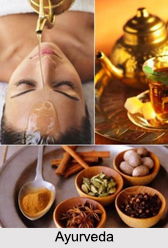
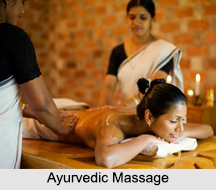
 Ayurvedic Massage is the key to good health and is necessary both for prevention and cure of diseases. Also known as "Abhyanga", Ayurvedic massage is a type of passive exercise. Abhyanga is done before the morning shower or bath and is one of the commonest practices of Ayurveda. Ayurvedic massage is an important part of daily life in India. It is a traditional technique used for balancing body and mind.
Origin of Ayurvedic Massage
The origin of Ayurvedic massage dates back to 3,000 years and is used to promote the importance of health and well-being to all generations within the family, especially to the younger members.
Ayurvedic Massage in Panchakarma
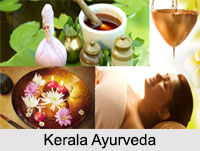
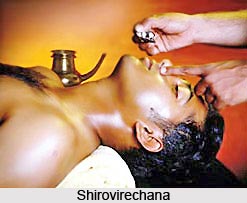
An Ayurvedic massage is the part of the traditional detoxification and rejuvenation program of India called Panchakarma, in which the entire body is energetically massaged with large amounts of warm oil and herbs to remove toxins from the system. Oil is also poured into the ears, between the eyebrows and at specific chakras, or energy points, during techniques known respectively as Karna Purana, Shirodhara and Marma Chikitsa. These treatments have been powerful in their effects upon the mind and nervous system by calming, balancing, bringing a heightened sense of awareness and deep inner peace.
Techniques of Ayurvedic Massage
 The techniques of Ayurvedic Massage can be done either as stand-alone treatments or in conjunction with other Ayurvedic treatments. In Samhita, which stands as one of the most ancient and most reliable Ayurvedic texts the technique of Abhyanga or Ayurvedic message is mentioned. Ayurvedic massage or the Abhyanga incorporates the usage of warm oils and herbs along with stimulating the specific energy points to help restoring balance to the body. Massage strokes, oils and herbs are selected based on individual"s need.
Benefits of Ayurvedic Massage
Abhyanga, the Ayurvedic message is an easy method that can be incorporated in one"s daily routine without much complication. It has many positive effects and therefore none wants to miss its beneficiary sides. It is especially good for weak people, who are unable to exercise. Abhyanga makes one strong and smooth skinned and helps to fight against the exhaustion and exertion.
Ayurvedic Oil Massage
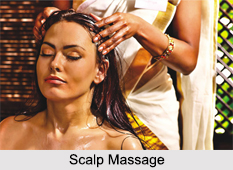
Application and messaging warm oil regularly on head which is a part of Abhyanga prevents headache, baldness and greying of hair. The person who regularly performs oil-massage has his sense organs working properly. It also brightens the skin of face and the body. It is said that regular oil message on head maintains the muscle, tissues and joints properly and this lubrication increase their flexibility. Application of oil on head causes sound sleep and great happiness.
Methods of Ayurvedic Massage
Abhyanga or the Ayurvedic message can be performed in both standing and sitting postures. The method of Ayurvedic Massage is as follows:
•The oil should be slightly warmer than body temperature.
•One has to start from massaging the head. Small amount of oil is vigorously messaged in the scalp. The open palms of the hand and the flat surfaces of the fingers should be used for the scalp massage rather than the tips of fingers. The strokes for the scalp massage should be circular, describing small circles over the total area of the head.
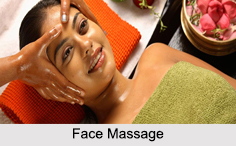
•After the head massage, face message and messaging the outer part of earlobes using the fingertips is done. Ear massaging is also thought to influence the whole body, so it should have some extra time. But ear massaging should not be done vigorously.
•Now smear oil on the rest of the body. The front and back of the neck and the upper part of the back is to be messaged by using open palm and the surface of the fingers but certainly not by the fingertips.
•The next step is to massage the arms vigorously. For joints circular motion is recommended and for the long bones straight motion message therapy is used.
•Then Abhyanga is performed in chest and stomach. One should be careful about being not too vigorous in these parts. A gentle vertical motion over the breastbones and solar plexus and circular motion over the pectoral areas are used. The massage over the abdomen should follow a clockwise movement.
•The backside and the spine should be massaged vigorously.
•Massaging the legs should be with the same force as it was applied on arms.
•The soles of the feet also have energy points that are connected with the rest of the body, so extra time and attention is to be given while massaging the soles of the feet. The palm or the flat surfaces of the fingers are to be used for messaging this part of the body.
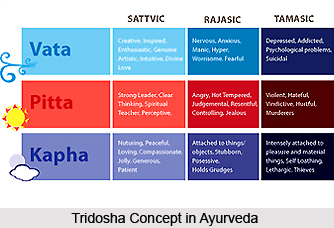
The ideal time length for Ayurvedic massage should be 10 to 20 minutes, but even only 2 to 3 minutes is also beneficial on a regular basis. If someone has cold or flu or indigestion problem, Abhyanga should be avoided. After the Ayurvedic massage a shower or bath should be taken. The basis for effectively performing all of the various Ayurvedic massage techniques is a thorough understanding of the primordial energies of the five elements (space, air, fire, water and earth) and of Vata, Pitta, and Kapha - the three basic constitutional types. This knowledge allows the therapist to determine not only which Ayurvedic massage techniques to use, but also how to customize treatments by selecting proper oils, herbs, rate and pressure of massage strokes to maximize the benefits for each patient.