


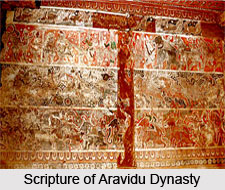
 Aravidu dynasty , the fourth and last to hold sway over the Vijayanagara Empire, is often not counted as a ruling dynasty of that empire, for reasons delineated below. Rama Raya patronised the Sanskrit scholar Rama Amatya. Aliya" Rama Raya and his brother Aliya Tirumala Raya were sons-in-law of the great Vijayanagara emperor Krishna Deva Raya. The word "Aliya" means "son-in-law" in the Kannada language. Along with another brother Venkatadri, the Aravidu brothers rose to prominence during the rule of Krishnadevaraya. Aravidu dynasty , the fourth and last to hold sway over the Vijayanagara Empire, is often not counted as a ruling dynasty of that empire, for reasons delineated below. Rama Raya patronised the Sanskrit scholar Rama Amatya. Aliya" Rama Raya and his brother Aliya Tirumala Raya were sons-in-law of the great Vijayanagara emperor Krishna Deva Raya. The word "Aliya" means "son-in-law" in the Kannada language. Along with another brother Venkatadri, the Aravidu brothers rose to prominence during the rule of Krishnadevaraya.
Rama Raya was a successful army general, able administerator and tactful diplomat who conducted many victorious campaigns during the rule of Krishnadevaraya. After the demise of his illustrious father-in-law, Rama Raya, as a member of the family, began to wield great influence over the affairs of the state. Krishna Deva Raya was succeeded in 1529 by his younger brother Achyuta Raya, upon whose demise in 1542, the throne devolved upon his nephew Sadashiva Raya, then a minor. Rama Raya appointed himself regent during the minority of Sadashiva Raya. After Sadashiva Raya came of age to rule, Rama Raya kept him a virtual prisoner. During this time he turned into a virtual ruler having confined Sadashiva Raya. Rama Raya removed many loyal servants of the kingdom and replaced them with officers who were loyal to him. He also appointed two Muslim commanders, the Gilani brothers who were earlier in the service of the Sultan Adil Shah as commanders in his army, a mistake that would cost the empire the final Battle of Talikota. Sultanate Affairs: During his reign, the Deccan Sultanates were continually occupied in internal conflicts and requested Rama Raya on more than one occasion to act as a mediator, enabling Rama Raya to push north of Krishna River and expand his domains utilizing the disunity of the Deccan Sultans. He also suppressed revolts of the chieftens of Travancore and Chandragiri. Some scholars have criticised Rama Raya for interfering in the affairs of the Sultans too much, but scholars like Dr. P.B. Desai have ably defended his political affairs indicating that Rama Raya did whatever he could to increase the prestige and importance of the Vijayanagar empire, ensuring no single Sultanate would rise above the others in power hence preventing a difficult situation for Vijayanagar empire. In fact Rama Raya had interfered in Sultanate affairs only upon the insistence of one Sultan or the other, just the way the Sultans had acted as parelys between Rama Raya and Achyuta Raya in earlier years. When the Nizam of Ahmednagar and Qutbshah of Golconda sought Rama Raya's help against Bijapur, Rama Raya secured the Raichur doab for his benefactors. Later in 1549 when the Adilshah of Bijapur and Baridshah of Bidar declared war on Nizamshah of Ahmednagar, Ramaraya fought on behalf of the Ahamednagar ruler and secured the fort of Kalyana. In 1557 Ramaraya allied himself with Ali Adilshah of Bijapur and Baridshah of Bidar when the Sultan of Bijapur invaded Ahmednagar. The combined armies of the three kingdoms defeated the partnership between Nizamshah of Ahmednagar and the Qutbshah of Golconda. This situation of Vijayanagar ruler constantly changing sides to improve its own position made the Sultanates form an alliance. Intermarraige between Sultanate families helped solve internal differences between Muslim rulers. This consolidation of Muslim power in the northern Deccan resulted eventually in the Battle of Talikota. Battle of Talikota: Rama Raya continued to be devoted to the legitimate dynasty until finally extinguished by war. In 1565, it was Rama Raya, as the finest general of the Vijayanagar army, who led the defense against the invading army of Deccan Sultans (i.e. Husain Nizam Shah, Ali Adil Shah and Ibrahim Qutb Shah) in the battle of Talikota. This battle which seemed an easy triumph for the large Vijayanagar army was a disaster following the revelation capture and death of Aliya Rama Raya who led the forces, a blow from which it never recovered. The city of Vijayanagara was thoroughly sacked by the invaders and the inhabitants were massacred. The royal family was largely exterminated. Vijayanagara, once a city of fabled splendour, the seat of a vast empire, became a desolate ruin, now known by the name of a hallowed inner suburb within it, Hampi. |
| |||



Home > Reference > History of India > History of South India > Aravidu Dynasty > Ruler of Aravidu Dynasty
Ruler of Aravidu Dynasty
| Rama Raya was a successful army general, able administerator and tactful diplomat of Aravidu Dynasty. |
| ||||||||||||||||||||||||||||

