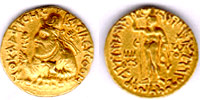
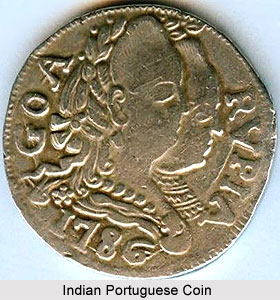
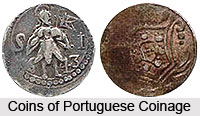
 The other foreign influence still in India at the end of the nineteenth century was Portuguese. A number of enclaves on India`s west coast were once under Portuguese control, but the power of the Portuguese in these areas was greatly reduced once the British and Dutch traders began to "take over" in the early seventeenth century. Eventually Portuguese control was reduced to just three small enclaves - Goa, Damao and Diu. Hundreds of years of Portuguese control did not come to an end with independence in 1947, but much later on in 1962, with the forced annexation by India of these enclaves. There are only a limited number of twentieth century coins for Portuguese India, especially since for most types there are only two different dates. The Portuguese India coins did change to a decimal system around the time that the Republic did - undoubtedly this allowed it to align with the other "Escudos-based" system in other Portuguese colonies (Angola, Mozambique etc.) as well as in Portugal.
The Portuguese Indian Rupiya was the currency of Portuguese India until 1958. Before 1871, it was subdivided into 10 tangas, each of 60 réis. After 1871, 16 tangas (still of 60 réis) equaled 1 rupia. In 1958, the currency was replaced by the escudo at the rate of 1 rupia = 6 escudos. This was the currency till 1961. It was divisible into 100 centavos. After Portuguese India was annexed by the Republic of India in 1961, this currency was replaced by the Indian rupee.