


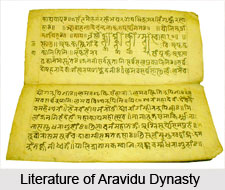
 During the reign of the Vijayanagar Empire, poets, scholars and philosophers inscribed in Sanskrit and the regional languages, Kannada, Telugu and Tamil and enclosed such subjects as religion, biography, Prabhanda (fiction), music, grammar, poetry and medicine. The Telugu language became a popular literary medium, reaching its peak under the patronage of Krishnadevaraya. During the reign of the Vijayanagar Empire, poets, scholars and philosophers inscribed in Sanskrit and the regional languages, Kannada, Telugu and Tamil and enclosed such subjects as religion, biography, Prabhanda (fiction), music, grammar, poetry and medicine. The Telugu language became a popular literary medium, reaching its peak under the patronage of Krishnadevaraya.
Most Sanskrit works were commentaries either on the Vedas or on the Ramayana and Mahabharata epics, printed by well known figures such as Sayana and Vidyaranya that extolled the superiority of the Advaita philosophy over other rival Hindu philosophies. Other writers were famous Dvaita saints of the Udupi order such as Jayatirtha (earning the title Tikacharya for his polemicial writings), Vyasatirtha who wrote rebuttals to the Advaita philosophy and of the conclusions of earlier logicians, and Vadirajatirtha and Sripadaraya both of whom criticised the beliefs of Adi Sankara. Apart from these saints, noted Sanskrit scholars adorned the courts of the Vijayanagara kings and their feudatory chiefdoms. Numerous kings of the dynasty were themselves litterateurs and authored classics such as King Krishnadevaraya's Jambavati Kalyana, a poetic and dramatically skillful work. The era's Kannada poets and scholars shaped significant writings supporting the Vaishnava Bhakti movement heralded by the Haridasas (devotees of Vishnu), Brahminical and Virashaiva (Lingayatism) literature. The Haridasa poets celebrated their devotion through songs called Devaranama (lyrical poems) in the ragale metre. Their inspirations were the teachings of Madhvacharya and Vyasatirtha. Purandaradasa and Kanakadasa are considered the foremost among many Dasas (devotees) by virtue of their immense contribution. Kumara Vyasa, the most prominent of Brahmin scholars wrote Gudugina Bharata, a translation of the epic Mahabharata. This work marks a transition of Kannada literature from old Kannada to modern Kannada. Chamarasa was a famous Virashaiva scholar and poet who had many debates with Vaishnava scholars in the court of Devaraya II. His Prabhulinga Lile, later deciphered into Telugu and Tamil, was a eulogy of Saint Allama Prabhu (the saint was considered an incarnation of Lord Ganapathi while Parvathi took the form of a princess of Banavasi). At this peak of Telugu literature, the most famous writing in the Prabhanda style was Manucharitamu. King Krishnadevaraya was an accomplished Telugu scholar and wrote the celebrated Amuktamalyada. In his court were the eight famous scholars regarded as the pillars (Astadiggajas) of the literary assembly, the most famous being Allasani Peddana honoured with the title Andhrakavitapitamaha (father of Telugu poetry) and Tenali Ramakrishna, Krishnadevaraya's court jester who authored several acclaimed works. This was the age of Srinatha, the utmost of all Telugu poets in legend, who wrote books like Marutratcharitamu and Salivahana-sapta-sati. King Devaraya II patronized him and his stature was equivalent to the most significant ministers in the court. Though a great deal of the Tamil literature from this period came from Tamil speaking regions ruled by the feudatory Pandya who gave particular attention on the cultivation of Tamil literature, some poets were patronised by the Vijayanagara kings. Svarupananda Desikar wrote an anthology of 2824 verses, Sivaprakasap-perundirattu, on the Advaita philosophy. His pupil the ascetic, Tattuvarayar, wrote a shorter anthology, Kurundirattu, that contained about half the number of verses. Krishnadevaraya patronised the Tamil Vaishnava poet Haridasa whose Irusamaya Vilakkam was an exposition of the two Hindu systems, Vaishnava and Shaiva, with a preference for the former. Notable amid secular writings on music and medicine were Vidyaranya's Sangitsara, Praudha Raya's Ratiratnapradipika, Sayana's Ayurveda Sudhanidhi and Lakshmana Pandita's Vaidyarajavallabham. |
| |||



Home > Reference > History of India > History of South India > Aravidu Dynasty > Literature of Aravidu Dynasty
Literature of Aravidu Dynasty
| Sanskrit and Telugu were the popular literary medium of communication during Aravidu dynasty. |
| ||||||||||||||||||||||||||||

