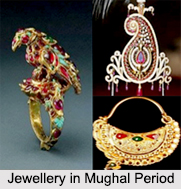
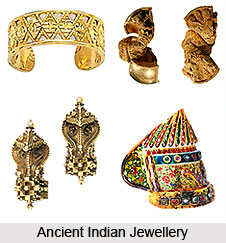
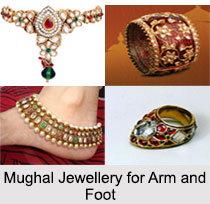
 Mughal Jewellery for Arm and Foot like Armlets, Rings and Anklets are the symbolisation of Rajputana art and art work with Holy Quran.
Armlets in Mughal Period
The armlet is an enamelled gold set with an emerald, yellow beryl`s (heliodor), pale emeralds and seed pearls made in Mughal India during the second half of the 18th century. This armlet would have been tied on to the upper arm.
Another armlet incorporates poppy motifs, which have exact parallels on the Watson turban ornament, with a powder-blue enclosing border found frequently on 19th century jewellery. However, the broad swathes of red enamel on the petals of the large flowers framing the oval panel of the armlet and the 4 curling leaf sprays surrounding the 6 petalled flower at the centre are both characteristic 18th century decorative features of Mughal jewellery.
The enamelled gold, each set with foiled rock crystals, a spinel, coral, pearl and zircon during Mughal India in the 18th century. These are set with coloured stones imitating the auspicious Navratna setting.
This armlet is an enamelled gold Nathdvara made in the 19th century. Most of the pilgrims visiting to the shrine of Shrinathji were seen wearing this armlet. On one side of the central plaque the name of Shrinathji is reserved in gold against a red quatrefoil, surrounded by red flowers and green leaves on a white ground. To left and right, peacocks perch on a flowering tree. On the reverse, the Vishnupada, or feet of Lord Vishnu, are shown within a circle on a blue ground representing the primordial waters. The 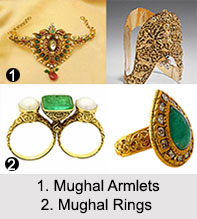 peacocks are repeated on this side.
Another armlet is an enamelled gold set with diamonds and this armlet was acquired from London"s Great Exhibition of 1851 as an example of "modern" work from Dholpur. It is enamelled on the inside with lovebirds, parrots and flowers on a translucent red ground, which must have enchanted the careful observer at the exhibition. Though the traditional Mughal red, green and white predominates, there are unusual touches of opaque pale turquoise and yellow.
Bazubandhs in Mughal Period
These Bazubandhs are gold enamelled with translucent green and pale opaque turquoise and set with nine stones (Navratna) and diamonds. These armlets were acquired by the Indian Museum in 1855. They would have been worn on the upper arm and are each set with the auspicious Navratna. The stones used here vary slightly on each armlet and include moonstone, pearl, ruby, turquoise, coral, aquamarine, diamond, orange sapphire, white sapphire and hessonite. One has 9 rubies at its centre; the other has a diamond surrounded by what are probably white sapphires.
Bracelets in Mughal Period
 This bracelet is also an enamelled gold set with diamonds, in 3 hinged sections; it is enamelled on the outside with the translucent royal blue popular in contemporary Victorian England. It came from the Great Exhibition and was also described as modern work from Dholpur. The inside is enamelled with a scroll of red flowers and green leaves on a white ground, red and green parrots and pigeons pecking the leaves with translucent yellow or green beaks. A narrow band of opaque powder blue divides the front and back surfaces.
Rings in Mughal Period
The thumb ring is an engraved gold set with rubies and emeralds, enamelled in opaque colours on the inside and it is unequivocally a courtly piece. In shape and material, it relates closely to the thumb ring worn by Shah Jahan in the portrait of 1620 in the Metropolitan Museum of Art. In technique and quality, it is part of a small group of objects, which date from the late 16th century to the mid 18th century. The colours and design of the enamel on the inside of the ring show an awareness of European Renaissance jewellery, the result either of European craftsmen at court, or of European jewels brought to the court for presentation to the emperor. The palette now seems to be extremely unusual, with its opaque pastels and black. This ring is an enamelled gold set with diamonds. Robert Phillips later copied the enamelled floral design on the inside of the ring for a necklace he exhibited at the 1867 Paris exhibition. This seal ring is a chased gold set with an inscribed emerald Ring. It may therefore have been a seal used for marking a nowruz gift, or have been a gift made to mark an important event (such as a birth), which took place at nowruz. The stone, which is step-cut at the back and probably Colombian, is in a rather incongruous setting: enclosing the open rectangular bezel are two applied cobras, their bodies encircling the hoop.
Anklets in Mughal Period
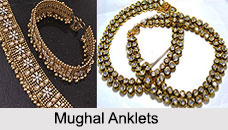
This anklet is engraved on gold rosettes, set alternately with diamonds or lidded and set with precious or semi-precious stones. This was acquired from exhibition as an anklet; despite the usual restrictions on wearing gold on the feet the diameter would be too great for a conventional armlet. Each alternate rosette is lidded and foiled in a colour, which matches its stone. The stones, beginning with the pearl and moving clockwise, are: blue sapphire, ruby, diamond, emerald, yellow sapphire, spinel, hessonite garnet, turquoise and coral.
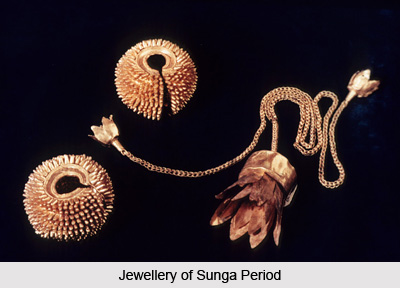
These pair of anklets are made from gold with applied lozenges and stamped spheres imitating granulation. The imitation granulation was done by stamping sheet gold onto a shaped depression in a jeweller"s mould.