 Holi celebration in India states has a regional influence of their rituals and traditions. The festival of Holi is celebrated with great fervour mostly in Bihar, Uttar Pradesh, West Bengal, Orissa, Northeast India, Himachal Pradesh, Punjab, Rajasthan, Maharashtra, Gujarat, Goa and Tamil Nadu. The celebration of the festival of Holi has been attributed to various legends. Holi is also known by various names in different parts of India. Holi is known by various names like Lathmaar Holi, Dulandi Holi, Rangpanchami, Basant Utsav, Dol Purnima, Hola Mohalla, Shimgo, Kaman Pandigai and Phagu Purnima.
Holi in Bihar
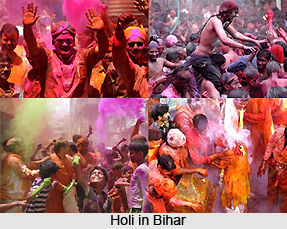
In Bihar people clean their houses a week before Holi and start collecting twigs, unnecessary furniture, chopped wood of araad, redi and holika tree and pile it up at some place for lighting the Holi. On the first day of Holi, thalis of colour and a pot of liquid colour are arranged. The elder member of the family applies some colour on the forehead of each member in the family. Each family member repeats the same. Youngsters apply colours to the feet of their elders. People gather together for the Holika fire. At some places mud baths are prepared. High-pitched folk songs, use of dholaks along with drinking of bhang are seen during Holi.
Holi in Uttar Pradesh
In Uttar Pradesh effigies of Holika are burnt. On the night of Holi (Phalgun Poornima) it is lit with the chanting of Raksogna Mantras from Rig-Veda and so on. People offer prayer to the fire and pray for a good harvest. This day is also called as Puno. They offer gram and stalks from the harvest along with coconuts and flowers to render gratitude. It is believed that Holi is named after fried cereals or parched grains called, as Holla in Sanskrit. It is also a tradition to offer wheat and oat. Scorched coconuts are taken home as Prasad.
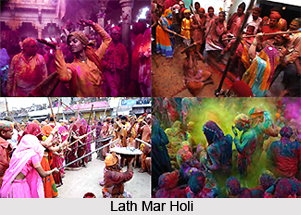 Latthmar Holi is another name of Holi as is called in Braj. It`s a two-week long festival enjoyed with Hori and Raslila. The preparations start a week before than the rest of India. It is really a severe form of Holi played in honour of Radha and Lord Krishna. The men-folk of Nandgaon go to Barsana to tease and play Holi with the women-folk. They also have to pull up their flag at the famous Shri Radhikaji temple. The women strike back with long sticks and men have to save themselves; hence the name Latthmar. They have to make way to the temple to hoist their flag. They are well padded and are trained not to retaliate. They shouldn`t get caught at the hands of women. The ones who are caught are made to wear women`s attire and make-up and made to dance.
The next day, it is the turn of men of Barsana. They visit Nandgaon showering colours of reds. These are natural colours made from flowers of Kesudo. They are similarly beaten up by the women-folk of Nandgaon. It is also celebrated in Vrindavan, Gokul, Nandgaon, Barsana. At Dauji in Nandgaon, people beat men with whips made from old clothes. It starts from Shukla Chaturdadhi of Phalgun.
Holi in Bengal
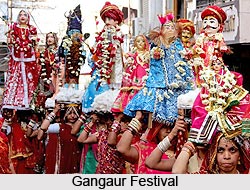
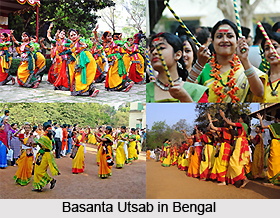
In Bengal, Holi is known as Dol Jatra or Dol Purnima. Here, people put on yellow clothes and attend Jatra, which is a peaceful ceremony. It is celebrated as the birthday of Mahaprabhu Chaitanya. People decorate the idol of Lord Krishna and Radha and carry it on the streets in a beautifully decorated palanquin.
Holi in Orissa
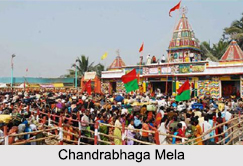
People of Orissa also celebrate Holi by worshipping God Jagannath and visit the Puri temple in Orissa on this day. Idol of Lord Jagannath is placed in the decorated palanquin and a procession is taken out in the main streets. Gwalas carry the palanquin on their shoulders as Krishna belonged to their clan. They play games such as Dandi Khela and they set up special tents, Jhoolan mandap, to place the idol of Lord Jagannath at night.
Holi in Northeast India
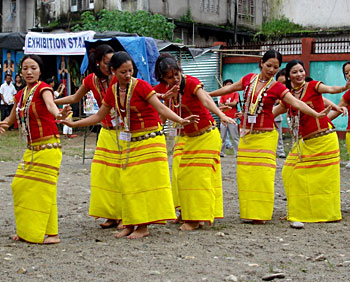
Initiated in the 18th century with Vaishnavism, Holi is celebrated for six days in Manipur. An amalgamation of Holi and another very old festival called Yaosang is observed, when Holi is played here. A thatched hut of mud and clay is burnt, in the evening. In Manipur, boys have to pay the girls to play Holi with them. Dances, devotional songs, cultural programmes are organized at temples. Devotees gather in white dresses and yellow turbans and play with colours in front of the temple. Large procession is taken to the Krishna temple near Imphal on the last day.
 The other tribes of Northwest India have their own ways celebrating this spring festival. They light fire on the eve of Holi and these tribes worship the goddess. They have preserved some of the Hindu customs. Tribesmen offer kesudo and mango spring flowers and grains to the Holika. The young men and women are able to make contacts, which further give way to marriages.
Holi in Himachal Pradesh
In Himachal Pradesh thousands of people gather at Ponta-Sahib, a holy shrine in the Sirmour district on the banks of Yamuna River. People here are more enthusiastic about playing colours. Fascinating Ice Holi is played in Kullu. People gather at the Slang Pass and make colourful snowballs by mixing colour and snow.
Holi in Punjab
Hola Mohalla is an annual festival in Punjab`s Sikh community and was started by Guru Gobind Singh. It is fair starting on second day of Holi at Anantapur Sahib in Punjab. It is a three-day festival and it incorporates events such as standing on two running horses, bareback horse riding, mock fights and tent pegging. Kirtan and religious lectures are also arranged in durbars in the presence of Sri Guru Granth Sahib. On the last day a procession is led by Panj Pyaras from Takht Keshgarh Sahib. This procession passes through several important Gurudwaras like Qila Anadgarh, Lohgarh Sahib, Mata Jitoji and terminates at the Takht. For people visiting Anandpur Sahib, langars are organized as a part of sewa.
Holi in Gujarat
The colourful Holi in Gujarat is also significant for tribals of Garasia and Bhil Adivasis. They get together at Darbargarh and also arrange fairs at Chhota Udaipur and the Rajpipla hills. Dangs Darbar, Satpura and north Gujarat are full of fairs even after Holi. Holi in Gujarat is also known as Hulosani. They light Holika with the fire brought from the temple of Mata. People offer, raw mangoes, coconut, corn, toys made of sugar, khoya to the Holika. The ash from the pyre of Holika is used in the preparation of idols of goddess Amba. Young women wishing for a handsome groom decorate these idols with flowers.
Holi in Maharashtra
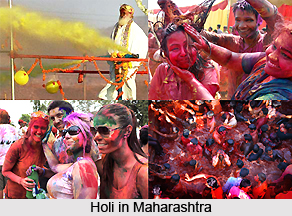
A colourful Holi in Maharashtra is known as Shimgo. It is significant in fisherman community. The folksongs, folk dances, colours are the essence of Holi here. People let out their repressed feelings through this dance. People also make an unusual sound by striking their mouth with the back of their hands. Puranpoli is a sweet exclusively prepared in Maharashtra. People drink sugarcane juice and eat watermelon juice. Rowdiness during Holi is observed in many parts of Maharashtra. It was on this day that Jijabai, splashed coloured water on young Shahaji, since their engagement was announced that day.
 In Goa a procession is carried which plays religious and mythological stories. Here too, Holi is called Shigmotsav, Shigmo. People of Goa perform Naman from the 9th moon day to the full-moon day and avoid non-vegetarian food and alcohol. From the 11th day of Holi, people decorate their doorframes with torans. Some village` groups wear most colourful dresses and gather at the village temples at the beat of drums and the sound of flutes. They dance and sing in the temple courtyards. The 5th day is the day of fun and is called Rangpanchami. Celebrations are different at various places. Usually gulal and neel is used.
Holi in South India
In South India Holi is known as Kaman Pandigai, Kamavilas, Kama-dahanam. It is generally celebrated to honour Kama Dev. People offer sandalwood mixed with a beer to Holika. Such an act is performed traditionally to honour Kama Deva`s sacrifice and as an act to relieve Kam Dev of his burns. The next day people apply this mixture to their forehead and eat it after mixing it with young leaves and flowers of Mango tree. In Tamil Nadu, songs sung here are stories of grief at the loss of Kama Deva.