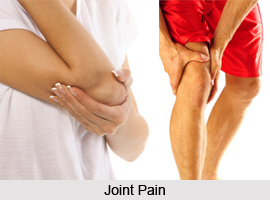
 Joint Pain is one of the most common problems faced by almost every person of the world. The usual treatment used is the allopathic NSAID`s and certain painkillers besides some rare cases where the surgery is needed.
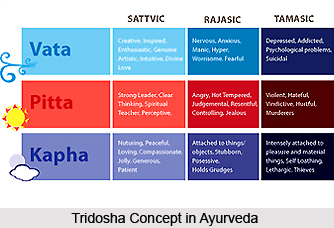
Since ancient time, Ayurveda has solutions for all the joint pains. According to Ayurveda, the joint pains are supposed to originate from Vata doshas. The elements of vata dosha are cool, rough, subtle and movable. All the diseases involved in joint pains are usually involved with Vata dosha. So, whenever there is a joint pain Ayurveda starts the treatment as in vata dosha.
The common places for joint pain in human body are back, shoulder and knee. The back pain is associated with pain in vertebral column. The joint pain sometimes involves inflammation (swelling) and red discoloration. This redness and swelling also proves the presence of Kapha dosha at the site.
Massaging in joint pain is hazardous as it is not very safe to massage the affected area without completely knowing about it because the massage has many contradictions in it. Usually in case of swelling, oil massage is avoided, as Ayurveda believes that kapha dosha is aggravated on the application of oil and ultimately worsens the disease condition.
When only Vata dosha is involved in the joint pain i.e. the pain without swelling or discoloration, then the oil massage is very useful. However, it is always recommended to consult the ayurvedic physician before applying any kind of oil or lotion.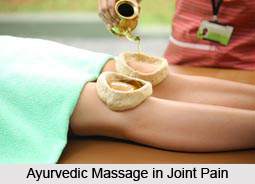
Oils that are applied while Massaging Joint Pains are:
•Dhanwantaram tailam (special ayurvedic preparation)
•Kottumchukadi tailam (special ayurvedic preparation)
•Eranda tailam (castor oil)
•Tila tailam (sesame oil)
•Ashwagandha tailam (withania somnifera oil)
Procedure of Ayurvedic Massage in Joint Pain
First, one has to make sure that there is no swelling or redness in the affected area as it could be harmful to massage if there is any redness or swelling. The area is washed properly and then cleaned. There should not be any dust particle as it might block the route of oil in the skin. It is always recommended to have the testing done first. Apply the oil somewhere in the body preferably with the back of the palm and wait for at least half an hour to confirm that there is no reaction due to oil or lotion application.
Then the oil is heated and the temperature is maintained at slightly warmer than body temperature. For the massage in the knee the best procedure is to sit in the chair peacefully. The oil massage is done with the circular movement first and then in the reverse movement. This is done for minimum fifteen to twenty minutes. During this massage if any kind of discomfort is felt, the massaging should be stopped and the doctors must be consulted immediately. After the oil application, it should be kept for two hours and then wiped off with warm water. For the final touch, smooth cotton cloth is used. At the knee area steam bath is applied traditionally with different herbs and this is applied with special techniques to enhance the effectiveness of the massage.
For the back massage, one masseur is needed. The ideal method for this massage is outward stroke from the centre of the vertebral column. This massage can be continued throughout the back. At the lower portion of the back, both hands should be used for massaging the lumber region. The massaging should be done with semi circular movement and it should be continued to the point where buttock starts getting separated. Hands should pass the sacro-iliac dimples that come in the way. If the shoulder gives the trouble then the shoulder grid should be massaged. The method involves using both the hand to grasp the whole shoulder and then lifting it and releasing it for several times. The massaging is done in the same fashion as is done for the knee. Massaging is performed in circular movement over the shoulder and it is continued up to the biceps on both the sides.