Introduction
 Padma Purana is one of the major Puranas among the eighteen Mahapuranas and an ancient Hindu religious text. There are five parts in this Purana. The first part of this Purana deals with sage Pulastya`s (one of the seven Prajapatis or mind born son of Lord Brahma) explanation about religion and the essence of religion to Bhishma. `Prithvi` or the earth is described vividly in the second part of the Padma Purana. The third part, on the other hand, describes the `cosmos` and India (Bharat Mata). The life and deeds of Lord Rama are described in the fourth part of the Purana. The fifth part is written in the style of a conversation between Lord Shiva and his spouse, Parvati, and deals with the indispensable knowledge about religion.
Origin of Padma Purana
It is quite impossible to say anything definite as to the date of the Padma-Purana, It is rather loose compilations parts of which belongs to totally different periods and are probably many centuries apart. The common characteristic of the five or six books is merely their rigidly sectarian character, for all of them inculcate the cult of Lord Vishnu. Moreover, all these books contain references to fairly modern aspects of the Vishnu cult, such as the adoration of Radha as a goddess, the sanctity of the Salagrama stone, of the Tulsi plant, and the like. The latest portions are certainly later than the Bhagavata Purana, which belongs to the latest works of Purana literature. Nevertheless there is sure to be an ancient nucleus at least in the Sristi, Bhumi, Swarga and Patala Khandas.
Khandas of Padma Purana
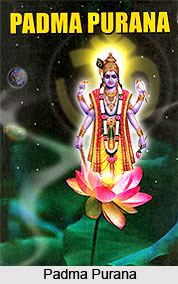 Khandas of Padma Purana are the five parts into which this ancient Indian text is divided. Khandas in Sanskrit means a partition, portion or part divided off from the whole. The following five Khandas are contained in the Padma Puranas- Book I, Srishti Khanda, i.e. section of the Creation; Book II, Bhumi Khanda i.e. section of the earth; Book III, Swarga Khanda, i.e. section of the heavens; Book IV, Patala Khanda, i.e. section of the nether world, and, Book V, Uttara Khanda, i.e. last section. A kind of appendix to the Uttara Khanda is formed by the Kriyayogasara, i.e. the essence of Yoga.
Srishti Khanda : Book I, Srishti Khanda, i.e. `section of the Creation,` commences with the usual introduction. Lomaharsana sends his son, the Suta Ugrasravas, to the Naimisa forest to recite the Puranas to the Rishis assembled there. At the request of Saunaka he tells them the Padma Purana, so-called after the lotus (Padma) in which the god Brahman appears at the creation. The Suta then reproduces the account of the creation as he has heard it from Brahman`s son Pulastya, The cosmological and cosmogonic myths are here too related similarly as in the other Puranas. But in this book, it is not Lord Vishnu who is assumed as the first cause, but the highest Brahman in the form of the personal god Brahman. Nevertheless, even this book is Vishnuite in character, and contains myths and legends for the glorification of the god Vishnu.
After the account of the Creation come the usual genealogies of the solar dynasty, into which a section about the Pitrs, the fathers of the human race and their cult by means of Sraddhas has been interwoven, and of the lunar dynasty down to the time of Lord Krishna. Myths are then told of the conflicts between gods and demons, followed by a chapter which is of interest from the point of view of the history of religion.
One of the principal parts of the book consists of the description of the lake Puskara (Pokher in Ajmer) sacred to Brahman, which is recommended and glorified as a place of pilgrimage. Numerous myths and legends, many of which occur in different connections in other Puranas, are told in praise of Puskara. Moreover various feasts and vows (vrata) in honour of the Goddess Durga are mentioned here.
Thereupon, the theme of the Creation is resumed. The book concludes with myths of Vishnu as the destroyer of demons, and the birth and marriage of Skanda.
Bhumi Khanda : Book II, Bhumi khanda i.e. section of the earth, begins with legends of Somasarman, who in a later rebirth became the famous Vishnu worshipper Prahlada. The aim of the legends is to explain why on the one hand he was born among the demons, and yet, on the other hand, was able to become so great a devotee of Vishnu. Besides a description of the earth, this book contains numerous legends which are intended to prove the sanctity of various Tirthas or holy places. Not only sacred places are regarded as Tirthas, but also persons, such as the teacher, the father, or the wife. As a proof of the fact that a wife can be a tirtha there is told, for instance, the story of Sukala, whose husband goes on a pilgrimage and leaves her behind in want and misery; the love-god Kama Deva and the king of gods, Indra, try in vain to seduce her: she remains faithful to her husband, and when he returns from the pilgrimage, he receives a divine reward on account of the virtues of his wife. Here, too, in order to prove that a son can be tirtha, the story of Yayati and his son Puru, already known from the Mahabharata, is told.
Swarga Khanda : Book III, Swarga Khanda, i.e. section of the heavens, gives a description of the various worlds of the gods, of the highest heaven of Vishnu, Vaikuntha, the worlds of the Bhutas, Pisacas, Gandharvas, Vidyadharas and Apsaras, the worlds of Lord Surya, Indra, Lord Agni, Lord Yama and so on, into which are woven numerous myths and legends. A mention of King Bharata gives rise to the narration of the story of Sakuntala, which is here not told as in the Mahabharata, but more in agreement with the drama of Kalidasa. A comparison of Kalidasa`s drama with the versions of the Mahabharata and of the Padma Purana shows that in all probability Kalidasa used the last-mentioned as a source. A description of the world of the Apsaras is the occasion for narrating the legend of Pururavas and Urvasi. Also numerous other legends, which are known from the epics, recur in this book. It further contains instructions upon the duties of the castes and of the Asramas, upon the modes of Vishnu-worship and much upon ritual and morality.
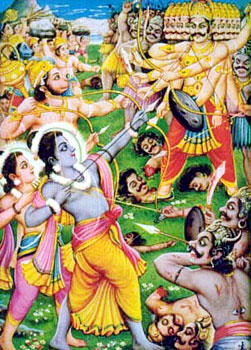
Patala Khanda : Book IV, Patala Khanda, i.e. section of the nether world, first describes the subterranean regions, in particular the dwellings of the Nagas or snake-deities. A mention of Ravana is the cause of the narration of the whole Rama-legend, which is here given partly in conformity with the Ramayana, but also often in literal agreement with Kalidasa`s epic Raghuvamsa. Here is also found the Rsyasrnga-legend in a version which is older than that in the Mahabharata. The actual Rama-legend is preceded by a story of the forefathers of Rama, beginning with Manu, the son of the sun-god, and his rescue from the flood.
The slaying of Havana, who was a Brahmin, has laid the guilt of the murder of a Brahmin on Rama. By way of expiation he arranges a horse-sacrifice. In accordance with the prescribed rules, the horse destined for the sacrifice is let loose to roam at will for the space of one year, accompanied by a host of warriors with Shatrughna at their head. The adventures of the steed and his followers on their wanderings over the whole of India take up a considerable portion of the book; many sacred places are described, and legends attached to them are told. At length the horse reaches Valmiki`s hermitage, which is an occasion for narrating that part of the Rama legend which concerns Sita. Detailed instruction on the eighteen Puranas then follows. Here it is said that Vyasa first proclaimed the Padma Purana, then sixteen others, and finally the Bhagavata Purana, which is glorified as the most sacred book of the Vishnu-worshippers. The book ends with a few chapters, probably added at a very late date, on Krishna and the cowherdesses, with mention of Radha, on the duties of Vishnu-worshippers, the sanctity of the Salagrama stone and other details of the Vishnu cult.
Uttarakhanda : Book V, Uttarakhanda, i.e. last section, is a very long book expounding the Vishnu cult and the feasts and ceremonies connected with it, in the most impressive manner. A large portion is devoted to the glorification of the month Magha, which is especially sacred to Vishnu. Numerous legends are related as evidence of the great merit of bathing during this month.
Another section glorifies the month Kartikeya, in which the giving away of lamps is especially meritorious. In order to give especial prominence to the Vishnuite standpoint, the author causes Lord Shiva himself, in a conversation with his wife Parvati, to declare the glory of Vishnu and to recite a long account of Vishnu`s avataras, which involves a repetition of the entire Rama-legend in summary and the Krishna-legend with a fair amount of detail. In answer to Parvati`s question about who the heretics are, it is Shiva himself who declares that the Shaivaite teachers and the adherents of the Shaivaite Pasupata sect are among the heretics. Shiva also explains what Vishnu-Bhakti is, and the various forms of the Vishnu cult.
This book also contains a glorification of the Bhagavad Gita, in fact there are legends to illustrate the merit of reading each single canto. One chapter contains the enumeration of the thousand names of Vishnu, in another Radha is identified with the great goddess Lakshmi, and the celebration of her birthday is described.
A kind of appendix to the Uttarakhanda is formed by the Kriyayogasara, i.e. the essence of Yoga by works, which teaches that Vishnu should be worshipped not by meditation (Dhyanayoga), but by pious acts, above all by pilgrimages to the Ganges and the celebration of the festivals dedicated to Vishnu. In evidence of the fact that the fulfilment of all possible desires can be attained by worshipping Vishnu on the bank of the Ganga River, many legends are told.
Characters of Padma Purana
 Padma Purana, an encyclopedic and voluminous text is one of the eighteen major Puranas, holding a significant place in Hinduism. It is named after the lotus in which creator god, Brahma appeared. This text is considered to contain 55,000 verses. Major sections of the text are based on Vishnu and sections are also significantly based on Shiva and Shakti. Fortunately, manuscripts of Padma Purana have survived and have made their way into the modern era in numerous versions giving an idea about its contents and characters. Given below are some of the Characters of Padma Purana.
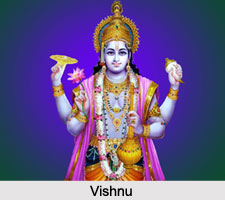
Vishnu : Vishnu, the Supreme Being according to the Vaishnavism tradition, is one of the major deities of Hindus. Vishnu forms a Hindu Trinity or Trimurti along with Brahma and Shiva. Indian mythology highlights Lakshmi to be the consort of Vishnu and Vaikuntha to be His abode. He can be recognized in places of worship with the help of dark or pale blue complexion and four arms. A padma or lotus flower in the lower left hand, kaumodaki gada or mace in the lower right hand, panchajanya shankha or conch in the upper left hand and the sudarshana chakra or discus in the upper right hand are His various symbols.
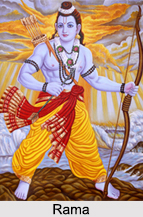
Rama : Rama, a major Hindu deity is the seventh avatar of Lord Vishnu. He is considered the Supreme Being, in Rama-centric traditions of Hinduism. Indian mythology highlights Rama to be the prince of Ayodhya, Dasharatha and Kaushalya to be His parents, Sita to be His consort and Ayodhya and Santanaka to be His abode. He is considered especially important to Vaishnavism.
Sita :
 Sita, the daughter of the earth goddess, Bhumi and the adopted daughter of King Janaka of Mithila and Queen Sunaina is considered to be an avatar of Lakshmi. Indian mythology highlights that Sita married Rama in her youth, thereby becoming His consort. She is regarded as an inspiration for all the Hindu women for holding high spousal and feminine virtues.
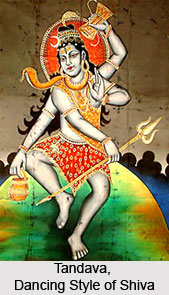
Shiva : Shiva, the Supreme Being according to Shaivism tradition, is one of the major deities of Hindus. Shaivism holds Shiva as the one who creates, protects and transforms the universe. Within the Hindu Trinity, Shiva is the "destroyer and transformer". Indian mythology highlights Parvati, Sati, Durga and Mohini as the consorts of Shiva, Mount Kailash to be His abode, Trishula to be His weapon and Lingam to be His symbol.
Parvati : Parvati is worshipped as the Hindu goddess of fertility, love, devotion, divine strength and power. She is the "mother goddess" in Hinduism. Indian mythology highlights Parvati to be the daughter of mountain king, Himavan and queen Mena and the consort of Shiva. It also highlights Mount Kailash to be Her abode.