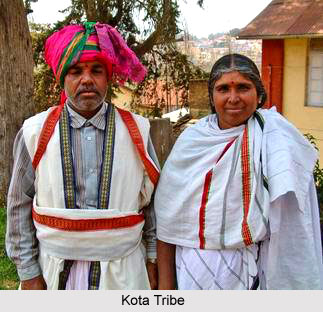
 Kota tribes of Tamil Nadu are believed to have moved to the Nilgiris Hills after the Toda tribe. They had earlier been living in Karnataka in a mountain known as Kollimalai in Mysore after which they named the first village "Kollimalai" (near Ketti village) which they built in the Nilgiris. The Kota Village consists of a row of few thatched huts. The Kota houses called `pai` were traditionally thatched huts, with mud and brick walls. The houses of the Kotas have a unique linear pattern with two or three localities called Keri with two or three streets which form the integral pan of the village. Each village had three exogamous clans of similar name. Each clan settled in a street called Keri. Kotagiri is the traditional home for the "Kotas". "Kota - Giri" means "Mountain of the Kotas." The name comes from Kotar-Keri, the street of the Kotas. Kota is the name derives from the word `Ko` means the cow and it believed that their ancestor where living in cows and thus the place they survive called Kokkal, the resting place of cows.
Language of Kota Tribe
The Kota tribal language known as "Ko-v Ma-nt" is a very old and rude dialect of Kannada language and is closely related to Toda Language. The Kota tribal population is about 2500. The origin of the name "Kota" is derived from the Dravidian root word "Ko" meaning Mountain.
The Kota village is known as Kokkal in the Kota Language. The pattern of settlement is believed to have been determined by a black cow who led the Kotas through the Nilgiris and with its hoof, indicating where to found each village. This footprint acts as a moral center of gravity, an important place for music making, dancing, and other rituals.
Dress of Kota Tribe
Kota traditional garment is known as "varad," a white bedspread cloth, is thrown around the body by men and women. Male dress consists of single piece of white coarse cloth called kir.Kadk, traditional earring ornament are used both by men and women.
Settlement of Kota Tribe
The house of Kota Tribe is divided into a living and sleeping apartments. The house consists of a front room, containing a raised platform on the left for sitting and sleeping and a hole in the floor for pounding, a kitchen, located to the right of the front room and containing a wood stove along the wall opposite the arched entrance, and a back room for bathing. Each room and parts of each room have particular names and functions. The walls have special crevices for oil lamps and wood and other objects are often stored in rafters above the kitchen.
Caste System of Kota Tribe
The Kota Tribe have no caste but are divided into Keris or streets viz "Kilker", "Naduker", "Pibberker", "Aker", "KorekerVor "Gager". People belonging to the same keri do not intermarry as they are supposed to belong to the same family. The Kotas prefer to marry within their own village. They practice both types of cross-cousin marriages, i.e., father`s sister`s daughter and mother`s brother`s daughter. The Kota tribal council, called as "Koot or "kut" maintains customary norms in the community. Kota village is led by a village headman called gotga-rn (pittakar). The "Gotgarn" from Menar was head of all the seven villages. Whenever a dispute arose, the gotga-rn will call a meeting known as a "kut" with the village elders and decide the solutions. Within a village, the gotgarn and elders decide when festivals are to be held and how to solve problems in the community. Although regular justice is handled through the Indian judicial system, local decisions of Kota cultural requirements are handled by the village "kut".
Religion of Kota Tribe
Kotas consider themselves to be Hindus. The major Kota deities are Aynor (father god) Kamatraya and Amnor (mother goddess) Kamatiswari. There are two male gods and one female goddess. It is believed that the mother goddess was married to two brother gods. The recognized place of worship of the Kotas in each village consists of a large square, walled round with loose stones three feet high and containing in its center two pent-shaped sheds. Open in front and rear and on the posts (of stone) that support them some crude circles and other figures are drawn. They don`t worship images of any sort. The temples are located in a separate sacred complex adjacent to the Kota settlement.
Culture of Kota Tribe
The Kota Tribe is excellent artisans; they excel in pottery making and terracotta Craft. The Kotas are also excellent blacksmiths, goldsmiths, silversmiths, carpenters, rope, and umbrella makers. The women do domestic duties, and also work in the fields, fetch water, collect firewood, make baskets, and earthen pots. Currently only a few families are engaged in these skills as a means of living. Majority of the Kotas are engaged in cultivation and cultivate potatoes, wheat, amaranth, samai, korali, mustard, onions, and other vegetables.
The Kota artisans produced fine hand-carved rifle butts and double-reed instruments (kol). The Kota women make baskets called "kik" are necessary for certain ceremonial occasions. Hides from goats and oxen are necessary for the production of their musical instruments, the kol (double reed), tabatk (frame drum or tambattai in Tamil), Dobar and Kinvar (cylindrical drums) and kob (brass horn). Their long curved horns, called kob, used to be fashioned of buffalo horn. Kota Tribe usually dance to the tunes of their music during their festivals, and also while celebrating life cycle rituals. The types of their dances are Kalcoose aat, Thiriganaat, Pippaalaat, and Koinaat. The Kotas supply the band for the Toda tribal people and Badaga festivals and funerals. The Todas pay the Kota musicians flesh of buffaloes and rice. Men always dance before women, and at the closing of larger festivals a day is devoted to women`s singing and dancing.