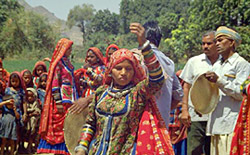
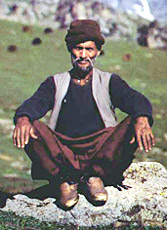
 In the heartland of Himachal Pradesh, a multitude of tribal communities have settled down over the years. Amongst them, the Gujjar tribal community has been held in high esteem. Gujjars are also known as Goojar, Gujar or Gurjara. The anthropological evidences stress that the Gujjar tribes are reckoned as scheduled tribes. The major concentration of Gujjar tribe lies in the north western provinces of the Himachal Pradesh.
The origin of these Gujjar tribes also is quite interesting. Though the proper origin of the Gujjar tribes is not known but it is said that during the time of the invasion by Hunas the Gurjara clan moved to northern India and the Himachal Pradesh. However, there are various opinions that had been cited by eminent anthropologists of the Indian subcontinent. The famous scholar V. A. Smith, claimed that the Gujjar tribes were foreign migrants, perhaps belongs to the group: a branch of Hephthalites, better known as `White Huns`. Also D. B. Bhandarkar (1875-1950) assumed that Gujar tribes migrated to India along with the Huna tribes.
Another school of thought has assumed that the Khazar tribes are ancestors of these Gujjar tribes of Himachal Pradesh. Moreover, `Gujjar`, the term is a derivation of the `Khazar`. Interestingly, the Indo-Aryan languages are devoid of the use of the sounds `kh` and `z`, which got converted respectively into `g` and `j`. To top it all, the `Gazetteer of Bombay Presidency`, the British official James M. Campbell also distinguished Gujjar tribes with Khazar tribes. The relation of these Gujjar tribal community has also been established with other tribal communities, namely, Chechen tribes etc.
Cultural exuberance of these Gujjar tribal communities has nicely being depicted in several of its aspects like dancing, religious rites and customs etc. This Gujjar tribal community has got inclination towards religion. Quite a handful of these Gujjar tribes have been converted to Hinduism and also Islam. Only few Gujjar tribal members are there who have adapted to other religions as well.
In order to carry on conversation, these Gujjar tribal community use the beautiful language of Gujari , also called Gojri. This Gujari language belongs to the famous Rajasthani language group. In the ancient times, however, Rajasthani had been the main language spoken by all the Gujjar tribal community. In the present day, due to rapid interaction with the people of the modern community, many members of this Gujjar tribal community also have developed fluency in several other Indian languages. These are namely Punjabi, Urdu, Hindi, Pashto Language, Pahari languages namely Kangri and Dogri, Dardic languages viz. Khowar and Kashmiri and Balti.
Following the tradition of most of the tribal communities of the Northern hilly regions of Indian Territory, this Gujjar tribal community has adapted the occupation of semi nomadic tribal community. Majority of this Gujar tribal community used to herd animals like sheep, goats and buffalo. In some way the Gujjar tribes even cope to manage even an `old rag elegant`.
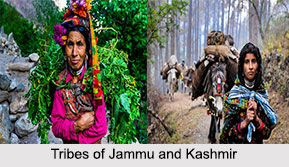
The Gujjar tribes migrate from the plains to the upper ranges of the Himachal Pradesh during the summer season. However to go hand in hand with the demands of the changing situations, many of the Gujar tribes of the contemporary period have taken various other occupations. Instances are found where these Gujjar tribes even would serve themselves out as `porters` or pony men for the tourists who got for trekking in the Himachal Mountains.
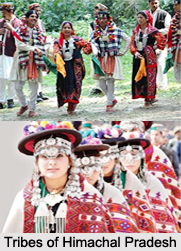
Gujjars are known for their exquisite tribal dressing style and their style of dressing in case of both men and women are of distinctive pattern. The colorful turban with the unique style of wrapping has been a style mark of this Gujjar tribal community. Topi which is also called Afgani hat is worn by the aged Gujjar men.
However, a Gujjar females beautify is greatly enhanced by the beautiful clothes called Dupatta. It looks like a shawl. Also these Gujar tribal females are very fond of the jewelries. These Gujjar females have got fascination for the necklace with a triangle pendant, studded with a beautiful stone in the center of it. It has a religious signification. It symbolizes `evil eye` and mainly utilized to avert bad luck.
The societal structure too follows the trend of almost all the tribal communities of the Indian subcontinent. Patriarchal norms are prevalent. Gujjar males also are very much family oriented. It is the Gujjar tribal female who has had the duty and responsibility of fulfilling all the activities of the households.
Festivals and fairs are also part and parcel of the life of this Gujjar tribal community. Apart from celebrating all the festivals of the national significance, these Gujjar tribes too have incorporated their religious beliefs and customs. Id is one of the main festivals of the Gujjar tribal society, which they fete, in great festivity and enthusiasm.