 Pongal is also referred to as `Thai Pongal` and is a significant harvest festival observed by the inhabitants of the state of Tamil Nadu at the conclusion of the harvest season. This four-day festival is celebrated in the Tamil month of `Maargazhi`, from 13th January till 16th January according to the Gregorian calendar. It continues till `Thai`, the Tamil month. Amongst all the festivities which are witnessed in Sri Lanka, Puducherry and Tamil Nadu, Pongal is said to be the most impressive and important amongst them. The term `Pongal` implies `overflowing` in the Tamil language and it symbolizes plentifulness and affluence. People boil milk in brand new clay pots and shouts `Pongalo Pongal!`, which is a symbolic rite of Pongal. Pongal is also observed for expressing gratitude to the Sun which encourages a good harvest and as sunlight is a boon for agricultural growth. This ritual of worshipping Lord Surya is known as `Surya Mangalam`. Houses are decorated with mango and banana leaves and the floors are adorned with colourful motifs made with the aide of rice flour.
History of Pongal
Pongal is a very ancient Indian festival which is believed to have been observed since more than 1000 years ago and some historical sources claim that it is still older than that. It has been proved that Pongal was celebrated as `Puthiyeedu` during the reign of the Chola Dynasty in medieval India. It is said that `Puthiyeedu` implies the very first harvest of the year. The residents of Tamil Nadu refer to Pongal as the `Tamizhar Thirunaal` which means the festival of the Tamils.
Rituals of Pongal
The day prior to Pongal is termed as `Bhogi` and during this time people dispose off their old belongings and concentrate on accumulating brand new possessions. The discarding of old things bears a marked similarity to `Holika` celebrated in northern parts of India. Inhabitants of Tamil Nadu gather at dawn, light a bonfire and throw all their old belongings in it to get rid of them.
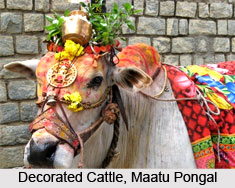 Houses are cleaned carefully, and painted to impart festive appearance to them during Pongal. The horns of buffaloes and oxen are adorned and painted in villages where the villagers celebrate Pongal, hoping for a delightful harvest. In Andhra Pradesh, this day is known as `Bhogi` and the fruits of harvest including sugarcane and regi are collected in a rite called `Bhogi Pallu`. In Punjab this day is observed as `Lohri` and `Magh Bihu` in Assam.
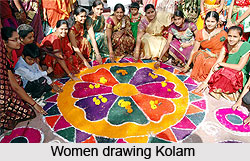
Colourful patterns or `rangolis` or `kolams` are drawn on the door steps of each and every household and a mixture of milk, jaggery, rice and sugarcane are offered to Lord Surya. Elders of the family bestow gifts upon the youngsters. Beautiful kites are flown in the sky to offer prayers and respect to the Sun God in northern India where people also take bath in the holy rivers for this very reason. Since cattle contribute to a large extent in agricultural activities like ploughing, provision of milk products and others, people decorate them with floral garlands, apply `kumkum` over their foreheads and feed them affectionately with jaggery, honey, banana, `venn pongal` and other fruits. It is known as `Maatu Pongal` and is observed by the villagers to display their gratitude to their cows for their assistance in farming. Games like `Jallikkattu`, which means taming the wild bull are interesting features of Maatu Pongal. Prayers are offered to Lord Ganesha in the evening.
One of the main highlights of Pongal is the rite of boiling rice in new clay pots which are decorated with beautiful patterns called Kolam. The rice is garnished with raisins, cashew nuts, sugar and ghee and Pongal has obtained its name from this ritual which is performed at dawn. When the milk boils over and tends to slip outside the container, people shout `Pongalo Pongal` and immediately conch shells or `saggu` are blown to welcome the new harvest season. It is believed that if one watches the boiled milk spilling over its vessel, it brings him great luck and prosperity. Sweets like `payasam`, `vadai`, `murukku` and many other kinds of sweets are prepared in Pongal and these are offered to relatives, friends and well-wishers.
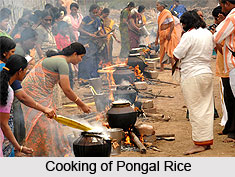 The main Pongal dish is dedicated to Lord Surya and while one of the dish is salted, the other is sweet. The cooked dish is then served on banana leaves.
During the third day of Pongal, family reunions take place in Tamil Nadu. Brothers offer gifts to their married sisters as a token of their affections while the workmen are granted generous gifts of money, food and new garments by the landlords. This is termed as `Kaanum Pongal`. `Kaanum` implies `to visit`. People visit the residences of each other and chew sugarnane, and observe Kaanum Pongal to express their gratefulness to their friends and relatives for all their cooperation they had extended during the last harvest. Tamils meet and greet each other saying `Iniya Pongal Nalvazhthukkal`, which means `Happy Pongal` in English language.