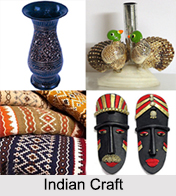
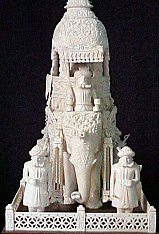
Papier Mache, which implies `chewed paper` in French, is composed of a combination of mashed paper pulp with reinforcements of textiles restrained with adhesives such as starch, gum or waste paper. The art of papier mache was ushered into India during the rule of Mughal dynasty and has retained its popularity even today. Papier mache is still being practiced by a lot of craftsmen all over India. Papier mache objects are utilized for household activities and many are also used for decorative purposes. Successful experiments have been made with replicas of famous temples, forts and gates in papier mache.
History of Papier Mache in India
The craft of papier mache had commenced in Persia (Iran), where it was known as `kar-i-kalamdan` (pen stand). It is said that Mughal emperors in the 15th and 16th century were so impressed by this unique art form that they patronized it in India. Papier mache craft flourished in India during the regime of the Mughal rulers. However, since none of the papier mache crafts can be retrieved from the period of the reign of Mughals, there is lack of evidence on the popularity and other details of this craft during that period.
Some historical accounts attribute the introduction of papier mache craft to India to a Kashmiri prince who was exiled to Samarkand as a prisoner in the 15th century. Mohammed Salem Beigh, a well-known, ancient papier mache artist had asserted that a majority of the talented craftsmen skilled in the art of papier mache were obtained from Samarkand, which is a part of Central Asia. In Samarkand, this art was also known as `kar-i-munakash`. Many historical records claim that this craft was restricted mainly to Kashmir, particularly in and around the region of its capital Srinagar. It is said that the `Shia` community, whose members had migrated from Persia largely practised it.
 In the 19th century, it was some French agents who were stationed in Kashmir who had encouraged the growth of the papier mache industry, though in an indirect manner. These French agents were involved in the trade of `pashmina shawls` and transported these materials in beautifully crafted papier mache boxes, from Kashmir to France. Gradually, the French developed a taste for papier mache objects and boxes, flower vases and other items composed of papier mache flooded the French markets. The influence of the French were evident from the fact that the original name of this craft was replaced by the word `papier mache` even n its local place.
The ingredients of papier mache objects were replaced over the years. Silver fir or `budloo` replaced paper as the basic constituent of papier mache crafts in the 19th century while mashed wood and paper replaced paper board sheet, or `ghata`. Most of the modern-day papier mache crafts today are not manufactured from paper. `Nakashi` is the new name for the art which comprise various kinds of paintings done in geometrical and floral patterns on different objects, which are available as papier crafts. These paintings are generally covered with lacquer.
Concentration of Papier Mache in India
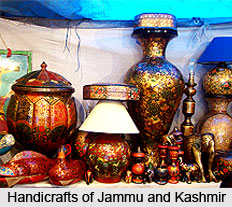
The craftsmen of Purulia make a variety of masks, mythological in characters that are used during folk festivals by the `chhau` dancers of Orissa. Kashmir specializes in the production of several forms of papier mache crafts. The districts of Srinagar, Anantnag, Pulwarna, Badgam, Kupwara and Baramula are renowned for their papier mache products. Other important centres for this craft are Gwalior, Ujjain, Indore , West Bengal, Andhra Pradesh and Harda. Artists from the Shantiniketan School of Art did some pioneering work in introducing this craft in West Bengal. Today quite a number of craftsmen in and around Kolkata have taken up the craft and their products have found a market for their beauty in designs and excellence in craftsmanship. The `Madhubani papier mache` is quite popular in Bihar, which was born in the Madhubani district of the Indian state of Bihar. Various parts of Rajasthan and southern India also make wonderful papier mache artwork.
Papier Mache Products
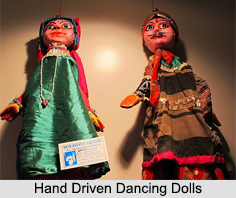
Papier mache artisans are capable of crafting various kinds of artefacts due to the inexpensive and non-hazardous nature of papier mache. There are a wide variety of papier mache products which comprise wall decorations, jewellery boxes, lamps, masks, paper boats, puppets, dummies, sets and costumes for theatres, mirror cases, flower vases, pen cases, utensils like kettles, plates or trays and powder containers. Other objects include animals and birds, particularly cocks, parrots and pigeons which are made into toys with the aide of papier mache. Gold and silver leaves are also used on larger articles, figures and objects like the houseboat are depicted. Landscaping is also done on wall plaques, trays, large bowls, screens, writing sets, etc. Most of the papier mache crafts are done on brightly coloured backgrounds which are embellished with rich patterns of flora and fauna.
 Procedure of Making Papier Mache
The technique of manufacturing papier mache products consist of two categories. The first one is called `sakhtsazi` or developing the object and the second one is known as naqashi, which implies painting the surface of the objects.
Papier-mache articles are made of waste paper applied in layers and pressed together on wooden modules. Waste paper is soaked in water for about 10-15 days, and beaten up with a hammer. Gum is mixed thoroughly to this pulp. Multani mitti is added and kneaded to get a pulp paste. This pulp is beaten so that a roller can roll it. These sheets are pressed on to the required mould many times by an invert of a broken pitcher and dried for some time. The mould is separated after drying and the object is taken out. This object is in a raw form and is finished, polished and coloured. File is used to smoothen it. Also a thin mixture of white clay is applied for further softening. Imagination runs wild as craftsmen breathe life into this mould, bringing out a variety of expressions on masks.
Papier mache in Kashmir is never fully pulped. It is softened by water and the desired thickness obtained by pasting on the mould layer over layer. The object under preparation is kept covered in a wet cotton cloth and while in a moist state covered with a thin layer of plaster of paris mixed with glue, then smoothened and furnished to a fine finish with a wet stone, after which the ground colour, `zamin` as it is called is applied. The base may be in colour or gold or tin foil, it is furnished with a piece of agate after drying then fine verdigris powder is applied to lend a subtle greenish tint to the metallic background, or with a lac preparation where a red tint is needed. On coloured grounds, black, blue, rose, green, violet, brown, almond and dark olives are generally used.