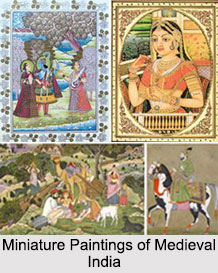
Mughal Paintings in India date back to the period in between the 16th and 18th centuries. It was the period when the Mughal Emperors ruled over a large portion of India. The Mughal Paintings of India flourished and developed during the rule of Emperor Akbar, Jahangir and also during the reign of Shah Jahan. The form of Mughal Paintings is a blend of the Persian and Indian style along with combinations from different cultural aspects. The paintings of the Mughal period were rich in their range and included events, portraits and scenes of life of the courts, hunting scenes and wild life and instances of battles.
History of Mughal Paintings
Essentially a court art, Mughal Paintings of India developed during the reign of Humayun. When he returned to India from his exile, he brought with him two great Persian artists; Abd-us-samad and Mir-Sayyid Ali. It was during this initial period, that the Mughal Paintings took inspiration from the Safavid school of Persian paintings under the influence of these two artists. In the course of time the art of these two artists made their presence felt in the local art works and slowly resulted in the evolution of the Mughal Paintings. The most former example of the Mughal style of art is the Tutinama Painting; `Tales of a Parrot`, which is presently in the Cleveland Museum of Art. There is another famous Mughal painting which is called the `Princess of the House of Timur`. It is one of the early Mughal Paintings which was redone a number of times.
Themes of Mughal Paintings
Mughal Paintings possess a great variety including within itself portraits, scenes and events of court-life, along with paintings depicting lovers in intimate positions, etc. The Mughal Paintings often revolved around themes like battles, legendary stories, hunting scenes, wildlife, royal life, mythology, etc. These paintings also became an important medium to narrate the tall tales of the Mughal emperors.
Development of Mughal Paintings
Mughal Paintings prospered during the reigns of Akbar, Jahangir and Shah Jahan and the early Mughal period paintings are seen in a specialist organization of a scriptorium or palace studio, which was then managed by Baysunqur. The scriptorium was led by the renowned painter Bihzad belonging to the period of the Mughals. Unfortunately, the scriptorium ruined at the end of the rule of Husayn Bayqara, and Saiavid Shah Ismail brought Bihzad to Tabriz in order to organize there the palace studio. Several other painters were brought to Bukhara by the conqueror of Uzbek, Muhammad Shaybani. But the scriptorium`s fame was not marred and it acted as a role model for the scriptoria constructed later by Humayun and Akbar.
 Mughal Paintings during Akbar
The paintings of the Mughal era experienced growth on a large-scale under the rule of Akbar. At that time, a large number of artists painted under the supervision of two Persian artists. Since Akbar was interested in epic tales, the paintings of his period are based on Ramayana, Mahabharata and Persian epics. Mughal Paintings demonstrated raised naturalism which is accompanied by animal tales, portraits, landscapes, etc. One of the earliest painting projects commissioned by Akbar was `Tutinama` which literally translates to `Tales of a Parrot." `Tutinama` is an episodic Persian story divided into 52 parts. Akbar commissioned 250 miniature paintings that narrated `Tutinama` in an artistic manner. From 1570 to 1585, Akbar hired more than a 100 painters who practiced Mughal Paintings in his court.
Mughal Paintings during Jahangir
Jahangir ruled over India from 1605 to 1627 and he offered huge support to several forms of arts, mainly paintings. The reign of Jahangir witnessed more finish in brushwork, as well as the use of subdued and lighter colours. The major themes of the paintings of the Mughal era in India circled round the instances from the life of Jahangir, and also portraits, flowers, birds, animals, etc. The most famous examples of the paintings of the Mughal period include a pictorial exemplification of the Jehangirnama, Emperor Jahangir`s biography. Jehangir was largely influenced by European painting and the Mughal Paintings commissioned by him had finer brush strokes and lighter colours. He also had several other paintings, including some unusual subjects such as the union of a saint with a tigress, and fights between spiders.
Mughal Paintings during Shah Jahan
The refinement and grace of the period of Jahangir was seen during the rule of Shah Jahan (1628-1658). The warmth and the feel of the paintings were substituted by rigidity and coldness. The themes of the Mughal Paintings of Shah Jahan`s period focused on lovers on gardens and terraces, musical parties, gathering of ascetics around a fire, etc. One of the most important works produced during his reign was the "Padshanama", which was made to look lavish with generous volumes of gold plating. The "Padshanama," narrated the achievements of Shah Jahan and contained several paintings. The work was so elaborate that even servants were painted with amazing details that provided a great individuality to each and every character.
Abu al-Hasan, Painter of Mughal Period
Abu al-Hasan was a famous painter of the Mughal period in India and the Mughal ruler of that time was Jahangir. Abu al-Hasan belonged originally to Afghanistan. Afghanistan was regarded as `the city with an artistic tradition`. He was the son of Aqa Reza of Hera. Jahangir was responsible for training Abu al-Hasan in his spacious workshops and studios, Abu al-Hasan excelled his father and his employer in a short period. In the form of an acknowledgement to his talent, Jahangir bestowed upon him the title `Nadir-uz-Saman` or `Wonder of the Age`.
Decline of Mughal Paintings
The movement which was witnessed during the rule of Shah Jahan was also visible during the period of Aurangzeb. However, Aurangzeb did not care much for the development and growth of Mughal Paintings. Still, the Mughal Paintings in India continued to exist by getting some aid from other patrons. Slowly, due to the lessening support, a declining movement was initiated in the course of Mughal Paintings in India. During the rule of Muhammad Shah, the Mughal paintings witnessed a short revival. However, with the coming of Shah Alam II to power, the Mughal art form became already extinct and another form of painting called Rajput Paintings, started to evolve.
Today, miniature Mughal Paintings can be seen, being created by a few artists in the state of Rajasthan centralized chiefly in Jaipur. Although several miniature paintings are nice copies of the originals, various artists have developed modern works by using the classic methods, at times, with outstanding artistic effect.