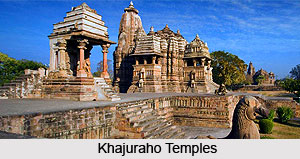
 Khajuraho temples have their fames spread like the scented flowers that have bloomed in the garden over for their marvellous architectural style. Situated in Bundelkhand in the state of Madhya Pradesh, a total number of 85 temples had been originally constructed by the Rajputs of the Chandella dynasty between 950 and 1050 AD. Of these, only 20 now remain. These, however, are well preserved, considering that they have been neglected for nearly a thousand years. Unlike the temples in Orissa, these shrines are not the result of a slow, concerted development spread over several centuries, but rather a brilliant, although comparatively short phase in Hindu temple architecture when intense religious feeling and aesthetic talent combined to produce buildings of great beauty.
Khajuraho, the ancient Kharjjura-vahaka are the representative pillars of the distinct prototype of art and temple structural design of its own reminding one of the well-heeled and creative epoch it witnessed during the Chandella tenet. It was the principal seat of authority of the Chandella rulers who festooned it with copious tanks, scores of lofty temples of sculptural poise and elegance as well as architectural majesty. The local tradition lists eighty-five temples but now only twenty-five are standing examples in various stages of preservative perpetuation. But for Chausath-Yogini, Brahma and Mahadeva which are of granite, all the other temples are of fine grained sandstone, buff, pink or pale yellow in colour.
One of the most unique features of the Khajuraho temples is that, contrary to custom, they are not enclosed within a wall. Instead, they stand high on a terrace of solid masonry, as though in an effort to rise above their temporal surroundings. In addition, the constituent, parts are not built as separate units but present an architectural synthesis of striking unity. The Khajuraho temples are, however, not as imposing in size as the Orissan, but achieve the same grandeur through their graceful proportions and superb surface decoration. The largest of these is only about a hundred feet in length. As a rule there are three main compartments, namely, the garbhagriha, the mandapa and the ardhamandapa or entrance portico, arranged in the manner of a cross. The antarala, the mahamandapa or the transepts and the perambulatory passage supplement the other compartments in the more developed examples.
The aspiring quality associated with most styles of temple architecture is emphasised in the Khajuraho group to a marked degree. The entire mass of granite or sandstone, of which most of these are constructed, appears to have an upward movement, the effect of loftiness being further enhanced by a number of pronounced vertical projections. The range of open porches with overhanging eaves running horizontally around the temple serves to let in light, thus throwing a band of vivid shadow over the entire composition.
The exterior of the temples, decorated with parallel friezes in high relief, displays a rare wealth of human and divine forms, pulsating with life and warmth. They present varied themes of myriad interests. The graceful animation of these life-like forms, the skill with which they are executed on stone walls, and the vast variety and ingenuity of the techniques employed are unparalleled in any other similar style of temple architecture.
The tenuous, flowing lines of the sikhara give it an elegant and refined quality. The solid strength of these temples is further enhanced by the graceful sikharas. The halls of the Khajuraho temples are richly adorned with sculptures.
In addition to the over sailing courses of masonry, the highly sculptured ceiling is supported by four pillars, one at each corner of the hall which bear heavily ornamented bracket capitals- The pillars are carved above and below, with grotesque half human figures of dwarfs and griffins. In the spaces in between are statuettes of sculptured feminine forms in attitudes of enchanting grace and loveliness. The sharp contrast presented by the forbidding appearance of the former and the pervasive beauty of the latter perhaps symbolises the triumph of beauty over ugliness, or that of the spiritual over the bestial.
Eroticism is a recurrent theme in the shrines at Khajuraho. A number of different theories have been put forward to explain this. The most commonly accepted theory is that the many erotic groups depicted here with such abandon represent the mithuna ritual of the Tantric cult according to which personal salvation can be attained only through experience, both sensual and spiritual. Yet another theory holds that since such sculptures are usually found on the exterior surfaces of a temple and are absent from the interior, it may be concluded that they are meant to test the devotion of the worshipper or to warn him against entering the sanctum until he has conquered carnal desire. Whatever the significance of these sculptures may be, it is fairly clear from their intrinsic artistic merit that the sculptors who fashioned them found the temple walls an easy canvas for the depiction of such an elemental theme as love between man and woman.
The twelve Vaishnava and Saiva temples to the north-west of the site form the most important of the groups at Khajuraho. Among these are the Siva shrine of Kandariya Mahadeva temple, the largest and most representatives of all the Khajuraho temples. The temple has been planned as a double cross and has an air of vibrancy seen in the superb gallery of sculptures that embellish its walls. Built on the same principle as one Khandariya Mahadeva, but much smaller is size, are the Lord Shiva temples of Viswanath and the Lord Vishnu temple of Chaturbhuj. The former is believed to have been built about 1000 A.D. and both are of the Panchayatanu type. Facing the Visvanath temple and built on the same platform is a small temple which houses a colossal statue of Nandi, Lord Shiva`s bull. The temple of Devi Jagadamba, now dedicated to the goddess Kali, was originally a Vishnu shrine. There were four additional shrines, but these have now disappeared. The Chhattra-ka-patra temple is dedicated to Lord Surya, the sun-god, and is noted for its elegant proportions. Another notable temple is dedicated to the Varaha avatar, the boar incarnation of Lord Vishnu, a colossal monolithic statue of which is installed in the centre. The Matangeswara and Parvati temples are also notable examples of the north-western group at Khajuraho.
Basically similar to the Brahmanical temples, the six Jain temples grouped together on the south-east of the site are remarkable in that there is an almost complete absence of window openings. The Parsvanath is the largest and most beautiful Jain temple at Khajuraho. The sanctum contains an ornamental throne and a sculptured bull, the emblem of Adinath, the first of the Jain Tirthankaras. The modern image of Parsvanath was installed late in the 19th century. It is significant that this Jain temple also houses images and sculptures of Brahmanical gods and goddesses, for it speaks of a spirit of toleration not often seen in places of worship.
There can be seen a cluster of 12 pillars standing a little apart from the main group. This is all that remains of the Jain temple known as Ghantai. These have attracted considerable attention on account of their attic beauty. Along with Jain temples, this south-eastern group also includes Brahmanical ones such as the Dula-dev and the Chaturbhuj. The Kunwar Math, lying south of the Jain group near Kurar Nala, is perhaps the finest example of this class.
The remains of temples, belonging to the same period and of the same type, have been found as far as Rewa in Madhya Pradesh (e.g., the Visvanath temple at Maribag).to Jhansi, and as far as Osia in Rajasthan. The Shiva temple at Baroli believed to date from the 9th or 10th century, compares very well with contemporary structures in Orissa, both from the point of view of richness of design and fineness of sculpture.
Khajuraho Temples
Khajuraho Temples are known the world over for their beauty and architectural construction. This group of temples is situated in the central Indian state of Madhya Pradesh.