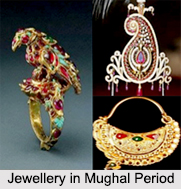
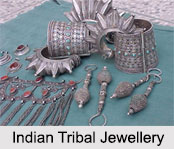
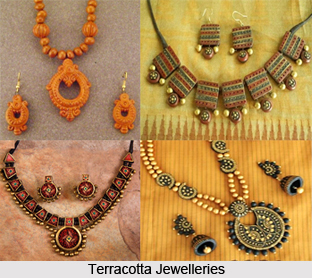
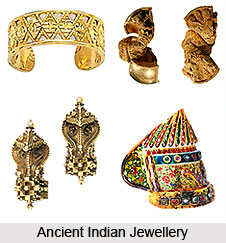
 Ancient Indian Jewellery was generally made of natural materials like feathers, seeds, leaves, flowers, animal bones and claws. Necklaces, earrings, armlets, embroidered belts and bracelets were used by both men and women. In classical Indian literatures, jewellery serves as an integral part of the plot. Even the Gods and Goddesses of the Veda are described wearing gold ornaments. Today, these types of jewellery are worn by various tribal people.
Historical Evidences of Ancient Indian Jewellery
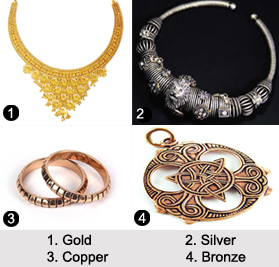
The excavations at various other sites, such as the Mohenjo-Daro and Indus Valley civilization unearthed a large number of ornaments worn by the people of ancient periods. This has made it possible to believe that both women and men belonging to the ancient period used to wear jewellery constructed by silver, ivory, gold, copper, semi-precious and precious stones.
The earrings in the Metropolitan Museum of Art, provides striking evidence of the finest pieces of ancient Indian jewellery known till date. However, most of the information about gold used in ancient India is derived either from the excavated material from early sites or the visual record provided by countless carvings and also from more rarely painted representations of richly adorned gods and goddesses from the 3rd to 4th centuries BC onwards.
Jewellery in the Indus Valley Civilization
Both women and men of the Indus valley Civilization used to decorate themselves with jewelleries like necklaces, armlet, fillets and finger-rings. The women during this time made a lot of use of shell bracelets and clay over their wrists. Women during that period wore earrings, girdles and anklets. The common metals being used in the preparation of ornaments for the people of Indus valley Civilization were gold, copper, silver, ivory and various other precious stones, shells, bones, etc. Other jewellery worn more frequently by women included thin bands made of gold worn over the forehead, primitive brooches, earrings, gold rings and chokers. In this period, the use of gemstone in jewellery was started.
 Jewellery in the Gandhara Period
The Gandhara period jewellery has ample Greek and Hellinistic influences. Commonly used jewellery of the Gandhara period was massive earrings, torques and armlets, often incorporating bird or animal forms.
Jewellery in the Sunga Period
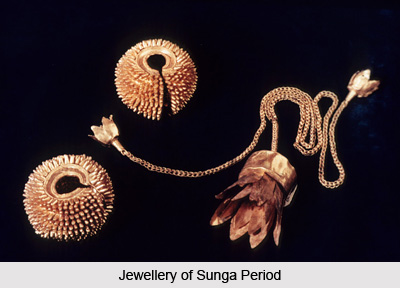
The Sunga dynasty refined the style and composition of jewellery. The sculptures of the Sunga period shows several references of the use of gold and other precious stones including rubies, corals, sapphires, etc. Beads and pearls of various types were also used abundantly. The royal kingdoms of the southern India made a generous use of gemstones and gradually the trend of using precious gems in jewellery became an essential part of Indian Jewellery.
Various Ancient Indian Jewellery
Some of the most common jewellery of ancient India includes earring, armlet, necklace, bracelet, hairpin, anklet, ring, etc. Earring or "Karnika" is one of the ancient Indian jewellery which was of three types including earrings having flower-like shape called "Karnaphul", circle or simple ring called "Kundala" and circular disc type earring called "Dehri". Necklaces form another kind of ancient Indian jewellery which was of two types. One had a short, flat and broad structure known as the "Kantha" and the long Necklace was called the "Lambanam". Women of the ancient period used to wear Girdle or "Mekhala", a belt wore over the hip having beads of several strings. Armlets or "Bajubandh" were made of gold and silver beads used to be worn over the upper arm. Bracelet or "Kangan" was a kind of ancient Indian jewellery which was prepared by round or square gold beads. Anklets and rings were worn by all women of ancient India. The anklets could be simple, thick chain, a Kara, a sankla and also in the form of ornamental circle having small bells known as "ghungru". The use of forehead ornaments was also common among women who wore it in the middle of the forehead. These ornaments are of thin plates of silver or gold stamped in different patterns, and also in the form of star called "bindi" or "sitara".
Since the ancient times, jewellery has been an important component of the Indian life. But the Ancient Indian jewellery"s history has undergone a tremendous change. The designs and delicate craftsmanship of the ancient jewellery have greatly influenced the designs used in modern jewellery. Jewellery is considered as one of the earliest art forms designed by man.
Ancient Indian Jewellery
Indian Jewellery has its roots in ancient times which gradually improved with dawn of every new civilization in India. The charm of jewellery and the beauty of Indian women by adorning it never separated.