
 Yajur Veda is one of the four great works of ancient Indian literature. The Yajur Veda Samhitas are prayer books for the Adhvaryu priest. It is believed to have been composed between 1,400 and 1000 BCE. The Yajur Veda contains the liturgy or the mantras and the details of their performance in the Vedic period. A number of different schools of this Veda existed.
Yajur Veda
Yajur Veda is crucial from the historical point of view, as it demonstrates the alterations in social and religious conditions in the Vedic times.
Introduction
Yajur Veda is one of the four great works of ancient Indian literature. The Yajur Veda Samhitas are prayer books for the Adhvaryu priest. It is believed to have been composed between 1,400 and 1000 BCE. The Yajur Veda contains the liturgy or the mantras and the details of their performance in the Vedic period. A number of different schools of this Veda existed.Samhitas of Yajur Veda
The least deviation in the ceremonies or in the liturgy was sufficient cause for the formation of a new Vedic school. Up to the present, five Samhitas and schools of the Yajur Veda are known to have existed. These are the Kathaka, the Yajur Veda Samhita in the recension of the Katha-school; the Kapisthala Katha Samhita, which is preserved only is a few fragments of manuscript; the Maitrayani Samhita, i.e. the Yajur Veda. Sainhita in the recension of the Maitrayaniya school; the Taittiriya Samhita, i.e. the Yajur Veda Samhita in the recension of the Taittirlya school, also called "Apastamba-Samhita" after the Apastamba-school, one of the chief schools in which this text was taught. These four recensions are closely inter-related, and are designated as belonging to the "Black Yajur Veda." Differing from them is the Vajasaneyi Samhita or the Samhita of the "White Yajur Veda" which takes its name from Yajnavalkya Vajasaneya, the chief teacher of this Veda. Of this Vajasaneyi Samhita there are two recensions, that of the Kanva and that of the Madhyandina School, which however differ very little from each other.
Composition of Yajur Veda
The Samhitas of Yajur Veda is divided into two parts: Shukla or white Yajur Veda and Krishna or black Yajur Veda. Shukla Yajur Veda has a separate Brahmana text written as Shatapatha Brahmana whereas the Krishna Yajur Veda has the Brahmana prose discussions.
Shukla Yajur Veda is divided into two parts. One is Vajasaneyi Madhyandiniya and the other is the Vajasaneyi Kanva. Both are known as Vajasaneyi Samhita. Vajasaneyi Madhyandiniya is popular in North India, northern parts Nasik of Maharashtra and Gujarat whereas, Vajasaneyi Kanva is popular in southern parts of Nasik, Andhra Pradesh, Orissa, Tamil Nadu and Karnataka. The chief difference between Samhitas of the "black" and the "white" Yajur Veda lies in the fact that the Vajasaneyi Samhita contains only the Mantras, i.e., the prayers and sacrificial formulae which the priest has to utter while the Samhitas of the Black Yajur Veda, besides the Mantras, contain a presentation of the sacrificial rites belonging to them, as well as discussions on the same.
Krishna Yajur Veda is divided into four parts. They are: Taittiriya Samhita, Maitrayani Samhita, Caraka Katha Samhita and the last one is Kapisthala Katha Samhita. All these parts are associated with a Brahmana that explains about Panchala, area of Kurukshetra and the parts of southern Punjab respectively.
The Taittiriya Samhita or Taittiriya Shakha is considered as to be the best known and best preserved portions of Yajur Veda. It consists of 7 books that are again subdivided in chapters. These subdivided chapters are further subdivided into individual sections known as Anuvakas.
Shukla Yajur Veda is divided into two parts. One is Vajasaneyi Madhyandiniya and the other is the Vajasaneyi Kanva. Both are known as Vajasaneyi Samhita. Vajasaneyi Madhyandiniya is popular in North India, northern parts Nasik of Maharashtra and Gujarat whereas, Vajasaneyi Kanva is popular in southern parts of Nasik, Andhra Pradesh, Orissa, Tamil Nadu and Karnataka. The chief difference between Samhitas of the "black" and the "white" Yajur Veda lies in the fact that the Vajasaneyi Samhita contains only the Mantras, i.e., the prayers and sacrificial formulae which the priest has to utter while the Samhitas of the Black Yajur Veda, besides the Mantras, contain a presentation of the sacrificial rites belonging to them, as well as discussions on the same.
Krishna Yajur Veda is divided into four parts. They are: Taittiriya Samhita, Maitrayani Samhita, Caraka Katha Samhita and the last one is Kapisthala Katha Samhita. All these parts are associated with a Brahmana that explains about Panchala, area of Kurukshetra and the parts of southern Punjab respectively.
The Taittiriya Samhita or Taittiriya Shakha is considered as to be the best known and best preserved portions of Yajur Veda. It consists of 7 books that are again subdivided in chapters. These subdivided chapters are further subdivided into individual sections known as Anuvakas.
Content of Yajur Veda
There are two major sacrifices present in Yajur Veda. They are Darsapurnamasa and Asvamedha or the horse-sacrifice. Darsapurnamasa is performed at new and full moon and in Asvamedha process 609 animals of various descriptions, domestic and wild, were tied to 21 sacrificial posts.
Some individual hymns in this Samhita are very popular in Hinduism. The Taittiriya Samhita of the Krishna Yajur Veda is the most popular Shakha in South India. According to Hindu mythology, it is believed that Vaisampayana, the disciple of Ved Vyas had received Yajur Veda from him. Once he committed an offence and uttered some nuisance on Yajnavalkya, the other disciple. As a result Yajnavalkya poured out all Yajus texts he had learned from Vaisampayan. The other disciples picked up these tainted texts, and retained them as Taittiriyas. But Yajnavalkya, prayed to the Sun to obtain the other Yajur texts, and had granted the wish - `to have all texts that were not known to his teacher. ` The Vajasaneyi Samhita in Yajur Veda has forty chapters along with their formulas used in the rituals. Few of the rituals of the Samhita are New and Full Moon sacrifices, Somayajna, Agnihotra, Rajasuya and Vajapeya. Sautramani is a ritual present in this Samhita is preventing the effects of excessive Soma-drinking. Its final chapter is the famous Isa Upanishad. The first volume of Taittiriya Samhita of Yajur Veda coupled with the commentary of Sayana or Madhava was first published in Bibliotheca Indica, in the period of 1860- 1865 by Baboo Rajendralala Mitra of Kolkata.
Some individual hymns in this Samhita are very popular in Hinduism. The Taittiriya Samhita of the Krishna Yajur Veda is the most popular Shakha in South India. According to Hindu mythology, it is believed that Vaisampayana, the disciple of Ved Vyas had received Yajur Veda from him. Once he committed an offence and uttered some nuisance on Yajnavalkya, the other disciple. As a result Yajnavalkya poured out all Yajus texts he had learned from Vaisampayan. The other disciples picked up these tainted texts, and retained them as Taittiriyas. But Yajnavalkya, prayed to the Sun to obtain the other Yajur texts, and had granted the wish - `to have all texts that were not known to his teacher. ` The Vajasaneyi Samhita in Yajur Veda has forty chapters along with their formulas used in the rituals. Few of the rituals of the Samhita are New and Full Moon sacrifices, Somayajna, Agnihotra, Rajasuya and Vajapeya. Sautramani is a ritual present in this Samhita is preventing the effects of excessive Soma-drinking. Its final chapter is the famous Isa Upanishad. The first volume of Taittiriya Samhita of Yajur Veda coupled with the commentary of Sayana or Madhava was first published in Bibliotheca Indica, in the period of 1860- 1865 by Baboo Rajendralala Mitra of Kolkata.
Adhyayas of Yajur Veda
Adhyayas of Yajur Veda consist of a number of prayers and sacrificial formulae which form the principal contents of the Yajur Veda. The chapters contain partly of verses and partly of prose sentences. It is the latter which are called "Yajus," and from which the Yajur Veda takes its name. The prose of these prayers is occasionally rhythmical and here and there even rises to poetical flight. The verses which occur are mostly found also in the Rig Veda Samhita. The various readings, however, which the Yajur Veda often presents, are mostly intentional alterations which were made in the verses, in order to bring them more into line with the sacrificial acts. Only rarely were whole hymns of the Rig Veda included in the Yajur Veda Samhitas. Mostly they are only single verses, torn from their context, which just appeared suitable to some sacrificial ceremony or other, and were therefore included in the Veda of prayers.
The simplest prayer found is the dedication of a sacrificial gift with the mere utterance of the name of the deity to which it is offered. Formulae of this kind are numerous in the Yajur Veda. "Thee for Agni, "thee for Indra," or "this for Agni," or also "for Agni Hail" "for Indra Hail!" etc- with such words the gift is laid down or thrown into the sacred fire. A shorter and simpler song of praise to a god can hardly be imagined than the words with which every morning and every evening the fire-sacrifice consisting of milk (Agnihotra) is offered: "Agni is Light, Light is Agni, Hail!" (in the evening), and "Surya is Light, Light is Surya, Hail!" (in the morning). In equally brief words the purpose of a sacred act is often indicated when, for instance, the sacrificial priest cuts off the branch with which the calves are driven from the cows, and says at the same time: "Thee for juice, thee for strength!" The deities are not always invoked or praised in these sacrifice-formulae, but in the most diverse ways sacrificial utensils and sacrificial acts are brought into relation with the deities. Thus, for example, the priest binds with a rope the sacrificer`s wife who takes part in the sacrifice, saying: "A girdle thou art for Aditi" and so on.
There are a number of formula like turns in the Yajur Veda which convey little or no meaning. Comparatively, however, rarely does one come across long prose prayers in which the sacrificer expresses his desires to the deity in simple words. Some prayer-formulae of the Yajur Veda are indeed nothing but magic spells in prose. Even exorcisms and curses, quite similar to those found in the Atharva Veda, can be seen among the prayers of the Yajur Veda. For there exist also sacrificial acts by which one can injure an enemy. Thus the priest says to the yoke of the car on which the sacrificial utensils are kept: "A yoke thou art, injure the injurer, injure him who injures us, injure him whom we injure."
Just as these exorcism-formulae have a primitive and popular air, even the riddles can be found possessing similar qualities. The genuinely theological riddles deserve the technical name of Brahmodya as they presuppose an acquaintance with Brahman or sacred knowledge. In the Yajur Veda one can also learn of the occasions at which the riddle-games were customary, indeed, even formed a part of the cult. Thus, in the Vajasaneyi Samhita in section XXIII, 2, a number of riddles with which the priests amused themselves at the renowned ancient horse sacrifice. These riddle games form an equally important part of the worship of the gods as the prayers and sacrificial formulae. However, the term "worship" of the gods expresses inadequately the purpose of the prayers and formulae, indeed, of the sacrifices themselves. The majority of the sacrificial ceremonies, as also the Yajus formulae do not aim at "worshipping" the gods, but at influencing them, at compelling them to fulfil the wishes of the sacrifice. The gods wish to be not only fed, but entertained as well.
 In the Yajur Veda can be found besides, already a mode of influencing the gods which prevailed very largely at later periods, and which consists of enumerating as many names and epithets as possible pertaining to a certain god and of worshipping him under all these names, in order to obtain something from him. Thus in the later literature there can be found texts which enumerate a thousand names of Lord Vishnu or a thousand names of Lord Shiva, the recital of which is regarded as a particularly effective and meritorious work of devotion. The first beginnings of this kind of prayers are found in the Satarudriya, the enumeration of the hundred names of the god Rudra, in Section XVI of the Vajasaneyi Samhita and in the Taittiriya Samhita.
Finally, there is yet another kind of "prayers," which are found in the Yajur Veda. They are single syllables or words, which convey no meaning at all, or whose meaning has been lost. They are pronounced in the most solemn manner at certain places in the act of sacrifice, and are regarded as immensely sacred. There is, first of all, the sacrificial cry Svaha, which can be translated as "Hail", with which every gift for the gods is thrown into the fire, while the cry Svadha is employed in the case of sacrificial gifts to the fathers. Other such cries of sacrificial worship include Vasat, Vet, Vat, but above all the most sacred syllable Om. This syllable has been regarded in India for thousands of years, and still to the present day is regarded, as inordinately sacred and full of mystical significance. In the Upanishads it is identified with Brahman, the world-soul, and recommended to the wise man as the highest subject of meditation. Centuries later, in the Tantras, the religious books of more recent Indian sects, the use of such mystical syllables and words has become prevalent to such an extent that one can frequently find nothing for pages, but inarticulate sounds such as Um, Am, Hrim, Um, Em, Krom, Phat, Ah, and so on. It is significant too, that the word mantra, which originally designated the verses and prayers of the Vedic Samhitas, later on had only the meaning of "magic formula." Already in the Yajur Veda we can trace quite clearly the transition from prayer to magic formula-the two had, in fact, never been very strictly separated.
The Yajur Veda Samhitas are supremely important, indeed, interesting literary works for the student of religion, who studies them as sources not only for the Indian, but also for the general science of religion. It delves rather deeply into and provides a profound insight into the origin, the development, and the significance of prayer in the history of religion. For the understanding of the whole of the later religious and philosophical literature of the Indians, too, these Samhitas are indispensable. Without the Yajur Veda one cannot understand the Brahmanas, and without these one cannot understand the Upanishads.
The simplest prayer found is the dedication of a sacrificial gift with the mere utterance of the name of the deity to which it is offered. Formulae of this kind are numerous in the Yajur Veda. "Thee for Agni, "thee for Indra," or "this for Agni," or also "for Agni Hail" "for Indra Hail!" etc- with such words the gift is laid down or thrown into the sacred fire. A shorter and simpler song of praise to a god can hardly be imagined than the words with which every morning and every evening the fire-sacrifice consisting of milk (Agnihotra) is offered: "Agni is Light, Light is Agni, Hail!" (in the evening), and "Surya is Light, Light is Surya, Hail!" (in the morning). In equally brief words the purpose of a sacred act is often indicated when, for instance, the sacrificial priest cuts off the branch with which the calves are driven from the cows, and says at the same time: "Thee for juice, thee for strength!" The deities are not always invoked or praised in these sacrifice-formulae, but in the most diverse ways sacrificial utensils and sacrificial acts are brought into relation with the deities. Thus, for example, the priest binds with a rope the sacrificer`s wife who takes part in the sacrifice, saying: "A girdle thou art for Aditi" and so on.
There are a number of formula like turns in the Yajur Veda which convey little or no meaning. Comparatively, however, rarely does one come across long prose prayers in which the sacrificer expresses his desires to the deity in simple words. Some prayer-formulae of the Yajur Veda are indeed nothing but magic spells in prose. Even exorcisms and curses, quite similar to those found in the Atharva Veda, can be seen among the prayers of the Yajur Veda. For there exist also sacrificial acts by which one can injure an enemy. Thus the priest says to the yoke of the car on which the sacrificial utensils are kept: "A yoke thou art, injure the injurer, injure him who injures us, injure him whom we injure."
Just as these exorcism-formulae have a primitive and popular air, even the riddles can be found possessing similar qualities. The genuinely theological riddles deserve the technical name of Brahmodya as they presuppose an acquaintance with Brahman or sacred knowledge. In the Yajur Veda one can also learn of the occasions at which the riddle-games were customary, indeed, even formed a part of the cult. Thus, in the Vajasaneyi Samhita in section XXIII, 2, a number of riddles with which the priests amused themselves at the renowned ancient horse sacrifice. These riddle games form an equally important part of the worship of the gods as the prayers and sacrificial formulae. However, the term "worship" of the gods expresses inadequately the purpose of the prayers and formulae, indeed, of the sacrifices themselves. The majority of the sacrificial ceremonies, as also the Yajus formulae do not aim at "worshipping" the gods, but at influencing them, at compelling them to fulfil the wishes of the sacrifice. The gods wish to be not only fed, but entertained as well.
In the Yajur Veda can be found besides, already a mode of influencing the gods which prevailed very largely at later periods, and which consists of enumerating as many names and epithets as possible pertaining to a certain god and of worshipping him under all these names, in order to obtain something from him. Thus in the later literature there can be found texts which enumerate a thousand names of Lord Vishnu or a thousand names of Lord Shiva, the recital of which is regarded as a particularly effective and meritorious work of devotion. The first beginnings of this kind of prayers are found in the Satarudriya, the enumeration of the hundred names of the god Rudra, in Section XVI of the Vajasaneyi Samhita and in the Taittiriya Samhita.
Finally, there is yet another kind of "prayers," which are found in the Yajur Veda. They are single syllables or words, which convey no meaning at all, or whose meaning has been lost. They are pronounced in the most solemn manner at certain places in the act of sacrifice, and are regarded as immensely sacred. There is, first of all, the sacrificial cry Svaha, which can be translated as "Hail", with which every gift for the gods is thrown into the fire, while the cry Svadha is employed in the case of sacrificial gifts to the fathers. Other such cries of sacrificial worship include Vasat, Vet, Vat, but above all the most sacred syllable Om. This syllable has been regarded in India for thousands of years, and still to the present day is regarded, as inordinately sacred and full of mystical significance. In the Upanishads it is identified with Brahman, the world-soul, and recommended to the wise man as the highest subject of meditation. Centuries later, in the Tantras, the religious books of more recent Indian sects, the use of such mystical syllables and words has become prevalent to such an extent that one can frequently find nothing for pages, but inarticulate sounds such as Um, Am, Hrim, Um, Em, Krom, Phat, Ah, and so on. It is significant too, that the word mantra, which originally designated the verses and prayers of the Vedic Samhitas, later on had only the meaning of "magic formula." Already in the Yajur Veda we can trace quite clearly the transition from prayer to magic formula-the two had, in fact, never been very strictly separated.
The Yajur Veda Samhitas are supremely important, indeed, interesting literary works for the student of religion, who studies them as sources not only for the Indian, but also for the general science of religion. It delves rather deeply into and provides a profound insight into the origin, the development, and the significance of prayer in the history of religion. For the understanding of the whole of the later religious and philosophical literature of the Indians, too, these Samhitas are indispensable. Without the Yajur Veda one cannot understand the Brahmanas, and without these one cannot understand the Upanishads.
Rites in Yajur Veda
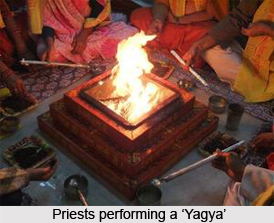 Rites in Yajur Veda, along with numerous sacrificial religious rituals occupy a significant position in the sacred texts of Hinduism. The term `Yajurveda` is derived from a Sanskrit word `Yajus`, which implies sacrifice and `Veda`, means knowledge. The Yajur Veda is often referred to as the `ritualistic veda` since it had mentioned various kinds of rites and rituals. Pushkara, a Hindu mythological character in `Agni Purana` has dealt with the rites of the Yajur Veda. It has been said in the Purana that a knowledge of the rites of the Yajur Veda grants enjoyment of good cheers in this world and salvation in the next.
Types of Rituals and Rites in Yajur Veda : In the Vedic Period, rituals and sacrifices or `Yagya` was performed by the priest or `Adhvaryu`, who was proficient in Yajur-Vedic rites. A detailed account of such actions was obtained from the `Brahmana` and the `Kalpa` compilations of Yajur Veda, known as `Yajur Veda Samhita`. Pushkara has said that the verse running as Manasa Kankhitam (what the mind craves for) etc, brings about the realisation of one`s heart`s desires, when made use of in a; `Homa` ceremony. Such a Homa undertaken with a view to confer blessings on a particular individual, as well as the one performed for the expiation of one`s sins, should respectively consist of oblations composed of barley and sesame.
Horse sacrifice, `soma` sacrifice and sacrifices offered during important ceremonies like coronations of royal lords, wedding ceremonies, birth ceremonies and various other ceremonies were the different kinds of offerings performed according to the Yajur Veda. Out of all these sacrifices, the most prestigious sacrifice was considered to be `Sarvamedha`, wherein the person performing the sacrifice offered his belongings to the priest as his fee. This was done at the conclusion of the ceremony.
Homas : Rites in Yajur Veda comprise various forms of principal sacrifices and rituals or `homas`. It has been said that oblations composed of paddy or white mustard-seeds, should be cast into the sacrificial fire, with the `Mantras`, whereby the performer of the Homa would attain all his objects. Such a Homa performed with a view to increase the number of one`s cattle or domestic animals should consist of oblations of the twigs of an `Oudumvara`, cast into the fire with the same Mantra.
A person, wishing to have an uninterrupted supply of boiled rice, should perform such a Homa with libations of curd, while a solicitor of earthly peace, should do the same with libations of milk. A man eager to have gold in abundance should perform a Homa with oblations composed of the twigs of an `Apsmarga` plant. A man seeking a wife, should perform the Homa with oblations of `Jati` flowers, threaded together in pairs, while the man praying for the proprietary right in a village, should do the same with oblations composed of grains of sesames.
Rudra Mantras : It has been said that a man wishing to secure the goodwill of others, should put on his nose a Tilak-mark made of yellow pigment (Gorochana), consecrated a thousand times with the proper Mantra. A repetition of the Rudra Mantras is sure to remove all sorts of misery, whether mental, physical or otherwise, whereas a Homa performed with the same Mantra, is sure to bring about the realisation of all desires, and is potent enough to work out peace under all circumstances. Rudra Homa is believed to attract the grace of Lord Shiva, and the many energies of this Hindu God. Performing this homa cleanses the environment by emitting `prana`, or life-force in the air. Many people consider that inhaling the smoke of a homa can heal ailments like asthma. If the holy ashes of the Rudra Homa are administered on the skin, one can get relief from such breathing disorders.
Similarly it has been said that a Rudra Homa performed with libations of sacrificial porridge or clarified butter, is the most soothing agent in stamping out and arresting the spread of plague or of any other epidemics among goats, horses, elephants, infants, women, men, kings or in checking any other disturbance, disease or foreign aggression, threatening or affecting a village, a town or a whole country.
Mantras as Significant Rites of Yajur Veda : A repetition of the `Mantra`, running as `Sastin Indra`, etc., removes all barriers both material and moral, standing in the way of an individual. A man, by seven times repeating the Mantra running as `Namas Sivaha`, is sure to be liberated from captivity. The verses `Drupuda` etc., being duly repeated under water destroys all sins of the repeater.
Agni Purana narrates that similarly a due repetition of the Mantra running as `Tasraa`, etc, acts as a powerful agent in bringing about one`s freedom from confinement, whereas a man, by duly repeating the Mantras, running as `Yuva Suvasaj` becomes the master of a splendid wardrobe. A man, praying for an utter annihilation of his enemies, should recite the verses, commencing as `Manchantu Ma`, etc., while by casting into the sacrificial fire oblations of sesame dipped in clarified butter and by repeating the Mantras of `Ma Mam Hinsi` , etc, a man is sure to keep his adversaries under a healthy control.
According to Pushkara in the Agni Purana man having practised self-control, should invoke and worship the Sun-god every day with the Mantras running as `Asou Yastamra` whereby he would enjoy a long and prosperous life and an abundant supply of food every day.
The Purana says that a man, by performing a Homa ceremony with the two successive Mantras beginning as `Gavo Bhaga`, is sure to have a large number of horned cattle. The Mantra running as `Pravadansha` etc., should be made use of in a sacrifice undertaken for the propitiation of one`s malignant stars. Similarly, the Mantras running as `Devabhyo Vanaspati` etc, should be used in sacrifices known as the `Druma-yajnas` (sacrifices in connection with consecration of trees). The Mantras running as `Tad Vishnu Paramam Padam`, etc., should be deemed as the sacred Gayatri Mantra to the Lord Vishnu, a recitation whereof tends to absolve the reciter of all sins and impieties.
Sacrifices : `Darsa Purnamasa` is a kind of sacrifice which is conducted on the first day of the new moon and also on the first day of the full moon. Both these days are considered holy by Hindus even today. Yajur Veda contains references of another sacrifice called `Pindapitri Yajna`, which is performed as a mark of respect to departed ancestors. `Agnihotra` is the name of a certain ritual in which milk is offered daily to the sacred fire and is done twice during the day in the morning and evening. `Chaturmasya` is another type of sacrifice prevalent in this ancient age which was offered once in every four months. `Agnishtoma` is another sacrifice which is the easiest form of `Soma` sacrifice. Kings performed the famous `Rajasuya` following their accession to the throne or immediately after the expansion of their fame and glory after successful conquests and annexations. There also existed the renowned sacrifice named `Asvamedha`, the sacrifice which was performed by kings after wars.
`Agnyadhana` was another essential sacrifice performed with sacrificial fires which were immensely crucial for Hindus. The person offering Agnyadhana selected four priests, the `Brahman`, `Hotri, `Advaryu` and `Agnidhra` for this ritual. Two separate sheds were created for the purpose of `Garhapatya` and `Ahavaniya` fires. The Garhapatya fire was lighted by after marking it withy a circle while the Ahavaniya fire was marked with a square. If required, then arrangements for a `Dakshinagri` or southern fire were also done. After this, the priest or the Advaryu would light a temporary fire by friction of from some other sources from the village. After the purification of the sacred fireplace of the Garhapatya, the Advaryu then placed the fire over it. The sacrificer worshipped and prayed to the gods in the evening till the time when he and his wife were offered two pieces of wood, called the `Arani`. The wood pieces were meant for the Ahavaniya fire which would be lighted the following morning. The couple offering this sacrifice had to remain awake throughout the night to ensure that the fire was aflame till the next day.
The White Yajur Veda has asserted that the dead were buried during that period. The bones of dead bodies would be accumulated in a container and then buried underground, beside a stream. The mound of the graves were built upto about knee length and covered with grass. Relatives of the deceased then bathed and left the burial grounds.
Agni Purana has said that in Yajur Veda different Mantras have been mentioned which are recited for various purposes and also a number of Homa ceremonies have been elucidated which are performed expecting various results. The Mantras, known as the great Vyahritis in the Yajur Veda should be used preceded by a Pranava Mantra. The wise should worship the gods by reciting the great `Vyahritis`, and cast a thousand libations of clarified butter into the fire in connection with the same, whereby all their sins would be expiated and all their objects fulfilled.
Recently updated articles in Indian Literature
Gadyakarnamrita
Gadyakarnamrita is a 13th-century Sanskrit literary work written mainly in prose. It describes the ninety-day battle at Srirangam between the Hoysala...
Women Writers in Malayalam Literature
Women writers in Malayalam literature have worked incessantly to make a place for their literary works. In the earlier periods, they were completely o...
Comrade Kirillov, Novel by Raja Rao
Comrade Kirillov, a distinctive creation of Raja Rao, is presented as a brief yet incisive novelette that offers an ironic portrayal of the self-contr...
The Foreigner, Novel by Arun Joshi
“The Foreigner” is a book authored by Arun Joshi and published by Vision. It is an illustrious creation in the entire career of Arun Joshi, the famous...
Short Story in Telugu Literature
Short Story in twentieth century Telugu Literature was extremely popular and growing in and developing in a major way. Their popularity was greatly fa...
Related articles in Indian Literature
Mythological Themes in Indian Literature
Mythological themes in Indian literature have been integral to every ancient and contemporary writer and their path to f
Literature During Gupta Age
It is during the Gupta Age literature in the form of poetry, epos and drama gained a colossal importance.
Literature of Aravidu Dynasty
Sanskrit and Telugu were the popular literary medium of communication during Aravidu dynasty.
Munshi Premchand
Munshi Premchand was a legendary Indian writer notable for his modern Hindustani literature. A writer of a very high caliber, Premchand`s writings hav...
Sanskrit Poets
The names of some of the Sanskrit Poets are Bharavi, Devarshi Ramanath Shastri, Jayadeva and Srinivas Rath.