
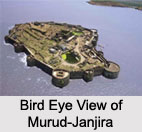
 Murud-Janjira is an island fort that was erected with the late Mughal art and architecture. This fort is located geographically in a village of Maharashtra named Murud in Raigad District of western Indian state of Maharashtra.
Murud-Janjira
Murud-Janjira is a magnificent Mughal fort built by Malik Amber, the minister of Sultan of Ahmednagar. This fort is now a tourism attraction.
Introduction
Murud-Janjira is an island fort that was erected with the late Mughal art and architecture. This fort is located geographically in a village of Maharashtra named Murud in Raigad District of western Indian state of Maharashtra.Naming of Murud-Janjira
Murud-Janjira is name of non indigenous origin. The word "Janjira" is not native to India. It is noted that this word is originated in Arabic dictionary. The Arabic word "Jazeera" means an island. The village of Murud was once known in Marathi language as Habsan. The name of this medieval fort is a mix of the Konkani language and Arabic language.
History of Murud-Janjira
 History of Murud-Janjira, in Maharashtra, can be traced back to 15th century when it was originally constructed on a smaller scale by a local Maratha-Fisherman Chieftain named Ram Patil. It was built with the aim of protecting the people from pirates and thieves. Previously it was known as Medhekot. The Chieftain was a courageous man having an independent bent of mind and was very popular among the local fishermen.
Once the ruler from Ahmadnagar, Nizam, sent one of his Siddi commanders named Piram Khan who arrived in the fort along with three armed ships carrying soldiers and necessary weapons and thereby captured the fort. Burhan Khan was the successor of Piram Khan and the former demolished the fort later replacing it with a much bigger and impregnable stone fort spanning an area of 22 acres. This construction was done during the period between 1567 and 1571. The new fort was named as Jazeere Mahroob Jazeera which is an Arabic word that refers to an island. Siddhi Ambersatak got nominated as the Commander of the fort.
Even the repeated attempts of the Marathas, the British and the Portuguese could not suppress the power of the Siddi`s. The Siddhi"s were themselves allied with the Mughal Empire. Yahya Saleh and Sidi Yaqub were some of the important historical figures associated with Murud-Janjira. Built with a mixture of sand, lead and gul, the fort houses a tunnel which leads to Rajpuri. The Marathas under the leadership of Chatrapati Shivaji tried to scale the 12 meters high granite walls of the fort but failed in their attempt. Chatrapati Sambhaji, his son, had also attempted to enter the fort through the tunnel but remained unsuccessful.
Siddis of Murud-Janjira, in the year 1736, attempted to recapture Raigarh from the clutches of Baji Rao. On 19th April 1736, during the Battle of Riwas near Riwas, the encampments of the Siddis were attacked by Chimnaji and in the confrontation, 1500 Siddis along with their leader Siddi Sat got killed. The war ended in September 1736 however the Siddis remained confined to Janjira, Gowalkot and Anjanwel. Three gigantic cannons namely Kalalbangdi, Chavri and Landa Kasam form the main attraction of the fort.
Architecture of Murud-Janjira
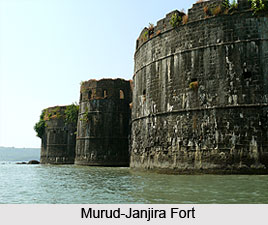
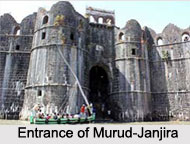
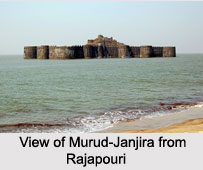
Murud-Janjira was built in Persian and Mughal style in art and architecture. This fort is situated on an oval shaped rock off the Arabian Sea. Murud is a port city and it is 165 kilometers from Mumbai. It is approached by the ferry system. The main gate of Murud-Janjira faces Rajapouri on the sea shore. This fort has 26 round bastions which are still intact. The canons are also intact.
Tourism in Murud-Janjira
 Tourism in Murud-Janjira covers the palaces of intricate Mughal art and architecture, the soldier`s quarter, the mosques and a fresh water lake. Murud-Janjira is an unconquerable island fort in western Indian state. Located in the Raigad District of Maharashtra, Murud-Janjira is popular for the panoramic view of Arabian Sea and Padmadurg that was built by Maratha Empire to give a challenge against Murud- Janjira. Murud-Janjira is now owned by Archaeological Survey of India.
Murud village has the majestic shrines, places of reverence and Nawabi establishments. The erstwhile Siddi tombs with their cryptic passageways, secret lockers and innovative methods overwhelm the tourists while visiting Murud-Janjira.
Panchchaitan Shrine : Panchchaitan Shrine was a seven-storeyed Durbar Hall. At present, this shrine is downed to four levels, due to the lack of maintenance.
Sheesh Mahal : Sheesh Mahal is a ruined fortified palace located inside the Murud- Janjira.
Chirekeni Talav : Chirekeni Talav is a fresh water lake located inside Murud-Janjira.
Jumma Masjid : Inside the fort, there located one mosque, which was once used by the Nawabs of Ahmednagar and Siddi Dynasty. Now the mosque is sill in good condition. Jumma Masjid is located near the lake.
Ahmedganj Palace : Ahmedganj Palace shows the architectural elegance of 19th century. It is a Nawab`s Palace shows an aura of timeless existence. The ceiling of this palace has collapsed in some places, and like a petticoat hem. The wooden rafters have surfaced up the detailing. On the ground level, two spiral staircases rise to the upper floor, which holds the locked rooms of the Nawabs.
Siddi Tombs : Khokri in Murud-Janjira is the final resting place of Sidi Sirul Khan, Sidi Yakut Khan and Sidi Khairiyat Khan, who were the main strong holders of Murud-Janjira. In 1670, Khairiyat had guarded Murud-Janjira when its own general, Fateh Khan, was willing to sell out to Maratha Emperor Shivaji. He fought against the Maratha Empire in 1682 against Shivaji`s successor, Sambhaji. The Siddi tombs have been constructed in the Indo-Saracenic style.
Boating near Murud-Janjira : Murud-Janjira is accessible only by ferry services from Rajapouri. The boat rides from the Rajpuri Jetty takes one to the fort, giving one approximately 30 minutes for exploration.
Tourist places around Murud :
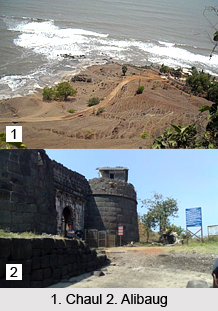 In spite of Murud gaining the centre of attraction, it does shake a bit in importance, when one talks of Chaul or Alibaug. Both the mentioned places are steeped in heritage and wield such historical importance and legends, that excavations still baffle historians. Ancient in its initiation, the places can easily be accessed by popular means of transport.
Chaul (44 km) : Inhabited since early historic times, Chaul has been under domination of umpteen dynasties, yet standing dignified with all the intact structures that were built by ruler, in admiration of the picturesque place.
Alibaug (54 km) : Though Alibaug was mentioned with negligence, the one man`s sincere endeavour has assigned the place in a tourist map forever. People owe much to Kanhoji Angre, the untiring man behind all these valiant feats. Alibaug today has changed much, owing to tourist pressure, yet retaining the old world charm through various spheres of life.
Recently updated articles in Indian Monuments
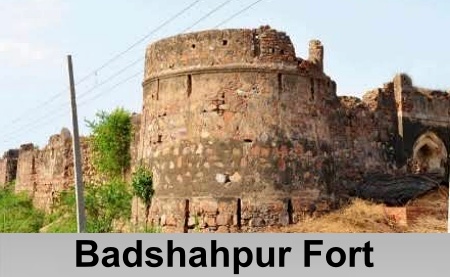
Badshahpur Fort
Badshahpur Fort is a historic defensive structure reflecting the architectural traditions of its era. Built with granite and red sandstone, the fort w...
Sitabenga and Jogimara Caves
Sitabenga and Jogimara Caves in Chhattisgarh are ancient rock-cut monuments dating to the early historic period. Known for their Brahmi inscriptions,...
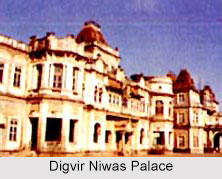
Digvir Niwas Palace
Digvir Niwas Palace in Vansda, Gujarat is one of the popular heritage buildings that reflect the majestic architecture of the early 20th century.
Historical Monuments of Satara
Among the historical monuments of Satara the fort at Satara is the most famous. Most of the constructions here belong to the Marathas.
Architecture Of Bihar
Architecture of Bihar consists of Buddhist and Mughal style of architecture.
Related articles in Indian Monuments
Monuments of Lakshwadeep
Monuments of Lakshwadeep are famous for their ancient religious feel and historical value.
Monuments of West Bengal
Monuments of West Bengal, mainly from the British era, are considered as priceless heritage of the state and attracts many tourists to the state.
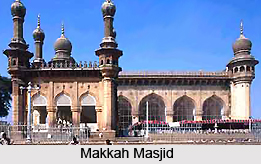
Monuments of Telangana
Monuments of Telangana covers the ancient, medieval and modern historical structures illustrating the architectural grandeur and attracting thousands...
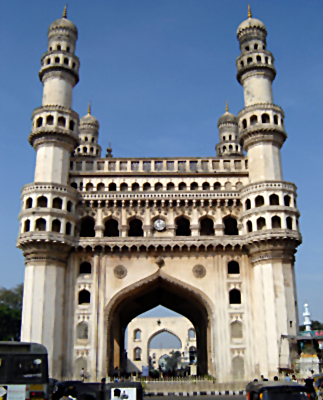
Architecture Of Andhra Pradesh
Architecture of Andhra Pradesh is an illustration of diverse types of Hindu, Buddhist and Islamic architectural styles.
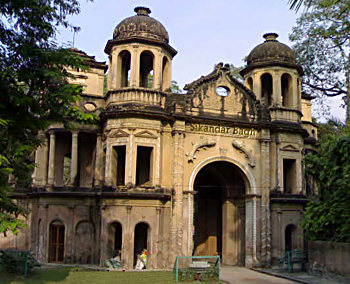
Architecture of Lucknow
Architecture of Lucknow is mostly Islamic in nature. It is representative of 18th and 19th century Indian architecture. The architecture is broadly di...