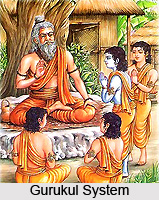
 In the early days students went to live with his teacher which was generally situated outside the cities amidst the groves as education was mostly residential. This system is called gurukulam.
The surroundings were beautiful with plenty of space to move about and there was very little of any big structure. Teachers and students lived together morning and night. There were regular physical services that the pupils had to render to the teachers. They got up very early in the morning, said their prayers, and went for a bath in the river, which would be at quite a distance from the ashram (residence) of the teacher. They would have to wash their clothes and their teachers` clothes also. They cooked their food, cleaned the ashram, took care of the animals and acquired knowledge of the texts.
Usually up to the seventh year, no particular attempt was made to impart knowledge to the child. The age at which it commenced depended upon the student. In case of the intellectually advanced student it started in the eighth year and in other cases it started at eleven or twelve. The period of studentship lasted anywhere between nine to forty eight years according to the pupils requirements as to whether he wanted to master a part of the scriptures only or acquire all knowledge.
Student not received instructions on cultural and academic subjects but also of knowledge having a distinct bearing upon the life he had to lead as a grihasta or married man. They were recommended to learn a lot of things which they in their later life would be able to understand. Without being brutal the teacher imparted instruction without doing injury to the pupil, using mild and sweet words. Punishments existed only on a very limited scale.
.In the brahmacharya (studenthood), one was expected to stay at the gurukula devoting time to study and discipline. When the number of students increased the houses of teachers would grow into institutions, patronized by kings and the rich, endowing them sufficient property and funds so that they could provide quality education, free o dost. This led to the foundation of centres of learning later, like those found in Varanasi, takshasila, Vidisa and Kanchipuram.