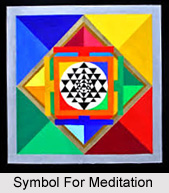
 The symbols for meditation are also termed as Yantra and are the `instruments`, or more simply codes and hidden messages, usually used to focus the mind. Traditionally they are used in Eastern mysticism to balance the mind or focus it on a spiritual concept. Yantra is said to have spiritual, astrological or magical benefits the act of wearing, drawing, or concentrating on a Yantra is beneficial in its every way. Yantra is a Sanskrit word that is derived from the root yam meaning to control, subdue, or "to restrain, curb and check.
Literally, the symbol for meditation or Yantra is any instrument or machine and is either controlled or it controls. The body is also said to be a yantra. Another idea of Yantra is to depict it as any instrument for holding, restraining, or fastening. Spiritually, Yantra fastens the mind to a particular idea. However, in Kundalini meditation, Yantra is a mystical or astronomical diagram, often inscribed on an amulet and also possesses mystical or magical powers.
The shapes and patterns commonly employed in the symbol for meditation include squares, triangles, circles and floral patterns but may also include even more complex and detailed symbols. The lotus flower typically represents chakras, the number of petals represent a psychic propensity or vritti associated with that chakra. A dot, or bindu, represents the starting point of creation or the infinite and confined cosmos. While the shatkona or the star of David is the composed of a balance between an upwards triangle denoting action, extrovertiality or Shakti and a downwards triangle denoting introversion, concentration, or Shiva. The shape of the swastika represents good luck, welfare, prosperity or spiritual victory and the bija mantrams, often represented as characters of Devan?gar? that correspond to the auditory roots of a particular chakra or vritti.
Yantra or the symbol for meditation function as revelatory conduits of celestial truths. Yantra, as instrument and spiritual technology is often envisioned as ideal and mysterious concept mapping machines or theoretical looms. Certain yantras are held to personify the energetic signatures of the Universe, consciousness and also ishta-devata. Though often practiced in two dimensions through art, yantras are conceived and conceptualised by practitioners as multi-dimensional sanctified architecture and in this quality are alike their correlated mandalas. Meditation and trance induction that generates the yantra of the self-possessed body in the balancing modes of the utpatti-krama and sampanna-krama are empowered in the various descents of tantric transmission as exterior and interior sacred architecture that enhance the addition and manifestation of siddhi.
The Yogini Tantra says that the goddess may either be worshipped as image, mandala or yantra. The Yogini tantriks believe that yantra is the outward form of a deity, while a mantra is the deities` subtle form. In essence of the mantra resides the deity, and when a yantra is inscribed with its bija mantras and empowered by consecration the deity is installed within the yantra. Empowerment happens to be the entry of the deities` prana into the yantra, and without this the yantra is just a void construction. When auspicious rites consecrate a yantra it removes all malevolent influences from the worshippers family. Yantras can be used for magical purposes and when employed in destructive rituals the yantra is personified as more of a prison than as the deity.
In Kundalini meditation, the yantra is usually constructed with a circular point or bindu at the center personifying the seed or bija of the deity. Surrounding the bindu are usually triangles, which may form a hexagram or geometric design, the upward pointing fire triangles denotes the God, and the downward pointing wind triangles represent the Goddess (Yoni). Intersecting squares may house the center, which usually rest on the circular bed of a lotus. Outside this in concentric circles are the petals of the lotus, which usually number eight or sixteen. The whole diagram is contained within a square bhupura or ground plan with four gateways in the cardinal directions.
Yantras or the symbols for meditation are inscribed on various materials according to their utility and the function they perform. For peaceful and magnetising customs, rock crystal and birch bark are often used; while for enriching: gold, silver or copper plates are used. Similarly, for destructive rituals, metals like iron, skin or bone is employed. The metal plate is often smeared with a paste of sandalwood, saffron or aloe, and adorned with a stylus of gold, wood, iron, or thorn taken from shrubs such as bael, acacia, or datura depending again on the ritual for which it is used.
Three-dimensional yantras are sometimes commissioned for their stable influences of peace and prosperity, skillfully carved from such precious metals as rock crystal, coral or lapis lazuli. The Shri Yantra is one of the most famous and ancient Yantra. Yantras are often thought to be astrological devices. They represent the astronomical position of the planets over a mentioned date and time. Yantras are considered auspicious in Hindu mythology. These yantras are created on various objects like paper, precious stones, metal plates and alloys. It is believed that constantly concentrating on the representation layout helps to build fortunes, as planets have their strange gravity, which can rule basic emotions and karma. These yantras are often made on a specific date and time according to methods defined in the Vedas.