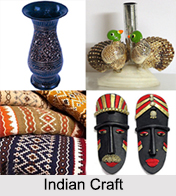
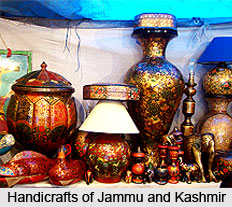
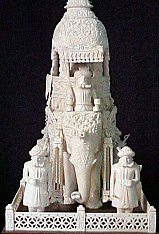
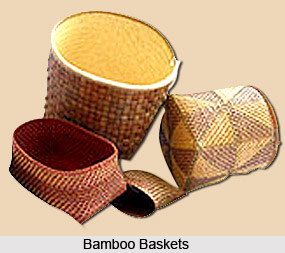
Stone today continues to be highly recommended for its durability and versatility across a broad range of products and architectural elements. Handcrafted stone products fall into three broad categories: products, architectural elements and sculpture. Further, there are two distinct categories: products meant for the domestic and foreign market.
The stone craft of Uttar Pradesh have flourished to a great extent due to the fact that the Muslim rulers of India have patronised this craft to a great extent. The stone crafts in Uttar Pradesh reached the zenith of excellence during the Mughal period when the Taj Mahal was made.
 The stone crafts of Uttar Pradesh have shown their creative excellence through intricate architectural masterpieces. These are perfectly chiselled and are decorated with inlay work. Stone carving on sandstone carry the rich cultural heritage of royal fascination and the variety that had been explored by the artisans. These outstanding stone crafts are visible in the intricate curving on the forts and palaces. In the 3rd century B.C., the imperial court of Ashoka provided a great boost to the art of stone carving. The excavations found in Mathura and Agra areas verify that the red sandstone of Chunar has been lavishly used in the stone sculptures. The statues of religious gods and goddesses with excellent carving, brilliantly created articles of inlay work, stone carvings with embedded inexpensive shells or semi precious stones are some of the well known stone crafts that are admired in all around the country. The famous among the stone crafts of Uttar Pradesh is the mosaic work of Taj Mahal and Fatehpur Sikri.
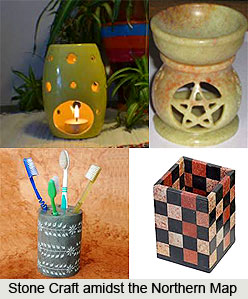
The base material of stone craft in Uttar Pradesh is marble, gorara soapstone and occasionally cuddapah. The artisans of Agra sometimes use country made machines for cutting, grinding, buffing and polishing of stone. In some places the craftsmen still use chisel and hammer to bring out curved patterns and designs followed by grinding and polishing. The artisans are called Sadakars and Pachikars. The Sadakars create cutting and carving by machines and the Pachikars create carvings with the chisels. The stone craft of Uttar Pradesh include marble boxes, wall plates, table tops, coasters, and ashtrays inlaid with semi-precious stones and mother of pearl in pleasing pietra dura designs that is derived from the Mughal monuments and paintings. Even the Gurara stone carvings, paperweights, and Rubic cube like candleholders, which take four different sizes, are considered as the intricate craftsmanship of the artisans of Uttar Pradesh.
Apart from creating different articles that catch the fancy of the local people and the tourists as well, the artisans create exclusive items that are placed in the trendy house to suit the decorative purpose.
The stone crafts of Himachal Pradesh carry a discernable variety and a distinct style of stone carving that are displayed in the creations of colossal constructions and the other items created out of stone. Sandstone is predominantly used in the stone crafts of Himachal Pradesh. Even good quality lime stone is available in Kangra, Bilaspur, Mandi and Kulu and the artisans create wide varieties of objects out of them. The plentiful supply of sandstone on the Shivalik hills has encouraged the stone crafts in Himachal Pradesh. The landscapes of Himachal Pradesh are dotted with numerous beautifully carved temples which stand unique in their carving styles. The temples of Masroor, Baijnath temple in Kangra, Shiva and Devi temples at Jagatsukh, Naggar, Nirmand and in Kullu are the great examples of stone craft. In addition to these temples, the shrines located on the banks of the river Beas in Mandi, the temples at Brahmaur, Chhatrahi, Chamba, Bilaspur and Sirmaur are exemplary of the superb creations of the 7th and 13th century AD.
Kangra, Mandi, Bilaspur, Sirmaur, Chamba and Kullu have been traced as the traditional centres of stone crafts of Himachal Pradesh. The people of Bataihra community are adroit in stone carving. Apart from carving excellent designs in temples and relief structural panels for temples, the artisans of this place create different utility items such as traditional stoves (angithi), circular pots for storing (kundi), pestle and mortar (dauri danda), millstones (chakki) etc that are used by the local people in day to day life.
Showcasing the work in stone by architects who have used it extensively and by exceptional products on display from crafts persons, the seminar proves the potential of the material and skill availability in our country even today.