
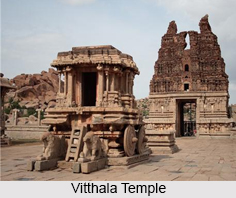
 Vitthala Temple is one of the temples of Hampi that received substantial patronage from the royal families of the region. The kingdom of Vijayanagara consciously promoted religious activity, particularly in its heydays, when a variety of religious cults were incorporated into the capital city and a large number of religious establishments were constructed. The Vitthala temple is exemplary of the extravagant architectural excellence; is remarkable from the artistic point of view and sheds light on the religious history of the site.
Vitthala Temple
Vitthala Temple is one of the major temples of Hampi which stands exemplary of the architectural excellence. It is considered to be the most ornate of the Vijayanagar temples. Lord Vishnu is enshrined as Lord Vitthala in this temple.
Introduction
Vitthala Temple is one of the temples of Hampi that received substantial patronage from the royal families of the region. The kingdom of Vijayanagara consciously promoted religious activity, particularly in its heydays, when a variety of religious cults were incorporated into the capital city and a large number of religious establishments were constructed. The Vitthala temple is exemplary of the extravagant architectural excellence; is remarkable from the artistic point of view and sheds light on the religious history of the site.Etymology of Vitthala Temple
The temple is named after one of the many avatars or forms of Lord Vishnu, "Vitthala" who is worshipped widely in this region. It is considered to be the most ornate of the Vijayanagar temples.
History of Vitthala Temple
Vitthala Temple was constructed in the 15th century AD and the structure of the present temple has got the perfect setting because of the patronization of different kings who ruled for several years in Hampi. The remnants of the township of Vitthalapura are extant in and around this temple.
Architecture of Vitthala Temple
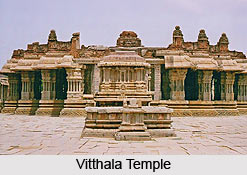 The architecture of Vitthala temple is the example of great artistic bent of mind that the rulers of the Vijayanagara possessed and the efficiency of the artists who projected the temple.
The structure of the Vitthala temple consists of the sanctum and antechamber, the open "mandapa". The temple, situated on a rock, faces east, a lamp-pillar is in front of it, and steps on the east and north sides lead down to the ground level. On the exterior, the "vimana", that is, the "cella" and antechamber, has a plinth of plain unadorned courses: "upana", "jagati", "padma", another "jagati" like a horizontal band, "tripatta kumuda", a narrow "kantha" and "pattika". There is a "pranala" (water-spout) on the north side. The wall surface is plain, consisting of unadorned rectangular blocks of stone. The wall surface ends with a narrow beam and a "kapota" course on the top, which is decorated with very flat "kudus". Over the sanctum is a stone pyramidal superstructure of nine receding tiers. The front "mandapa" stands on a plinth of plain courses: "jagati", "padma", "kantha" and "pattika". It is an open hall, fully open on the east, north and south sides, and the eaves are of the inclined variety.
The interior of the rectangular sanctum is plain. The door leading into the "cella" from the antechamber is decorated with foliated bands. There are neither the customary "dwarapalas" on the door-jambs nor any image on the lintel. The antechamber is also rectangular in plan, the door leading into it from the "mandapa" decorated with bands of scroll and petal designs. Vaishnava "dwarapalas" are carved on the jambs and the goddess Lakshmi on the lintel.
The "mandapa" has twenty detached pillars, each pillar has a monolith carved into three square blocks and separated by two eight-sixteen-eight sided blocks. The corbels resting on the pillars are of the bevelled variety. The three square blocks of the pillars are decorated with crudely carved reliefs. The pillars are plastered and the interior and the exterior of the temple have traces of plaster-work. The detached "mandapa" at the rear of the temple is built against the natural rock on its west and south sides. Open on the other two sides, it has three rows of four pillars each. The pillars are plain; they are crudely cut into three square blocks, separated by octagonal ones; the corbels are bevelled. There are no reliefs on these pillars.
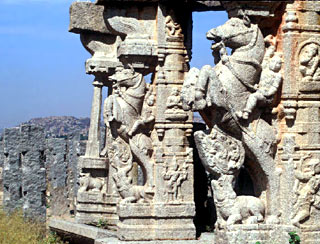
The ancient structure of the Vitthala temple had the sanctum and antechamber, which were constructed in the typical Deccan style with a plain plinth, unadorned wall surface and a pyramidal stone superstructure. The two "mandapas" are later additions. The front, attached "mandapa" is definitely of the period when the Tamil influence was marked in the Vijayanagara temple style, for its pillars are of the typical pattern found in the temples built in that tradition. The climax of development of Vijayanagara temple architecture is revealed in the "mahamandapa" or swing pavilion of the Vitthala temple, which was built in AD 1554 by the Aravidu chief Udayagiri Timmaraju. Though the ceiling of the central part of this structure is in ruins, the monumental nature of this columned hall is still evident. The "mandapa" is polygonal in plan and stands on a high plinth with intricately carved basement mouldings, including one on which is carved a frieze of horses with attendants. Along the basement there are also ten elaborately sculpted niches enshrining the ten avataras of Lord Vishnu. 2 Architecture of Vitthala Temple.jpg Carved elephant and Yali balustrades flank the access steps on the east, north and south sides of this open, pillared hall.
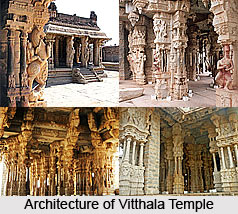 Above the piers is a graceful double curved cave, embellished with foliate medallions and upraised feather-like elements in the corners. The stone rings at the corners of the eaves once supported chains. Above the eaves there was once a brick and plaster parapet, only a part of which now survives. The virtuosity of the stone-cutters and architects of this hall was primarily concentrated on the piers. The outer columns have groups of colonettes with slender fluted profiles clustered around the central pillar shafts. The whole pier is cut out of a single block of granite and the piers in the middle of each side also have, besides the attached colonnette, fully modeled Yalis in prancing poses. The interior columns create a large open central space as well as smaller open areas on the north and south sides. These inner piers depict combinations of clustered colonettes, rearing Yalis and sculptured divine and human figures on the side of the internal spaces. The brackets above these massive pillars and their superimposed corbels are also beautifully sculpted. They support large stone beams fashioned on an inverted T formation, which array of smaller roofing slabs. The ceilings, where T beams, some more than ten metres long, have survived, reveal a variety of deeply recessed floral designs.
This "mandapa" of the Vitthala temple is undoubtedly the most elaborate as well as, perhaps, the best known structure of Vijayanagara temple architecture. Yet, this imaginatively executed "mandapa" is not the last dated religious monument in Vijayanagara city. A couple of years after it was built, Aubhalaraju, the elder brother of Udayagiri Timmaraju, constructed in AD1556 a shrine for Tirumarigai-alvar to the north¬west of the Vitthala temple complex. This building disproves the theory that Vijayanagara architecture became increasingly more ornate and elaborate.
Images of Lajja-Gauri appear on the east "gopura" of the Vitthala temple, the cloister along the interior of the enclosure wall, the hundred-pillar hall and the "mahdmandapa" of the principal shrine. The "gopuras" of the Vitthala temple are dated AD 1513. On the south side of the east gate, on the lowest level of the brick and mortar superstructure is a Lajja-Gauri "murti" in stucco, fairly large. This is the largest Lajja-Gauri image at Vijayanagara and also the only one in stucco. The right hand of the goddess rests on her right knee, and the left arm is in the traditional upraised pose.
The cloister of this temple is believed to be of the early sixteenth century. Along the now dilapidated cloister, of which many pillars have disappeared, there are still three extant pillar-reliefs of Lajja-Gauri. More important is a small relief in the south-east corner of the plinth of the cloister, where, hidden among the basement mouldings, is an interesting representation of the goddess who is seen in the traditional pose. The goddess is seen with her right hand at her pudenda, while with the left she is touching a pot that rests on the ground.
In the hundred-pillar hall of the Vitthala temple, dated 1516-17, there are three pillar-reliefs of Lajja-Gauri, in two of which one hand is resting against the knees, while the other is in the traditional upraised position. In the third, both arms rest against her knees. The "mahdmandapa" of the principal shrine of the Vitthala complex is dated AD 1554. On its basement is a small relief of Lajja-Gauri in an arch on the topmost moulding with both arms resting against the knees. This is probably the latest representation of the goddess at Vijayanagara.
The architecture of Vitthala temple is the representation of the excellent sculptural and architectural work that delineates the story of the past tradition of Vijayanagara and Hampi. The style of architecture dates back to the time of the foundation of the city and is the amalgamation of Deccan and Tamil style that reflects the creative bent of mind of the artisans.
Sculpture of Vitthala Temple
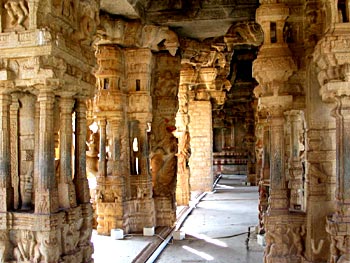 The sculpture of Vitthala temple deserves mentioning for the artistic touch of the then sculptors. The sculptural work of the Vitthala temple involves religious and mythical themes, motifs and other decorative representations. The sculptural work of the Vitthala temple is one of the major elements that has enabled the temple to be enlisted of the important temples of Hampi.
In the sanctum of the Vitthala temple, there is an idol of Bhoga-Ranganatha: Vishnu reclining on the coils of the cosmic serpent, with his two consorts at his feet, though this is not original to the temple. In the antechamber is a large stone slab on which Vira-Anjaneya is carved. It is difficult to determine whether or not this was originally here. Possibly, it was placed here in post-Vijayanagara times.
The reliefs on the mandapa pillars are roughly carved, and are of little interest from the point of view of either sculptural quality or iconographic variety. The most common themes among the pillar reliefs are the squatting lion, the Vaishnava namam (sectarian mark), the conch and the disc. There are a number of vegetal and floral motifs. Among the representations of deities, those of the zoomorphic Matsya and Kurma and reliefs of Narasimha are the most recurrent; the linga is seen a couple of times. A number of reliefs of saints and sages, including the alvars in stereotype poses and Matsyendranatha, occur repeatedly. Animals and birds, such as the lion, cow, monkeys, hamsa and so on, appear occasionally and so do other motifs.
The most interesting sculptures are those of some donors or devotees. On the west wall of the detached mandapa is a finely executed panel of a human group. In front is a turbaned, standing gentleman, who is handing a mala or garland to an ascetic or priest. Behind him are three standing figures, a man and two women, and all three have their hands joined in anjali-mudra. The elaborate coiffures of the ladies are striking, while the man wears a high cap and a buttoned-up jacket. Earrings are worn by all irrespective of men and women. On a rock to the south of the temple is a relief of three standing couples, who are devotee figures, with hands in anjali. The figures are placed within foliated arches. The men wear lungis and jackets; each has a cap or pleated turban, with a small finial, on his head. Both the men and the women wear ear-rings. Around the lamp-pillar in front of the temple are a number of naga stones which are crudely carved stone slabs.
Since there is no foundational inscription to help date the "vimana", one has to do so mainly on the basis of its architecture. The archaic nature of its construction, in the Deccan style, indicates that it is an early monument, possibly of the late fourteenth century. At the latest, it could have been constructed at the very beginning of the fifteenth century. There are two epigraphs from elsewhere, of the first decade of the fifteenth century that may apply to this monument. According to one of the epigraphs it could be that Vitthala of the Prata Vitthala temple was originally called Prasanna Vitthala, and the area around this temple was known as Prasanna Vitthalapura. The name Prata (Old) Vitthala for this deity would have come into use only after the construction of the great Vitthala temple.
 In sixteenth-century records of grants made in the presence of god Vitthala of the great Vitthala temple at Vijayanagara. But since it is not very likely that the great Vitthala temple was in existence in 1408, this could be a grant made in the presence of Prata Vitthala. The next grants that were made in the presence of Vitthalesvara on the bank of the Tungabhadra River are dated AD 1493 and AD 1503, during the reign of King Immadi Narasimha of Saluva dynasty. It is likely that the great Vitthala temple had been erected before or during his reign (AD 1491- AD 1505) for from the sixteenth century many grants were made in the presence of the great Vitthala-deva of Vijayanagara.
Regarding the construction of the separate "mandapa" behind the Vitthala temple, it was obviously built after the temple itself was erected, for the inscription within it clearly refers to it as the "mandapa of Vitthalesvara". The attached "mandapa" in front has pillars of the type common to the temples built according to the Tamil temple tradition at Vijayanagara. In the Narasimhapuranam, a late sixteenth-century literary work, it is mentioned that Proluganti Tippana, a commander of Devaraya II (AD 1424-1446), built a "bhoga-mandapa" for god Vitthala. From the early sixteenth century, especially after AD 1513, there are innumerable references to the great Vitthala temple.
The existence of the Old Vitthala temple at Vijayanagara from the late fourteenth or early fifteenth century onwards proves that the cult of Vitthala was not a late importation into the city, as had been held by some historians. It was one of the earliest Vaishnava cults to be incorporated into the capital fairly soon after the establishment of the Vijayanagara kingdom. The early Sangama period saw the promotion of the worship of the Vaishnava deities Narasimha and Vitthala at the site, and possibly also Lord Krishna. The Vitthala cult in the sixteenth century grew from strength to strength: and in the last quarter century before the city"s destruction, it was to overshadow in importance the cult of Virupaksha. The gradual growing popularity of Vitthala at Vijayanagara during the fifteenth century elevated the need was felt to build a larger and more magnificent temple to this deity at the site. Yet, with the construction of the great Vitthala temple, the first temple to this god at the site slowly declined in importance and after AD 1565, its very existence fell into oblivion till it was resurrected recently.
The half-way between the Virupaksha and Vitthala establishments was a zone where both Shaiva and Vaishnava temples and shrines were to be found. The old Vitthala temple lies in this mid-way zone. This is, perhaps, symbolic of the reality that it was constructed at a time when such tensions were at a minimum and the rulers were consciously fostering religious harmony through the promotion of all sects. The Prata Vitthala temple though small, and, in comparison to other larger and more elaborate temples at Vijayanagara, insignificant from the architectural and sculptural points of view, is an important and interesting monument. It throws some light on the evolution of temple architecture at Vijayanagara and on the religious history of the city.
The sculpture of Vitthala temple includes the construction of different subtle details of the deities and artistic works that enhanced the vividness of the temple.
Recently updated articles in Cities of India
Places of Interest in Deogarh Uttar Pradesh
A place of historical and archaeological significance, Deogarh is a site with few popular places of interest.
Deoghar in Jharkhand
Deoghar is the divisional headquarters of Santhal Parganas located in Jharkhand and is popular for the famous Baidyanath temple and Shiva Temples.
The Asiatic Society of Mumbai
Asiatic Society in Mumbai is the temple of Asian Studies from the time of British rule in India.
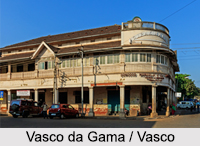
Vasco da Gama / Vasco City
Vasco da Gama / Vasco is the biggest city of Goa and is one of the most visited for its perfect amalgamation of business as well as leisure options.

Agriculture of Ladakh
Agriculture in Ladakh is primarily practiced in the short summer season due to its cold desert climate. Farmers grow hardy crops like barley, wheat, p...
Related articles in Cities of India
Holy Cities of North India
Holy Cities of North India are having the rich history of Hinduism and the entire civilization was grown up with the hands of beliefs, rituals and the...
Holy Cities of South India
Holy Cities of South India gives the detailed cultural formation of Dravidians from the early era, which later developed to the world by the Pallavas...
Holy Cities of West India
Holy Cities in West India were established by the rulers of Rajputs and the Satvahana Dynasty and the medieval rulers of Junagadh.
Cities of West Uttar Pradesh
Cities of West Uttar Pradesh include Meerut, Bulandshahr, Ghaziabad, Saharanpur, Muzaffarnagar, Bijnor, Bareilly, Rampur, Agra, Aligarh, Mathura and m...

Port Cities of South India
Port Cities of South India are developed from the early phase of colonial era when the Portuguese and the French traders came to India