
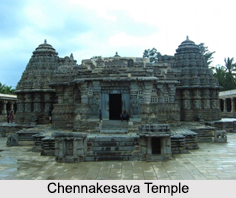
 Chennakesava Temple, also known as Somnathpur Temple is a popular shrine located in Somanathapura town, about 35 km away from Mysuru. This temple still stands majestically as one of the finest exemplary of Hoysala Architecture. It has been also nominated for the status of UNESCO World Heritage Site and is maintained by the Archaeological Survey of India (ASI).
Chennakesava Temple in Somanathapura
Chennakesava Temple is a Hoysala temple sculptural example of Hoyasala art and sculpture.
Introduction
Chennakesava Temple, also known as Somnathpur Temple is a popular shrine located in Somanathapura town, about 35 km away from Mysuru. This temple still stands majestically as one of the finest exemplary of Hoysala Architecture. It has been also nominated for the status of UNESCO World Heritage Site and is maintained by the Archaeological Survey of India (ASI).History of Chennakesava Temple
Chennakesava Temple was built by Somanatha, a Dandanayaka in 1268 C.E. under Hoysala king Narasimha III, when the Hoysala Empire was the major power in South Indian political scenario. By this time, Hoysala reign was already more than 250 years old. It is said that Dandanayaka Somanatha, after establishing a village on the banks of Cauvery River named Somanathapura, had taken the permission of King Narasimha III to create a temple dedicated to Lord Vishnu. The temple was created not only to seek blessings of the lord but also to showcase the enviable brilliance of Hoysala architecture and to represent its grandeur and intricate craftsmanship.
Architecture of Chennakesava Temple
The entrance of the temple is through a porch that has been designed with lathe turned pillars. As per chronology this temple was built by the architect and sculptor, Ruvari Malithamma.
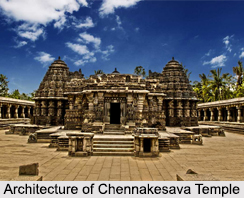
The temple building stands on a high plinth with vimanas and their superstructures. The Chennakesava Temple is considered triple shrined. The vimanas have entrances that connect them to the main rectangular hall. These entrances have their own towers which are known as sukanasi. However, due to their short heights they appear almost as low extensions of the primary superstructure on the shrine.
The temple building stands on a high plinth with vimanas and their superstructures. The Chennakesava Temple is considered triple shrined. The vimanas have entrances that connect them to the main rectangular hall. These entrances have their own towers which are known as sukanasi. However, due to their short heights they appear almost as low extensions of the primary superstructure on the shrine.
The main temple rests on a platform. This shrine has three vimanas that are connected by a closed mandapa. Flights of stairs connect the wide platform and the mandapa. The vimana is the place where the main deity resides and it is the jagati where the devotees offer their prayers. The parikrama is done here before entering the temple hall. The hall has 16 bays. As far as the shape of the vimana is concerned it is star shaped and hence the three shrines have 16 pointed stellate. The towers also have the same pattern. Perforated windows and relief friezes have been widely used to decorate the exterior of the temple. The sculptures are detailed and intricately carved out of the hard stone.
This temple has two eaves that run around it. The upper eave appears where the tower meets the shrine wall and the lower eave is to be found about one metre below the upper one. The gap between the two eaves has been filled with the help of the decorative miniature towers. It is the lathe turned pillar, which support the ceiling of the temple. The ceiling here is dome shaped and is decorated with intricate designs. Multi-petalled lotuses, banana bud motifs, stepped ponds and ananta knots are part of these designs. There are three shrines at the Chennakesava Temple and they are dedicated to Keshava, Janardhana and Venugopala.
Therefore the whole temple looks like a rhythmic progression of well decorated projections and recesses. The basic layout of the temple is symmetrical.
A classic example of the famous Hoysala architecture, and is one of the three temples of the kind to be nominated in the UNESCO World Heritage list. Unfortunately, this temple is no longer used as a place of worship, the main idol of Kesava is missing and the idols of Venugopala and Janardhana are damaged. However, the beauty of the temple still charms thousands of visitors.
Sculpture of Chennakesava Temple
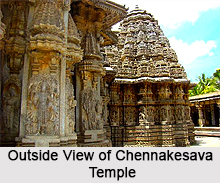 Sculpture of Chennakesava temple at Somnathpura is intricate in nature. Hoysalas introduced the innovatory ground plan: one big doorway and a shrine with three deities. Most of them are dedicated to Lord Vishnu though in some there are images of both Lord Shiva and Vishnu.
Reflection of Politics in Chennakesava Temple : This sculptural design reflects the open spirit of the Hoysala Empire. The female consorts stand on an equal level with the male gods. The spire above the shrine may have been of wood and brickwork. On either side of the entrance to the shrine there are small star-shaped spires. The fresco on the base of the outer wall has a line of elephants in different postures. Above that there are female figures and panels with scenes from the Mahabharata and the Ramayana epics. Below the `gutter` of the roof there are thirty eight attractive female figures that are dancing or engaged in some decorative activity.
Sculpture of Mohini : Mohini is shown looking in a mirror and puts a tika on her forehead. In between the first and second panel a king with his court and queen are depicted. In the frieze again the episode of Arjuna saving the cows from Mahabharata has been portrayed. The following sculptures are also seen: Girl with parrot, a girl sprinkling her beloved with coloured water during Holi, Girl with monkey, Hunting, Girl, Girl with drum, Durga, Krishna with flute. In between the tenth and eleventh frieze the story of Prahlada has been depicted. Then a singer, a dancer, girl with curly hair, Girl with fruit, hunting and a girl with drum are displayed.
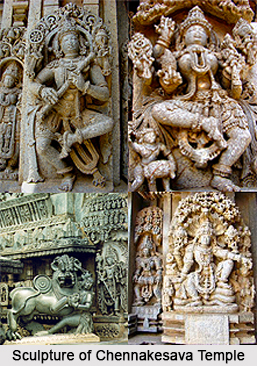 Sculptures of Western Wall in Chennakesava Temple : Some of the interesting sculptures on the south western, western and north western walls are: Harihara; Shiva with the demon Jalandhar on his trident; a dancing Kali; Vishnu in Vamana avatar; the demon Ravana shaking Mount Kailash; Daksha with the head of a goat; Durga Mahish-asur-mardini; Vishnu as Varaha (the Boar); Vishnu as Gadadhar (`with the mace`, a rare sculpture); Vishnu as Narasimha; a mother with child; the Sun God with his seven horses on a chariot; Kama deva and his wife.
Mahabharata in Chennakesava Temple : In a panel on the north-western side there are episodes of Arjuna who has to look in a reflection in oil to aim at the eye of a fish on top of a pillar. The other standing figures are: Dancer, Singer, Dancing Durga, Hunting, Girl with drum, Dancing Mohini and Girl and scorpion. On the right side of the northern entrance there is Panchatantra episode of the swans flying away with a tortoise, gesturing, Girl, Dancer, Dancer with lute, Girl with ring, Flute, Girl with drum, Girl with monkey and a ring.
Indian Mythology in Chennakesava Temple : In a panel on the north-eastern wall there are episodes of the cycle of destruction, with a boar, a python, an elephant, a lion, a Sharabh monster and a terrible bird. There is also a panel with Lord Vishnu on the cosmic snake Ananta. Further figures include Singer, Dancer keeping the beat by tapping her toe, while on top there is a bee sucking nectar. The entrance to the east is `guarded` by two doormen and by Manmath and his consort. On top the Eagle flies between two monsters. Even more higher there are fine sculptures of Vishnu as Narasimha, with Hiranyakasha.
Royal Sculpture in Chennakesava Temple : Other sculptures of Chennakesava Temple are the images of the royal family riding opulently decorated chariots, camel drawn chariots, soldiers and subjects riding horses, dancers, musicians and hunters heading for hunt with bows, arrows and their dogs. There are sculptures of palaces of kings looked after by armed guards; sculpted images of jewellery like pendants, necklaces, waistbands and rings and women with different hair styles.
Visiting Information of Chennakesava Temple
Chennakesava Temple is located in Somanathapura town. It is located about 35 km from Mysuru and 137 km from Bengaluru. There are many buses from Bengaluru, Mysuru and Srirangapatnam to Somanathapura.
Recently updated articles in Indian Sculpture
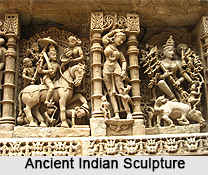
Ancient Indian Sculptures
Ancient Indian sculptures date back to the days of the Indus Valley Civilization. It was relatively simple.
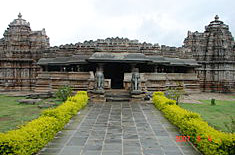
Hoysala Temple Art and Architecture
The Hoysala architecture and sculpture is a typical example of South Indian Dravidian art style.
Chennakesava Temple in Somanathapura
Chennakesava Temple is a Hoysala temple sculptural example of Hoyasala art and sculpture.
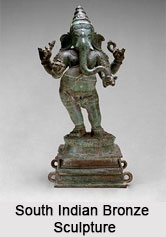
South Indian Sculptures
Types of South Indian Sculptures are categorized with the social and religious life of Hindus during the rule of Pallavas, Cholas and Rashtrakutas.
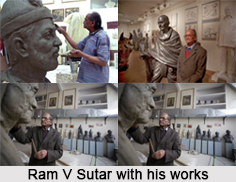
Ram V Sutar
Ram Vanji Sutar is an Indian sculptor and he is the recipient of Padma Bhusan in the year 2016.
Related articles in Indian Sculpture
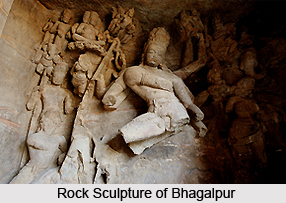
Rock sculptures
Champa, an important city during 6th century BC, was the ancient name of Bhagalpur. A number of Rock sculptures have been found here in the course of...
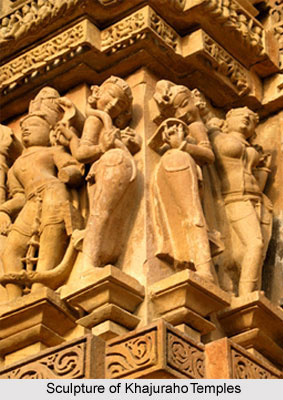
Indian Temple Sculptures
Indian Temple sculptures exhibits to the world the astonishing pieces of art. The religious places were the seats of learning and developing art in th...
Pallava Sculptures
Pallava Sculptures for the first time introduced the use of rock in Indian architecture.
Gupta Sculptures in India
Gupta sculptures exhibit the art works which was prevalent during the Gupta rule. The sculptures of the Gupta period remained as the ideals of art for...
Nagara Style of Architecture
Nagara style of Architecture, developed during the 5th century, is an emblem of architectural wonder and is scattered through out various regions of t...