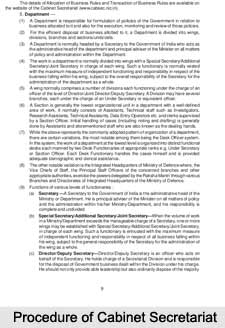
 Rules of Procedure refer to the principle which governs the work of the Cabinet and its various committees. This was approved by the Cabinet in the year 1947. There are three methods of disposal of cases by the cabinet, namely - by discussion in cabinet; by circulation for expression of opinion; and by discussion in a committee of the cabinet for two or more ministers nominated by the Indian Prime Minister. Some of the basic rules of procedure which is followed by the Indian Cabinet are mentioned below.
No invitation for the cabinet meeting is sent to any Cabinet Minister; the notice of the meeting serves the purpose. Invitations are, however, sent to the Ministers of State who are in independent charge of the ministries/departments when the matter relating to their ministries/departments is to be considered by the cabinet. A minister of this category is also invited when his ministry/department has expressed specific views on the proposals of another ministry placed before the cabinet.
All arrangements for the meetings are made by the cabinet secretary and other senior officials of the cabinet secretariat. Secretaries and senior officials of other ministries remain in attendance at the meeting when an item relating to their ministry is on the agenda. They are called inside the meeting room when so desired by their ministry or the Prime Minister.
The minutes of the meetings are drafted by the officials of the cabinet secretariat present at the cabinet meeting. They are submitted to the Prime Minister for approval within twenty-four hours of the meeting. After the Prime Minister has approved the minutes, they are circulated to the Cabinet Ministers of India, Ministers of State in independent charge of ministries and the Secretaries concerned. If any amendment in the minutes is suggested by Minister present at the meeting it is submitted to the Prime Minister for consideration and orders. If the Prime Minister accepts the amendment, revised minutes are circulated.
At the conclusion of each cabinet meeting, the cabinet secretary briefs the press on those important decisions taken that can be disclosed to the press. Similar briefing is given whenever necessary in the case of important decisions taken in a cabinet committee.
These are some of the basic rules of procedure followed by the Indian Cabinet.