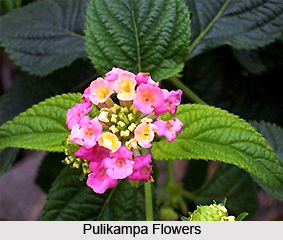
 Pulikampa is an erect and low shrub which is 1.2 to 2.4 meters in height and its Botanical name is Lantana camara L var. aculeata (L) Moldenke. Pulikampa is also known by various other names in India in different languages. Some of the other name of this shrub in different languages in India are Guye genda in Bengali, Kuri and Raimuniya in Hindi, Arippu in Malayalam, Caturangi and Vanacchedi in Sanskrit, Aripu, Kakke, Hesike, Kasutibu, Natahu, Lan-tanavaani and Unnigida in Kannada, Chandurang and Ghaneri in Marathi and Arippu and Unnichedi in Tamil. This medicinal plant is found almost in all parts of India.
Pulikampa is a low, erect or subscandent shrub which is 1.2 to 2.4 meters high, with quadrangular branches armed with stout recurved prickles; the plant has a strong odour of blackcurrants. The leaves of this medicinal plant of India are opposite, 2.5 to 7.5 centimetres long and 1.5 to 4.3 centimetres wide, ovate or ovate-oblong, apex acute or sub-acute, base truncate or narrowed, margins crenate-serrate, rugose above, scabrid on both surfaces; petioles are 5 to 13 millimetres long. Flowers of Pulikampa are 6 millimetres across, usually orange but varying from yellow to white, red or light purple, borne in pedunculate, axillary heads 2.5 centimetres across or on short spikes; peduncles 2.5 to 7.5 centimetres long; bracts 6 millimetres long, lanceolate; calyx about 2 millimetres long; corolla tube 7.5 to 13 millimetres long, slender, pubescent, four lobes, rounded. Fruits of this medicinal plant are 5 millimetres in diameter; shining, greenish, turning purplish-black or black when ripe and contain two-celled nutlets. Fruits and flowers are found in this plant all, over the year, depending on locality; in central India flowering occurs mainly between the months of September and January, and fruiting between October and February.
Pulikampa is probably native to the Caribbean islands, but presently it is widely distributed and naturalized in almost all subtropical and tropical regions of the world. This medicinal plant is introduced to India as an ornamental and hedge plant. Presently, this plant it is naturalized almost throughout the country in areas receiving from 75 to 500 centimetres of annual rainfall or more, on several types of soil. Due to its prolific growth, wide adaptability and tolerance of disturbed site conditions, the species is often considered a serious, invasive pest.
Pulikampa is regarded as antiseptic, carminative, anti-spasmodic and diaphoretic. In Ayurveda, the leaves of this plant are used to treat diarrhea and hemorrhage. The pounded leaves are applied to relieve ulcers, cuts and swellings and a decoction of the fruits and leaves are used as a lotion to promote the healing of wounds. An infusion of the leaves is taken internally to treat catarrhal conditions and bilious fevers, and is used externally in the form of a lotion or fomentation for eczema and rheumatism. In the northeastern regions of Karnataka the leaf extract is reportedly used to treat fever in children and tuberculosis, and smelling the flowers is considered useful for overcoming giddiness. An infusion of the flowers is given to children as a pectoral.