 The Indian Subcontinent provides suitable habitats to various species of birds for residing and reproducing. Avadavats are no exception in this regard. Red Avadavats and Green Avadavats have been recorded in India. They belong to the kingdom, Animalia; Phylum, Chordata; Class, Aves; Order, Passeriformes; and Family, Estrildidae. These Avadavats are described below.
Red Avadavat
A Red Avadavat breeds in the Indian Subcontinent. It belongs to the genus, Amandava and its species name is A. amandava. Both the names, Amandava and Avadavat are based on the city of Ahmedabad in Gujarat, from where this bird earlier used to be exported in the pet trade. The distinctive features of this bird are rounded black tail and the bill that is seasonally red. The breeding male has red upper parts mainly. Its eye-stripe, lower belly and wings are black in color. White spots are present on the red body and wing feathers. Comparatively, the non-breeding male is dull in color, but has the red rump. The female bird is also dull relatively, and has less white spotting on the feathers. This sparrow-sized bird depends on grass seeds and insects such as termites for survival.
Green Avadavat
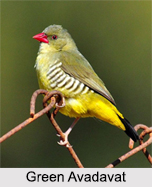
Green Avadavat is endemic to the Indian subcontinent. It belongs to the genus, Amandava and its species name is A. Formosa. Green Avadavat earlier acted as cage-bird and was exchanged in bird trade. This is a green and yellow bird with restricted distribution. More specifically, the bird has olive green upper plumage, pale yellow chin and bright yellow lower breast, belly and vent. Black and white bars on the flank of the bird stand out on the otherwise green and yellow body of the bird. Green Avadavat has waxy red bill and black tail, which is rounded with broad feathers. Its legs are pale fleshy or brown in color. Female Green Avadavat is slightly paler than its male counterpart. Two features help to tell the young and mature Green Avadavats apart. They are the bill and flanks. Green Avadavat when young has a black bill and is devoid of barring on the flanks.